
South Carolina Debt Relief by the Numbers: 5-Year Debt Trends
South Carolina's economy has enjoyed some expansion since the COVID-19 pandemic began in 2020, with solid wage and employment growth and increasing personal income. During this time, more people moved to the state than left it. The state's cost of living is close to the national average, and debt levels are in line with those in much of the U.S. The average South Carolina resident shouldered $56,600 in debt in 2024, about $5,000 less than the national average.
Depending on the circumstances, though, any amount of debt can become unaffordable if you fall behind on your payments. Data from Freedom Debt Relief shows that many South Carolina residents are experiencing difficulty. Debt relief seekers in the Palmetto State had an average debt-to-income (DTI) ratio of 42% in the first half of 2025, way up since 2021 when it was only 32%. And in 2024’s full year data, South Carolina debt relief seekers posted $343,112 in total debt, with $74,738 being unsecured debt. Unsecured debt is not backed by an asset like your home or car, and high levels can indicate financial distress.
South Carolinians can free up cash each month with Freedom Debt Relief

Ozzy S., Freedom client²
“Right away, I had more money each month because of program costs so much less than what I was paying on my minimums.”

Excellent •
5-Year Debt Trends in South Carolina
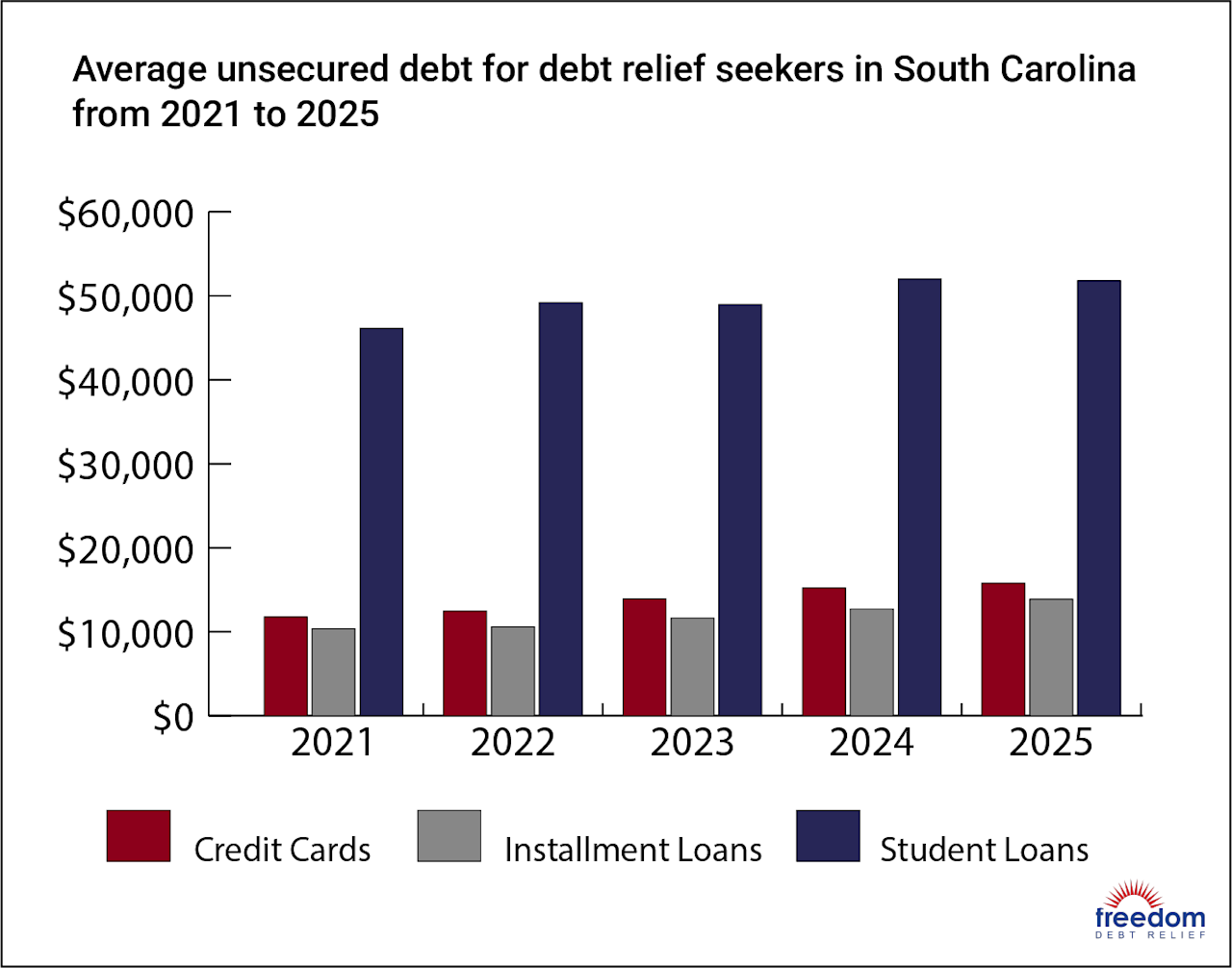
Unsecured consumer debt in South Carolina rose by 19% between 2021 and 2025, increasing from $68,315 to $81,473 among debt relief seekers. The average unsecured debt for U.S. debt relief seekers grew by 8% over the same period. Interestingly, the increase in unsecured debt is mainly attributable to higher student loan balances. Overall debt has also crept up since 2021, with debt relief seekers reporting 21% more total debt in 2025.
Age and credit scores play a large part in typical debt balances. For South Carolina residents seeking debt relief, unsecured debt peaks in the 65-and-over age bracket, with an average of $79,272 in 2024. Debt relief seekers with good credit (670-739) have the highest unsecured debt balances: $99,555 in 2024.
Debt collection numbers in South Carolina are positive. Among debt relief seekers with debt in collections, the average number of collection accounts has been going down, from 4.8 in 2021 to 1.9 in 2025. That’s better than the national numbers (3.3 in 2021 to 2.0 in 2025). The average collection balance (for debt relief seekers with debt in collections) was $3,400 in 2024 and $3,066 in the first half of 2025, slightly lower than the national average of $3,040 and down from $6,921 in 2021.
South Carolina credit card debt
Credit card debt is a serious issue for South Carolinians seeking debt relief, but there is some good news. On average, debt relief seekers in South Carolina carried $15,214 in credit card debt in 2024 spread across 7.3 cards, with an average of $4,756 in past-due balances. This is slightly lower than the national average of $15,636 among those looking for debt relief. And it's down over 16% from the $18,856 being carried in 2020.
However, in the first half of 2025, balances crept up by about $500, and it's somewhat alarming that past-due balances rose by over $700 to $5,468.
One of the challenges with making progress on credit card debt is that minimum payments are usually comparatively low. In South Carolina, the average monthly credit card payment in 2024 was $479. Debt relief seekers may be feeling the pinch of those payments, however, given that they show an average credit utilization of 76.5%, meaning they've borrowed against most of their available credit. (Credit experts recommend keeping utilization below 30%.) This kind of high utilization can be a sign of excessive debt that may require a credit card debt relief program.
The oldest group of consumers is also the deepest in credit card debt in South Carolina. Debt relief seekers 65 and older had the highest average credit card debt balance ($17,157) and past-due amount ($6,761). However, those with poor credit scores (579 and lower) had the highest percentage of past due credit card debt—of the $11,407 average credit card debt, $4,765 was past due in 2024.
South Carolina auto loan debt
Debt relief seekers in South Carolina reported an average car payment of $703 on a loan balance of $26,483 in 2024. Both amounts have risen significantly since the start of the decade. In 2020, the average payment was $356 and the average balance was $18,489.
South Carolina mortgage debt
South Carolina homeowners made an average monthly mortgage payment of $1,582 on an average balance of $206,009 in 2025. Debt relief seekers across the U.S. as a whole have an average monthly payment of $1,949 and an average mortgage balance of $241,535—significantly higher than South Carolinians.
South Carolina installment loan debt
Installment loan debt is a concern in South Carolina. The average South Carolina debt relief seeker carried $13,894 in installment loan debt in 2025, while debt relief seekers in the U.S. as a whole owed a bit less—$12,632. The 2025 average installment loan monthly payment in South Carolina was $464, slightly lower than the $485 national average for debt relief seekers.
South Carolina student loan debt
South Carolinian’s higher education balances are slightly higher than the national average. Debt relief seekers here carried an average of $51,803 in student loan balances in 2025 with monthly payments of $319. Across the entire country, debt relief seekers carried an average student loan balance of $49,932 and paid $313.
Student loan debt has been trending upward. In 2021, the average student loan balance for South Carolina debt relief seekers was $46,164 and monthly payments were a more manageable $202.
South Carolina Debt Delinquencies and Collections
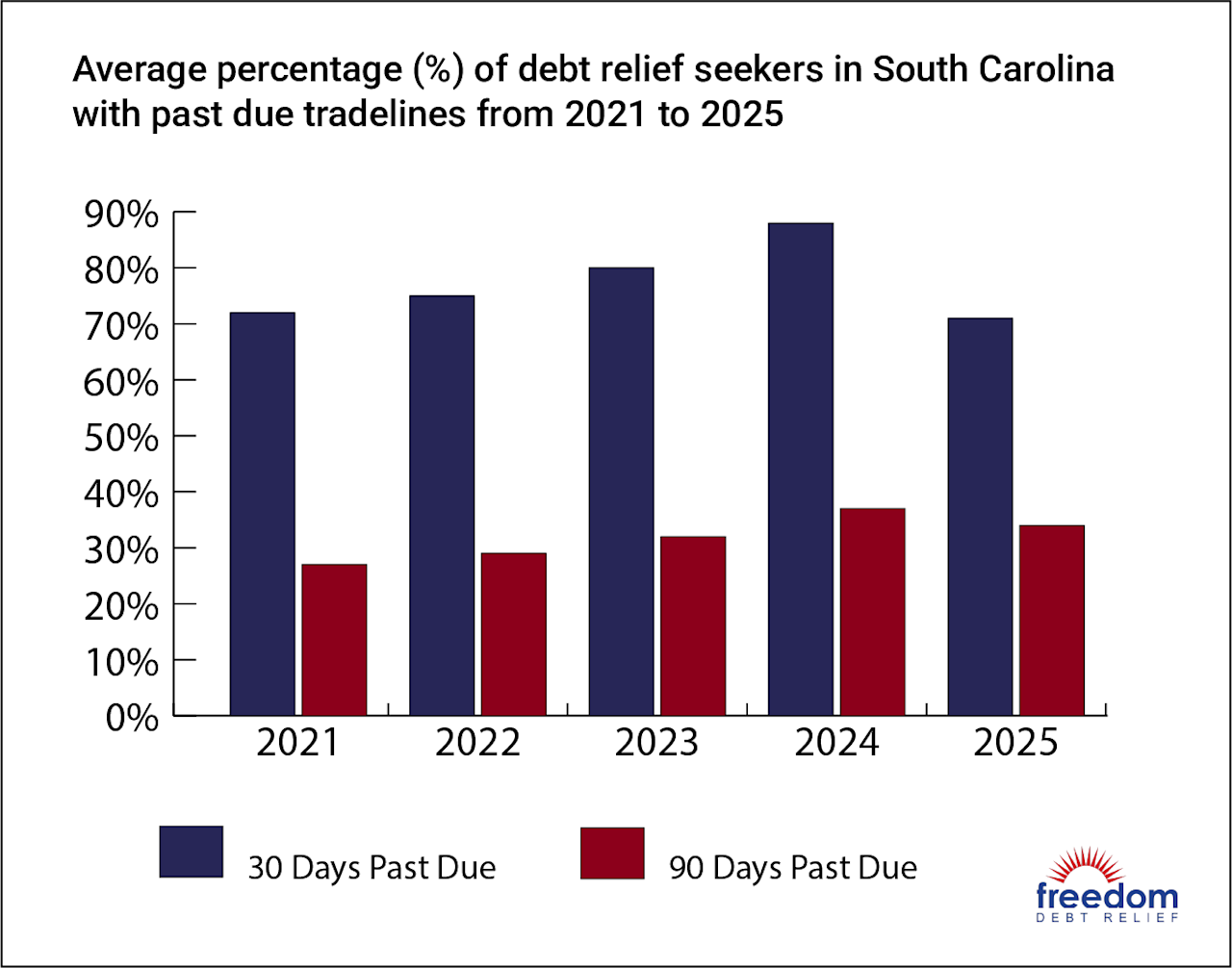
Debt delinquency rates in South Carolina are above the national average for auto loans and bankcards (credit cards), according to TransUnion data from September 2025. South Carolina's auto loan delinquency rate was 5.65%, compared to 4.34% nationwide, and past-due credit cards averaged 5.52%, vs. 4.66% for the U.S. as a whole. South Carolina’s mortgage delinquency rate was significantly higher than the national average (3.82% vs. 2.89% in the U.S.).
The table below provides delinquency rates for South Carolina auto loans, credit cards, and mortgages, with the percentage that are 30, 60, and 90 days past due.
| Type of debt | 30+ DPD | 60+ DPD | 90+ DPD |
|---|---|---|---|
| Auto loan | 5.65% | 2.16% | N/A |
| Credit card | 5.52% | 3.84% | 2.77% |
| Mortgage | 3.82% | 1.80% | 1.13% |
Many people looking into debt relief in South Carolina already have accounts in collections, and the average collections balance for this group has actually dropped in the last five years from $6,921 in 2021 to $3,400 in 2024, and then to $3,066 in the first half of 2025.
This tracks with the country as a whole, where the average collections balance (for debt relief seekers with debt in collections) dropped from $3,815 in 2020 to $3,183 in 2024.
South Carolina Statute of Limitations
The statute of limitations in South Carolina is the amount of time creditors and debt collectors have to sue you to collect a past-due debt. You’re not legally required to pay time-barred debt, meaning debt that has aged out according to the statute of limitations.
Statutes of limitations depend on the location and the type of debt contract you have. But in South Carolina, the statute of limitations is the same (three years) for all types of debt. Here’s a table with the types of debt and the South Carolina statute of limitations for easy reference.
| Type of debt contract | South Carolina statute of limitations |
|---|---|
| Written contracts | 3 years |
| Oral contracts | 3 years |
| Promissory notes | 3 years |
| Open-ended accounts (such as credit cards) | 3 years |
What are the South Carolina debt collection laws?
South Carolina debt collectors are governed by federal and state laws, including the Fair Debt Collection Practices Act (FDCPA). South Carolina also has its Consumer Protection Code that applies the FDCPA to original creditors as well as debt collectors. Under this law, once you ask an original creditor (like your credit card company or personal loan provider) to stop contacting you, it must comply. This law also states that creditors cannot garnish a debtor's wages to satisfy a consumer sale, lease or loan.
The law also protects certain assets and income (like Social Security, tools for work, necessary household items, and a vehicle) from seizure to help debtors maintain a basic living standard.
South Carolina Debt Relief
A debt relief program is a way to get rid of large, overwhelming amounts of debt. You make one affordable monthly deposit into a dedicated debt settlement account, and a debt relief company negotiates with your creditors on your behalf. The goal is to get your creditors to agree to accept less than the amount you owe but consider it payment in full.
Debt relief is most appropriate for consumers who have experienced a financial hardship and aren’t able to keep up with their debt payments. You can negotiate your own debts or work with a professional debt settlement company.
A debt relief program can take as little as 24 to 48 months and often helps make debt more manageable. In 2024, Freedom Debt Relief clients in South Carolina enrolled an average of $26,468 in debt.
If you’re looking for a South Carolina debt relief program, call Freedom Debt Relief at 800-910-0065. A Debt Consultant will speak to you about your financial situation and goals, and help you connect with debt relief resources that could work for you.
Is Debt Consolidation the Best Debt Solution?
Debt consolidation is just one of several solutions to overwhelming debt. Debt consolidation can be right for you if:
You have at least fair credit.
You can avoid going back into debt.
You’re in significant debt and it’s growing.
You’re paying high interest rates on your credit cards.
Debt consolidation doesn't reduce the amount that you owe, but it can make it easier for you to manage by reducing your interest rate and/or lowering your payment. Consolidating also simplifies your accounting by replacing several payments with one.
Other debt relief solutions include:
Debt settlement, in which you make a lump sum payment or a series of payments to your creditor in exchange for some amount of debt forgiveness. You can clear your debts for less than you owe. If your credit is damaged, this may be more workable than debt consolidation.
Bankruptcy, which happens in the court system and requires you to surrender certain property (Chapter 7) or commit to paying some of your future income into a bankruptcy plan (Chapter 13). The amount of debt forgiveness through bankruptcy ranges from 100% to zero. Filing protects you from creditor lawsuits.
Debt management plan (DMP), which can lower your interest rate and payment significantly—but doesn't reduce your balance. Credit counselors manage DMPs, and this can be right for you if you can afford a payment that will clear your balances in five years or less.
DIY debt repayment can be effective if you have the income to commit to a plan and the discipline to avoid adding to your debt. Popular plans include the debt avalanche and debt snowball, in which you target one account for accelerated repayment while paying the minimum on all the rest. Apps for getting out of debt can be very helpful. Every debt cleared frees up more cash for debt repayment, and you clear these accounts one by one.
South Carolinians can free up cash each month with Freedom Debt Relief
Ozzy S., Freedom client²
“Right away, I had more money each month because of program costs so much less than what I was paying on my minimums.”
Excellent •
How do I qualify for debt consolidation in South Carolina?
To qualify for debt consolidation in South Carolina, you typically need the following:
A fair or good credit score
Steady income
Debt-to-income ratio below 50%
A good credit score improves your chances of getting approved for debt consolidation loans. If your score isn’t high right now, you can work on it. The best way is to make timely payments.
Your debt-to-income ratio is the percentage of your income (before taxes) that goes to housing and debt payments each month. You can improve your DTI by earning more money or reducing your debts.
What is the best loan for debt consolidation in South Carolina?
There are several ways to consolidate debt in South Carolina.
Personal loans generally have lower interest rates than credit cards, and collateral isn't required. However, personal loan payments are likely to be higher than your credit card minimums.
Home equity financing typically has the lowest interest rates because the loan is guaranteed by your property. And terms are longer, which helps keep your payment affordable. However, setup costs can be high, and you could end up paying more total interest if you extend your repayment out for many years.
Balance transfer credit cards can also be used to consolidate debt. Many have a zero-interest period for 12 to 24 months. However, these cards usually require good credit and balance transfer fees reduce your savings.
What are South Carolina bankruptcy exemptions?
In South Carolina, bankruptcy filers must file in federal court and use the federal schedule of exemptions. These include:
Homestead: $31,575
Motor Vehicle: $5,025
Household Goods: $16,850
Jewelry: $2,125
Tools of the Trade: $3,175
"Wildcard" Exemption: $1,675 + up to $15,800 of any unused homestead exemption amount
Unmatured Life Insurance: $16,850
Personal Injury awards: $31,575
Health Aids: 100% exempt
Retirement & Benefits: 100% exempt
End Your Debt
Find out how our program could help.
- One low monthly program deposit

- Settlements for less than owed
- Debt could be resolved in 24-48 months