

New Mexico Debt Relief by the Numbers: 5-Year Debt Trends
While plenty of New Mexicans are thriving financially, it's also common to find residents carrying debt they find unmanageable. Among those who have sought debt relief, the average debt balance was $27,142 in 2024, slightly higher than the average of $26,573 among relief seekers nationwide.
New Mexicans seeking debt relief reported average incomes of $63,442. That's quite a bit under the national average among relief seekers of $69,121. That bind—more debt and less income to pay for it—may lead some residents to seek out debt settlement or other alternatives.
Here's a closer look at how New Mexico residents' debts have changed over the last few years, and the strategies they use to regain control of their finances.
New Mexicans can free up cash each month with Freedom Debt Relief

Ozzy S., Freedom client²
“Right away, I had more money each month because of program costs so much less than what I was paying on my minimums.”

5-Year Debt Trends in New Mexico
After seeing average debt take a slight dip in 2021, New Mexico debt relief seekers’ debts rose from an average of $19,666 to $27,142 in 2024. This increase is sharper than what we've seen with the U.S. debt relief seekers nationwide. In 2021, the typical American debt relief seeker owed $21,363. That rose to $26,573 by 2024.
With a larger debt burden, New Mexicans increasingly rely on their credit cards to make ends meet. Credit card utilization—the amount of your available credit that you’re using—rose from 67.2% in 2020 to 78.8% in 2024. This is far above the recommended 30% or less.
Minimum monthly debt payments appear to be holding pretty steady across the state. Debt relief seekers reported average monthly payments of $1,362 and $1,382 in 2023 and 2024, respectively. Data from the first half of 2025 suggested that monthly payments were rising more quickly at that point.
Here's a closer look at how New Mexico debt relief seekers are handling some of the most common types of debt.
New Mexico credit card debt
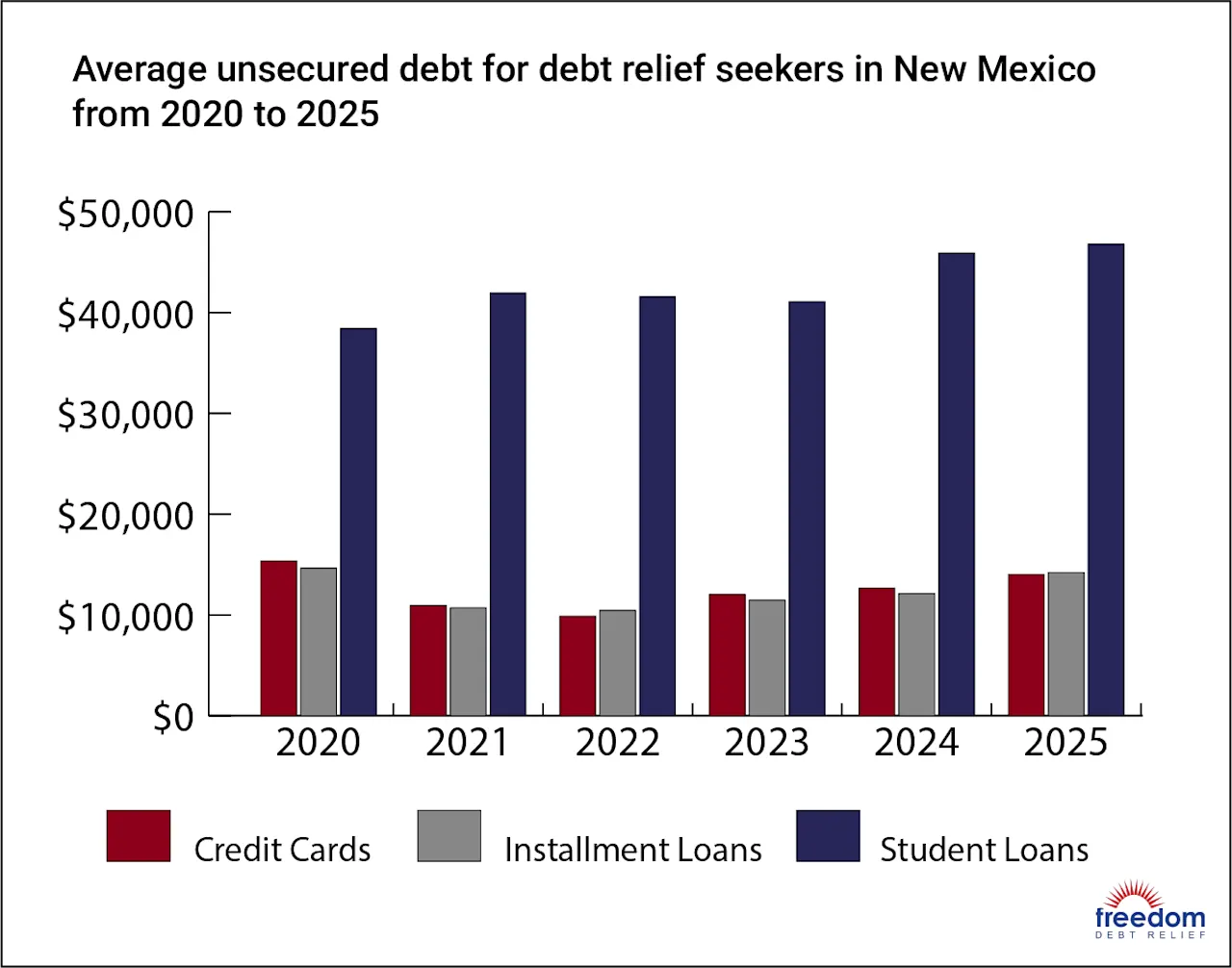
Despite higher overall debt rates among New Mexico debt relief seekers compared to the national average, New Mexicans fare somewhat better with credit card debt than much of the rest of the country. While the typical American seeking debt relief had $15,636 in credit card debt across 7.8 cards in 2024, the New Mexico average was just $12,672 across 6.7 cards.
That said, balances appear to have made a significant jump in the first half of 2025 with average reported balances topping $14,000. This is still lower than the 2020 high of $15,349, but it suggests that many New Mexicans have struggled to keep credit card balances down after reaching an average low of $9,880 in 2022.
There are several things that may account for this. One is the low minimum payments most credit cards offer. The typical monthly payment for New Mexico debt relief seekers is just $416, less than the national average of $487. This may not seem bad. But the high interest rates on credit card debt mean it’s easy for your balance to grow over time. And that can lead people to seek credit card debt relief.
New Mexico auto loan debt
New Mexico residents seeking debt relief usually have one to two auto loans, which is about in line with the national average. Auto loan balances in the state tend to be higher, and that often leads to greater monthly payments.
In 2020, the typical New Mexico resident seeking debt relief owed an average of $27,197 in auto loan debt, paying an average $669 per month toward it. In the first half of 2025, those numbers were $32,651 and $861. By contrast, the average for debt relief seekers nationwide is a $26,997 loan with a $749 monthly payment.
New Mexico mortgage debt
A mortgage makes up the bulk of the typical New Mexico homeowner’s debt, and as home prices rise, we've seen monthly mortgage payments increase as well. The average mortgage balance among New Mexico homeowners seeking debt relief was $161,809 in 2020 and $196,121 in 2024. Their average payments during that time rose from $1,212 to $1,552 per month—a $340 difference.
In this arena, New Mexico actually fares better than the rest of the country. The national average mortgage balance among debt relief seekers rose from $196,780 in 2020 to $241,535 in 2024, and their average monthly payments rose from $1,505 to $1,949—a $444 difference.
New Mexico installment loan debt
Installment loans like personal loans are another pain point for New Mexico debt relief seekers. They typically have three installment loans, carrying an average balance of $14,226 as of June 2025. While this is a little under the 2020 high of $14,654, it's quite a bit higher than the national average of $12,632 as of mid-2025.
Monthly payments for the typical New Mexican seeking debt relief are about $442 per month as of the first half of 2025. Curiously, despite the higher average balance, that's less than the national average payment of $485 among debt relief seekers. This could be because New Mexico passed a law in 2023 capping installment loan interest rates at 36%, which helps keep monthly payments lower.
New Mexico student loan debt
New Mexico college graduates seeking debt relief have far less student loan debt than the national average. The typical American seeking student loan debt relief in 2024 owed $49,861 across 5.4 student loans, and made monthly payments averaging $298. By contrast, the typical New Mexico debt relief seeker only owed $45,917 across 4.6 loans, with monthly payments of $255.
This isn't to say New Mexicans had it easy. Back in 2020, the average student loan balance among New Mexico debt relief seekers was $38,428, with monthly payments averaging $191. Since then, rates have slowly climbed, a trend that continued in 2025.
New Mexico Debt Delinquencies and Collections
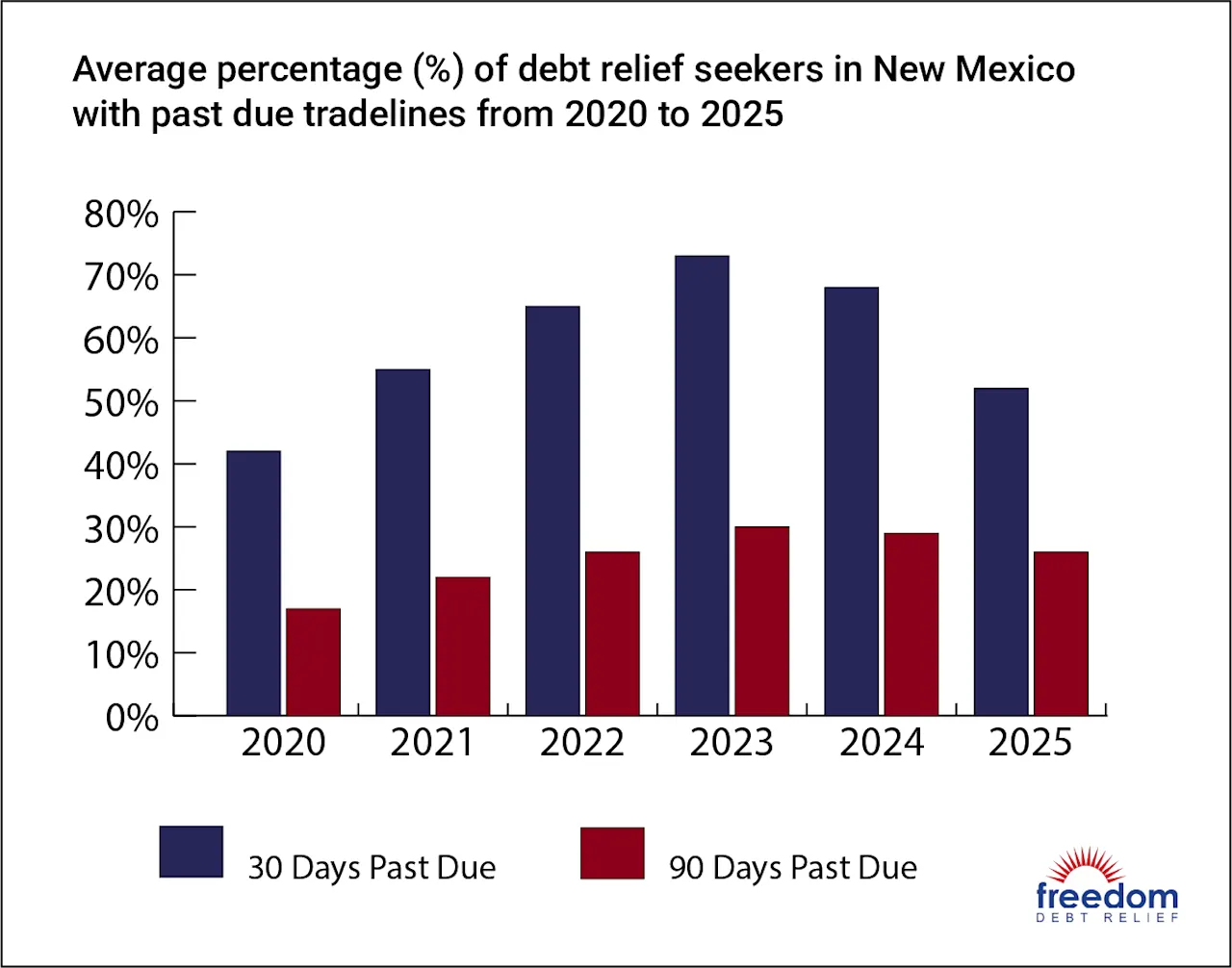
New Mexico residents seeking debt relief often do so before they fall behind on payments. Just 0.7% had payments at least 30 days past due, and only 0.3% had payments 90 or more days past due. This is pretty close to the national average, and has remained consistent over the last several years.
Some residents eventually see their accounts transferred to a collection agency, and this could be the trigger that causes them to seek help. Those who reach out to inquire about debt settlement typically have about two loans in collections, with an average balance of $3,209. This is only slightly higher than the national average among debt relief seekers of $3,183.
Most of that average amount in collections—$3,086 of $3,209 for New Mexico debt relief seekers—is past due.
New Mexico Statute of Limitations
The statute of limitations on debt is the window of time in which a creditor can successfully sue you over it. If it does not do so within the stated window, it cannot legally force you to pay your outstanding balance. Every state sets its own limits. In New Mexico, the statute of limitations varies based on the type of debt. It breaks down like this:
New Mexico Statute of Limitations for Debt
| Type of Debt | Statute of Limitations |
|---|---|
| Oral contracts | 4 years |
| Written contracts | 6 years |
To be clear, this doesn't mean a creditor won’t try to sue you beyond the statute of limitations. But if they do, you can tell the court that the statute of limitations has expired, and it should not force you to make further payments. Your creditors may still contact you and ask that you pay the outstanding amount.
What are the New Mexico debt collection laws?
New Mexico regulates the activities of collection agencies within the state via the New Mexico Collection Agency Regulatory Act. This gives the state permission to examine the books of any collections agency to ensure it's operating within the bounds of the law, and to enforce punishments for those who practice unlawfully. It also requires licensing for debt collectors.
In addition, New Mexico borrowers are protected under the Fair Debt Collection Practices Act (FDCPA). This is a national law that regulates what debt collectors can and cannot do. It prohibits them from doing things like threatening legal action they don't plan to take, or threatening harm to you or your family. It also sets limits on how frequently they can call you, and what information they can provide to others about your financial situation.
Reviews and Testimonials from New Mexico
I love these people they help me when no one else cause they said I didn't have a lot of debit but they help me
Narsha Weaver, US

They were very informative when I called about my debt. Everything was set up in a timely manner, and has been moving forward with speed and accuracy every since.I am very happy with this company.
Eleanor Smith, US
Samaria was awesome. She helped me understand my questions. Thank you for taking the time to help me with my concerns..
HECTOR MENDOZA, US
New Mexico Debt Relief
New Mexico debt relief seekers have several options to get back on a solid financial footing. One is debt settlement. This is when you (or a professional debt settlement company like Freedom Debt Relief) negotiate with your creditor to get it to accept less than what you owe and consider it full payment. This typically only works for unsecured debts (debts not backed by collateral like a home or vehicle).
Often, people seeking debt settlement stop making payments to creditors while they save up for negotiations. Any time you stop paying your bills, you should expect credit score damage. Debt settlement is for someone whose goal is financial stability, not for someone whose main priority is preserving their credit score.
The average New Mexican who enrolls in a Freedom Debt Relief program owes about $21,944. Time in the program varies, but many finish in as little as two to four years.
If you're interested in learning more about how Freedom Debt Relief works, you can schedule a free consultation. A knowledgeable debt consultant will look at your financial situation and work to come up with a plan that's right for you.
Debt settlement may negatively impact your credit.
Is Debt Consolidation the Best Debt Solution?
Debt consolidation is a debt relief strategy that works especially well for those with good or excellent credit. This is when you take out a new loan, ideally one with a lower interest rate and/or a lower monthly payment, and apply the money to your existing smaller balances. This gives you a single payment instead of several.
If you're considering this option, make sure it would save you money compared to what you're paying now. Compare options from three or four lenders before you decide. Many have tools that estimate what you'd owe (and these tools don’t affect your credit score). Pay attention to the overall cost of the loan as well as the monthly payment.
If debt settlement and debt collection don't seem like the right fit, you can explore some of these other options:
DIY debt payoff. You may be able to pay off existing debts without major changes to your budget. For example, if you owe debts on multiple credit cards, make the minimum payment on each one. Then put any extra cash each month toward the card with the highest interest rate or the one with the lowest balance. When that's paid off, move to the next card on your list. These options are known as the debt snowball and debt avalanche methods.
Debt management plan. Credit counselors can help you set up a debt management plan (DMP). They may also negotiate for waived fees or lower interest rates on your debts. With a DMP, you pay the credit counselor, and they then pay your creditors. Make sure the monthly payment is affordable before you choose this option.
Bankruptcy. Chapter 7 and Chapter 13 bankruptcy could both help you get out from under your debt for good. Chapter 7 bankruptcy typically only takes a few months. You may need to sell some of your possessions in Chapter 7. Chapter 13 is a three- to five-year payment plan available to those whose incomes are too high for Chapter 7 bankruptcy.
New Mexicans can free up cash each month with Freedom Debt Relief
Ozzy S., Freedom client²
“Right away, I had more money each month because of program costs so much less than what I was paying on my minimums.”
Frequently Asked Questions
Is there really a debt relief program from the government?
Yes, but for credit card debt, the only government program would be bankruptcy, if you qualify. The government offers debt relief for certain types of debt, like student loan forgiveness programs and IRS tax debt settlement programs. However, the government doesn't have a general-purpose debt relief program that you can use with any type of debt.
What is the hardship relief program in New Mexico?
New Mexico has assistance programs that can help low-income families and those struggling with debt to cover basic costs such as groceries, utilities, or housing. These programs may help you create some wiggle room in your budget that you can use to pay off other debts.
What is the 7 7 7 rule for debt collection?
The 7 7 7 rule for debt collectors is part of a federal law that says debt collectors cannot contact you more than seven times in seven days. They also cannot contact you for seven days after they last spoke to you on the phone about your debt.
End Your Debt
Find out how our program could help.
- One low monthly program deposit

- Settlements for less than owed
- Debt could be resolved in 24-48 months