

Debt Consolidation in Nevada: What to Know First
Key Takeaways:
Debt consolidation in Nevada replaces multiple debts, such as credit cards and medical bills, with a single monthly payment.
The total owed stays the same after consolidation. The repayment schedule and the interest rate are what change.
Adding up the current minimum payments gives a number to compare against a consolidation loan offer.
Between mortgages, credit cards, student loans, and car loans, many Nevadans live with debt. According to the Center for Microeconomic Data, in 2025, the average state resident had $71,140 in household debt, compared to a national average of $63,340. Among people seeking debt relief through Freedom Debt Relief in Nevada, the average debt was $30,640.
So how are Nevadans doing with that debt? Freedom Debt Relief’s numbers (as of June 2025) suggest that for some, staying on top of what they owe is a struggle.
The average FICO Score among Nevadan debt relief seekers in June 2025 was 588, and they were using 74.6% of their available credit.
Nearly 30% of Nevada debt relief seekers have at least one debt in collections, with a median collections debt of $4,430.
While Nevada debt relief seekers bring in $66,157 per year on average, about 45% of their gross income goes to debt payments.
Nevada's debt situation has become so concerning that the state legislature introduced a bill in early 2025 to increase protections for wage and bank account garnishments if someone is sued for a debt. If you live in Nevada and face a tough financial situation, debt relief can offer real solutions so you can face the future with hope.
Nevadans can free up cash each month with Freedom Debt Relief

Ozzy S., Freedom client²
“Right away, I had more money each month because of program costs so much less than what I was paying on my minimums.”

5-Year Debt Trends in Nevada
Nevada's household debt, including secured and unsecured debts, increased in the five year period from 2020 to 2025. That's not a surprise, given the financial impact that the COVID-19 pandemic and ongoing inflation have had on Americans' wallets.
Here's how the average estimated debt for Nevadans seeking debt relief from Freedom Debt Relief has changed over time:
5-Year Debt Trends in Nevada
| Year | Debt |
|---|---|
| 2020 | $23,181 |
| 2021 | $22,067 |
| 2022 | $23,228 |
| 2023 | $25,903 |
| 2024 | $31,196 |
| 2025 (June) | $30,640 |
These numbers represent only part of the total debt picture. When you combine mortgage debt, credit card debt, auto loan debt, student loans, and installment loans, Nevadans seeking debt relief went from owing $333,643 in 2020 to $412,792 in 2025. Among debt relief seekers nationwide over the same period, the average combined debt went from approximately $288,638 to $345,211.
Here's a closer look at five-year debt trends among relief seekers in Nevada:
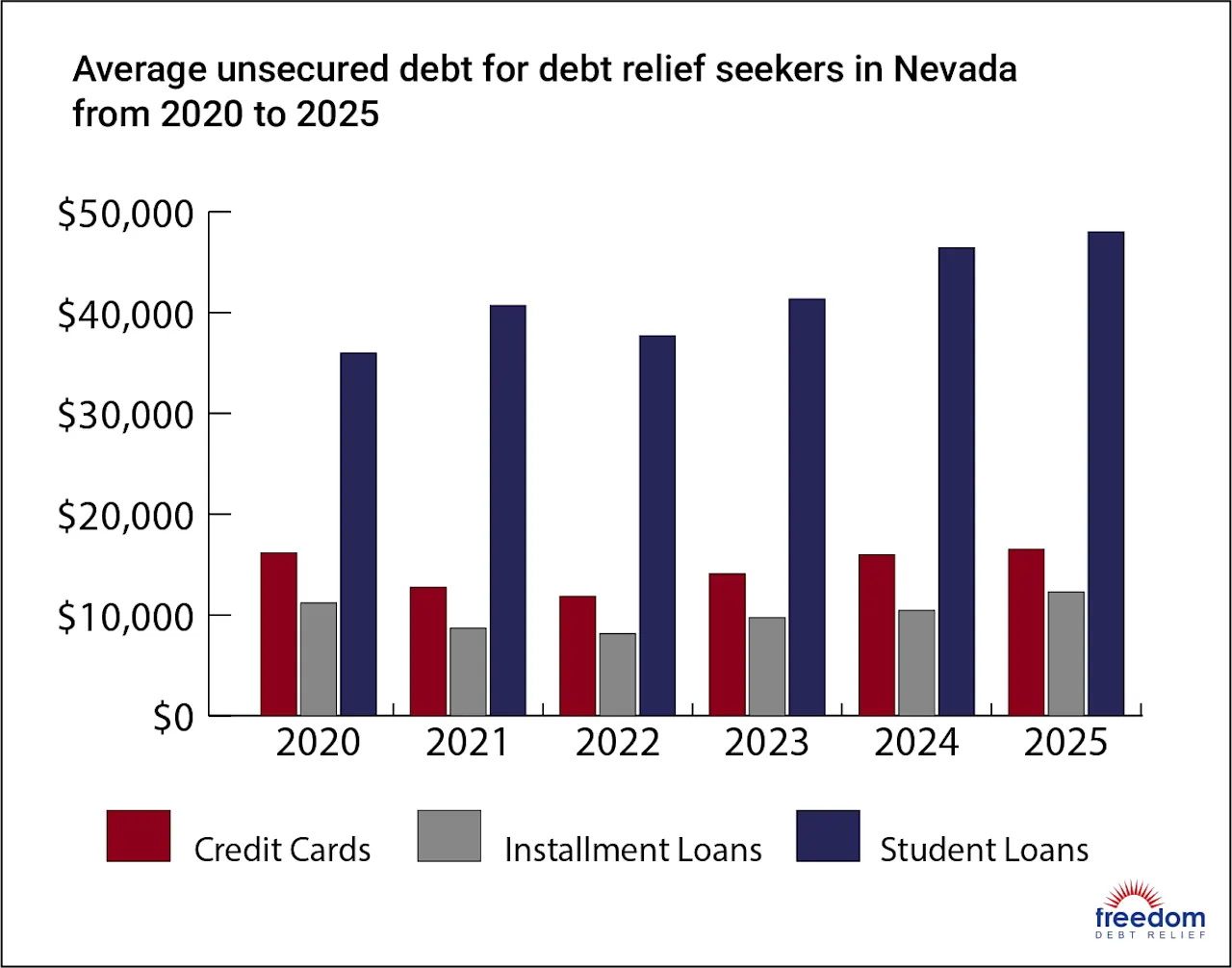
As of June 2025, the average credit card debt across all age groups was $16,512, a slight bump from the $16,174 reported in 2020.
Monthly minimum debt payments rose from $1,462 in 2020 to $1,854 in 2025.
Debt is highest for debt relief seekers 36 to 50 years old; they owe $32,562 on average as of June 2025. Since 2020, this age group has seen its average debt increase, while debt levels among other age groups have declined or held steady.
Average credit card utilization jumped from 68.1% to 74.6% between 2020 and June 2025.
Borrowers with good credit had more debt; Nevadans with a FICO Score of 670 to 739 carried the most debt on average ($35,156).
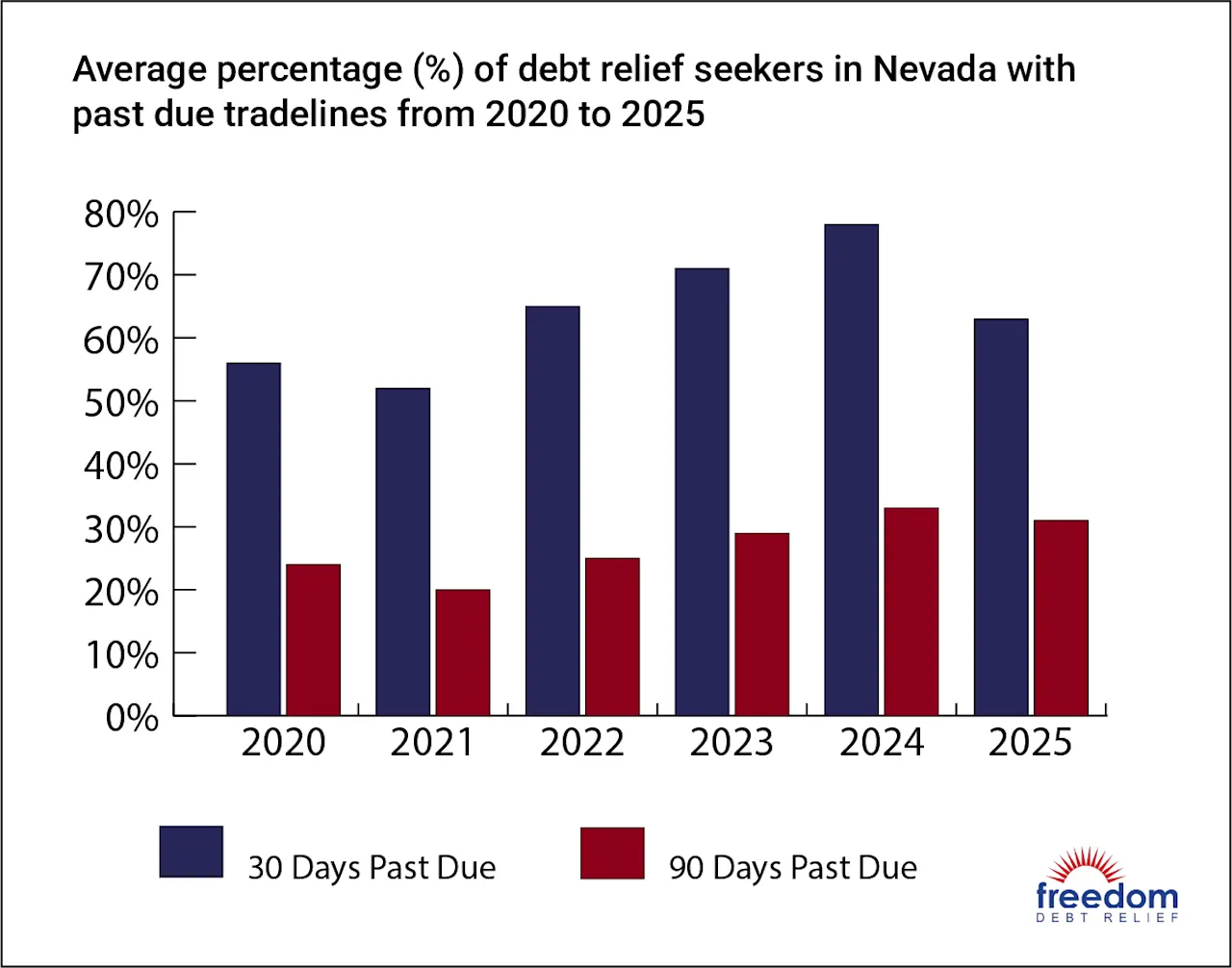
The number of debt accounts 30 days past due has held steady since 2020, while the number of accounts past due by 90 days or more has increased slightly.
Let's look more closely at specific categories of debt Nevadans owe.
Nevada credit card debt
Credit cards offer convenience and Nevadans aren't shy about using them. As of June 2025, the typical Nevada resident seeking debt relief:
Has seven credit card accounts
Owes $16,512 on average
Pays $495 to credit cards monthly
Has a past due credit card balance of $6,223
These numbers aren't that far off from the averages among debt relief seekers nationwide—as of June 2025, credit card users carried an average balance of $16,244 across seven cards, paying $489 on average per month. Of that balance, $5,793 was past due. Nevada debt relief seekers were using 74.6% of their credit limits on average, compared to 73.5% nationally.
Who has the most credit card debt? Here's a snapshot of the average credit card debt and total debt by age.
Nevada credit card debt
| Age Group | Average Credit Card Debt | Average Total Debt |
|---|---|---|
| 18-25 | $9,359 | $18,959 |
| 26-35 | $13,013 | $24,786 |
| 36-50 | $17,141 | $32,562 |
| 51-65 | $17,352 | $31,554 |
| 65-plus | $17,276 | $28,934 |
Credit card debt can be dangerous because it’s often high-cost. It can be difficult to pay down what you owe if you only pay the minimum due or a little more, and your card has a double-digit APR.
Credit card debt relief options may help you pay off your cards for less than what you owe by negotiating the balances down with the help of a debt expert. This often can help you get out of debt in two to four years. It's a way to handle debt without getting a loan or filing for bankruptcy protection.
Nevada auto loan debt
Nevada debt relief seekers who have a car loan owed $28,210 as of June 2025, paying $777 per month on average. By age, loan balances are highest for 36 to 50-year-olds seeking debt relief; they owe $31,021 on average.
Here's how Nevada's June 2025 numbers compare to the U.S. as a whole.
Nevada auto loan debt
| Nevada debt relief seekers | U.S. debt relief seekers | |
|---|---|---|
| Total Balance | $28,210 | $26,697 |
| Monthly Payment | $777 | $749 |
| Average Number of Loans | 1.4 | 1.5 |
Car loans can offer the advantage of fixed interest rates, so the monthly payments are predictable. But the debt can still be problematic if you have a high payment, or if you're stuck with a debt that's more than what your car is worth.
If you fall behind on auto payments, the lender could repossess the car and auction it off. If the auction doesn't bring in enough to cover the rest of the loan, you could be left with a “deficiency balance.” Nevada debt relief might help you negotiate the balance down.
Nevada mortgage debt
Nevada debt relief seekers with a mortgage owed an average of $307,738 as of June 2025. They paid $2,154 per month on their home loans on average. The typical Nevadan relief seeker with a mortgage has just one.
Relief seekers aged 26 to 35 owed the most mortgage debt, at $337,565 on average.
Senior relief seekers aged 65 and over had just over $282,000 in mortgage debt on average.
Here's a comparison of Nevada mortgage debt vs. the rest of the U.S. as of June 2025.
Nevada mortgage debt
| Nevada debt relief seekers | U.S. debt relief seekers | |
|---|---|---|
| Total Balance | $307,738 | $239,406 |
| Monthly Payment | $2,154 | $1,989 |
| Average Number of Loans | 1.2 | 1.2 |
It's not surprising that Nevada residents pay more to own a home. The average home value was $444,019, as of November 2025, according to Zillow. Nationwide, the average home value was $360,727. Lower home values can leave buyers with a smaller mortgage and less debt overall.
Nevada installment loan debt
Installment loans are repaid monthly over a set period. Personal loans are a common type of installment loan. On average, Nevadan debt relief seekers had three installment loans as of June 2025, and owed $12,297, paying an average of $556 to these loans monthly.
Here's how the numbers compare to the U.S. overall:
Nevada installment loan debt
| Nevada debt relief seekers | U.S. debt relief seekers | |
|---|---|---|
| Total Balance | $12,297 | $12,632 |
| Monthly Payment | $556 | $485 |
| Average Number of Loans | 3 | 2.8 |
Debt relief could help with unsecured installment loans. Unsecured loans aren't attached to collateral like a home or a vehicle. If you have a financial hardship, you could negotiate to pay off these debts for less than what you owe.
Nevada student loan debt
Nevada student loan debt averaged $48,035 among debt relief seekers in June 2025, and the typical borrower had 4.7 open loan accounts. They paid just $294 toward their loans per month on average, which suggests they may be taking advantage of income-based repayment options, forbearance periods, or deferments.
Here are the state and national numbers, side by side:
Nevada student loan debt
| Nevada debt relief seekers | U.S. debt relief seekers | |
|---|---|---|
| Total Balance | $48,035 | $49,932 |
| Monthly Payment | $294 | $313 |
| Average Number of Loans | 4.7 | 5 |
Debt relief can't help with federal student loans, but it may be an option if you have private loans. If you've defaulted on a private student loan, you might be able to settle the balance with your lender.
Nevada Debt Delinquencies and Collections
Financial hardship can make it difficult to keep up with debt payments. On average, debt relief seekers have the same number of collection accounts, but more delinquent debt, than relief seekers nationwide.
Here's a look at how they compare, as of June 2025:
Nevada Debt Delinquencies and Collections
| Nevada debt relief seekers | U.S. debt relief seekers | |
|---|---|---|
| Average Number of Collection Accounts | 1.9 | 1.9 |
| Accounts Past Due 30 Days | 0.7 | 0.6 |
| Accounts Past Due 60 Days | 0.3 | 0.3 |
| Average Collection Balance | $4,463 | $3,040 |
| Average Collection Past Due Amount | $4,430 | $2,884 |
Collection balances have been up and down over the last five years. In 2020, the average collection balance was $4,090; by 2022, it had dipped to $3,490. After that, the numbers climbed.
Nevada Statute of Limitations
Every state has a statute of limitations on debt. In Nevada, debt collectors are not allowed to sue you after the statute of limitations has expired—the debt is then considered “time-barred,” and therefore uncollectible. The Nevada statute of limitations applies to these categories of debt:
Open-ended accounts (like credit cards)
Written contracts
Oral contracts
Promissory notes
Here's how long the statute of limitations applies to each type of debt in Nevada.
Nevada Statute of Limitations
| Type of Debt | Statute of limitations |
|---|---|
| Credit cards | 4 years |
| Medical debts | 6 years |
| Auto loans | 6 years |
| Student loans | 6 years |
| Mortgages | 6 years |
| Personal loans | 6 years |
| Judgments | 6 years |
| Oral contracts | 4 years |
| Promissory notes | 3 years |
The statute of limitations clock starts ticking from the date of the last payment you make toward the debt. A creditor could still try to collect an unpaid debt beyond that date. If that happens, note that any payments toward a debt restart the clock on the statute of limitations.
What are the Nevada debt collection laws?
Nevada residents are protected by state laws and the Fair Debt Collection Practices Act (FDCPA). Under state law, debt collection agencies that operate in Nevada must:
Be licensed by the proper agency
Display and disclose their licensure
Notify debtors that phone calls are being recorded
Act openly, fairly, and ethically
Maintain records of all communications and transactions involving collection accounts
And collection agencies must not:
Use subterfuge to try to force someone to pay a debt
Collect fees or interest not allowed by law
File a debt lawsuit if the statute of limitations has expired
The FDCPA protects Americans against deceptive and unfair practices from debt collectors, including threats and harassment.
Under the FDCPA, creditors cannot:
Threaten you with violence, call you repeatedly, or otherwise harass you
Call you before 8 a.m. or after 9 p.m.
Continue you to contact you if you've asked them not to
Threaten to have you arrested for a debt
Attempt to collect more than what's owed
Call you at work if you're not allowed to receive calls there
Threaten to sue you if they don't have plans to do so
If you think your rights have been violated under the FDCPA, you could file a lawsuit for damages. Keeping good records of any and all contact you have with a debt collector could help back up your claim if you decide to sue.
Reviews and Testimonials from Nevada
A positive experience that helped us reach our goal of becoming debt-free was learning how to budget together as a family. By sitting down, reviewing our expenses, and setting clear priorities, we were able to make smarter financial choices. This not only improved our communication and teamwork, but also gave us a sense of control and confidence that kept us motivated throughout the process."
customer, US

FDR has been rapid to resolve with debtors. They have provided me with fast updates as to step they have taken on my behalf.
Jose R, US
Very good service from Noemi
Carlos Otero, US
Nevada Debt Relief
Debt relief may help you get rid of unsecured debt without paying in full. You could work with a reputable debt relief company who negotiates with creditors on your behalf. While you're enrolled in the program, you make one affordable monthly payment to a secure account (that you own and control).
Once a debt specialist reaches a settlement agreement with your creditor, you decide whether to approve it. If you give the green light, funds from your secure account are used to pay your creditor. You can also expect to pay the debt relief company’s fees for their service at this point. The rest of the debt is forgiven.
Here's what a typical Freedom Debt Relief plan in Nevada looked like in mid-2025:
Average enrolled debt: $26,562
Average monthly debt payment (pre-enrollment): $1,854
Average credit utilization before starting the program: 74.6%
The typical Freedom Debt Relief client navigates their way out of debt in as little as 24 to 48 months. Throughout that time, they have the reassurance of knowing there are debt experts working on their behalf to help them get the best deal possible.
You might consider debt relief if you want to get rid of debt faster than minimum payments, mostly owe unsecured debts, and want to save money while you resolve enrolled debt. If you're wondering whether debt relief is right for you, call 800-910-0065 to talk to a Freedom expert. They can evaluate your financial situation to help you decide whether debt relief is right for you.
Are debt settlement companies in Nevada regulated by state law as of January 2026?
Yes, debt settlement companies in Nevada are regulated by the Uniform Debt Management Services Act (UDMSA). Nevada law requires debt settlement companies operating in the state to register with the Commissioner of Financial Institutions and obtain a surety bond.
Debt settlement companies are also required to:
Act in good faith, and assume a fiduciary role when handling client accounts
Disclose all names under which they do business, and where they operates
Offer debt counseling services to consumers
Charge no fees unless at least one debt has been settled satisfactorily
Hold client payments for debt settlements in a secure account
Observe maximum limits on fees
Under state law, Nevada debt settlement companies can charge a maximum consultation fee of $50. They can also charge a monthly fee of no more than $10 per creditor, with a maximum fee of $50 per month. A reputable debt settlement company should be transparent about its fees.
What are the latest consumer protection laws regarding debt relief in Nevada as of January 2026?
As of January 2026, the Nevada legislature has introduced several measures to protect consumers who have debt.
Assembly Bill No. 204 prevents collection agencies from engaging in "extraordinary collection actions" for medical debts within the first 180 days after a bill is issued.
Credit card debts have a four-year statute of limitations, meaning creditors have no legal standing to sue and win a judgment once the statute expires.
Credit service organizations are barred from using deceptive practices, including making false promises or guarantees about credit relief in exchange for payment.
The state also filed a lawsuit in October 2025 to temporarily block tax debt relief scammers from impersonating federal agencies (including the IRS), or promising tax relief to Nevada residents. At the federal level, residents are covered by the Fair Debt Collection Practices Act (FDCPA), which prevents debt collectors from harassing you, providing false or misleading information, or contacting you about a debt when you've asked them not to.
Is Debt Consolidation the Best Debt Solution?
When you consolidate debt, you get a new loan and use it to pay off more than one smaller debt. Those could be credit cards, medical bills, or other debts. You then make one monthly payment to the new loan until it's paid off. You could also consolidate debt without a loan through a debt management plan (DMP), although that has some potential drawbacks.
A debt consolidation loan might be a good fit if you:
Can afford to pay off all your debt, but want a more streamlined way to do it
Have a good or excellent credit score that would help you qualify for a low rate on a debt consolidation loan
Want to potentially reduce your monthly debt payment amount or interest rate
You could get a personal loan for debt consolidation, or use your home equity. For example, a home equity loan or line of credit (HELOC) can often give you access to cash at low fixed rates with flexible repayment terms.
Debt consolidation and debt settlement can both help you pay off debt, but they work differently. The main takeaway is that debt settlement could reduce the total amount of money you repay. It’s for people who genuinely can’t afford to fully repay their debts. Debt consolidation could help you streamline your finances and possibly get a lower monthly payment, a lower interest rate, or both. Debt consolidation could make repaying what you owe easier.
What is the difference between debt consolidation and debt settlement in Nevada?
Nevada debt consolidation allows you to combine your debts, typically using an unsecured personal loan or a home equity loan or HELOC (home equity line of credit). Consolidation reduces the number of debt payments you make each month, but it doesn't change the amount that you owe.
Nevada debt settlement involves negotiating with creditors to get rid of unsecured debt without paying in full. A reputable debt settlement company licensed to do business in Nevada could help. Here's how it works:
You make monthly payments to a secure account you own and control.
Debt experts negotiate with creditors on your behalf.
Once a settlement is reached and you’ve given your approval, funds in your secure account are used to pay your creditors.
The remaining debt is forgiven
You won't owe state income tax on the forgiven debt, since Nevada doesn't have that. But the IRS counts canceled debt as taxable income unless you have more debts than assets (known as being “insolvent”).
How does debt consolidation work for Nevada residents?
Nevada residents can consolidate debt with a loan, through a debt management plan (DMP), or with a balance transfer credit card. Each one combines multiple debts into one, but they work differently:
Consolidation loans give you a lump sum you use to pay off other debts, like credit cards, medical bills, or loans.
Debt management plans collect one monthly payment from you and use it to pay your creditors. A DMP works with unsecured debts like credit cards.
Balance transfer cards help you combine multiple credit card balances onto a single new card.
Nevada residents could use a personal loan or a home equity loan or line of credit (HELOC) to consolidate debt; equity loans and HELOCs are secured by your home. A debt management plan lets you consolidate debts without a loan, but you may have to close your credit card accounts to qualify. Balance transfer cards can offer low rates, but for a limited time only, making them a less-reliable choice. A debt specialist can help you decide which debt consolidation option makes the most sense.
What are the pros and cons of debt consolidation in Nevada?
Debt consolidation in Nevada can streamline monthly payments, potentially lower interest rates (if you're getting a loan), and help you feel more in control of your financial situation. Your credit score may also improve over time. However, there are some downsides, including the potential to create new debt, and the costs you might pay for a consolidation loan.
Debt consolidation pros:
Consolidation could simplify your monthly budget and debt repayment journey.
You might qualify for a debt consolidation loan that has a lower interest rate than what you’re currently paying.
You might pay off your debt faster when you consolidate.
Debt consolidation cons:
If you pay off credit cards with a consolidation loan or transfer balances to a new card, you might be tempted to use them again.
If you transfer balances to a card with an introductory period of 0% interest, you risk not being able to pay off the balance before the intro period ends. Your remaining balance will then be subject to the card’s regular interest rate, typically very high.
You might pay more interest overall if you choose a consolidation loan with a longer term.
A Nevada debt expert can help you decide if debt consolidation could be right for you.
Where can I find reputable debt consolidation services in Las Vegas, Nevada?
To find reputable debt consolidation services in Las Vegas, look for a nonprofit credit counselor or a licensed debt relief company that has a solid reputation online. An internet search for “debt consolidation services near me” or “debt relief near me” may turn up results for local companies. You can research each one to learn:
What type of debt consolidation services are offered
The kinds of debt the company helps with
The requirements to qualify for debt consolidation or debt relief
How much you'll pay for debt consolidation, and when fees must be paid
What credentials or accreditations the company and its debt experts hold
If you've narrowed down the options to one or two companies, look at what other customers are saying. Trustpilot and the Better Business Bureau (BBB) are helpful sites you can use to learn what current and past customers like or don't like about a particular Las Vegas debt consolidation company.
Freedom Debt Relief is a legitimate debt relief company with many years of experience helping people put billions of dollars of debt behind them. You can get a free debt evaluation to find out if you’re a candidate for debt settlement, and we might be able to refer you to a reputable debt consolidation partner so that you can explore that option as well.
What are the alternatives to debt consolidation and settlement for Nevada residents?
Instead of debt consolidation or debt settlement, Nevada residents may choose DIY methods to repay debt, or file for bankruptcy protection. DIY methods include the debt snowball and the debt avalanche. Bankruptcy can eliminate certain debts, or give residents time to repay what they owe without fear of a debt lawsuit.
Debt snowball: The debt snowball method orders debts from the smallest balance to the highest. You pay as much as you can to the smallest debt while paying the minimums on everything else. Once you pay off the first debt, you roll its payment over to the next debt on the list, then repeat the process until your debts are gone. Knocking out debts can help motivate you to keep going.
Debt avalanche: The debt avalanche works the same way as the snowball method, only you order your debts from the highest interest rate to the lowest. You may pay less in interest with the debt avalanche.
Bankruptcy: Chapter 7 bankruptcy can cancel eligible debts, like credit cards, medical bills, and personal loans. There are income restrictions for Chapter 7. Chapter 13 bankruptcy lets you pay off what you owe over three to five years.
Nevadans can free up cash each month with Freedom Debt Relief
Ozzy S., Freedom client²
“Right away, I had more money each month because of program costs so much less than what I was paying on my minimums.”
Frequently Asked Questions
What are the requirements for debt settlement programs in Nevada?
Here are some requirements you may need to meet if you're thinking of enrolling in a debt settlement program in Nevada.
Minimum debt: You may need a minimum amount of debt to enroll.
Type of debt: Debt settlement companies in Nevada may only offer help with certain types of debt. For instance, you may get help with credit cards and medical bills, but not tax debt.
Hardship: Eligibility for debt settlement may hinge on whether you have a financial hardship that keeps you from paying what you owe.
Credit scores don't affect your ability to get debt settlement help.
Nevada law requires debt settlement companies to be properly registered and bonded. Debt settlement companies in Nevada can't charge upfront fees; they can only charge when a debt has been settled, and they can't misrepresent themselves or make false claims to clients. Any money collected from clients for debt settlements must be kept in a secure, FDIC-insured bank account.
What are the potential risks of debt settlement for consumers in Nevada?
Nevada residents who choose debt settlement run these risks:
Credit score damage: If you've stopped making payments to your debts while enrolled in a settlement program, your credit score may drop.
Increased debt: Interest and fees can continue to pile up on your original debt balance until a settlement is reached.
Tax implications: Unless you're insolvent, which means you have more debt than assets, you may owe taxes on forgiven debt.
Cost: Debt settlement companies typically charge a fee for their services. State law prevents them from charging those fees until a debt is settled.
No guarantees: Debt settlement is only successful when you commit to the plan and stay the course.
Nevadans should also be aware of debt settlement scams that could cost them money and worsen their debt situation. If a debt settlement company makes claims that seem too good to be true or demand money upfront, those could be signs of a scam.
How does debt relief affect credit scores in Nevada?
Nevada residents who seek debt relief may see positive and negative impacts to their credit scores. Debt relief could hurt your score if:
You have a history of late payments, or you stop making payments to any of your debts.
You apply for a debt consolidation loan (because new credit applications can knock a few points off your scores).
Settled accounts are reported as closed, charged-off, or settled for less than the full amount due on your credit reports.
Debt relief could help your credit if:
You can put your debt behind you faster and improve credit utilization by reducing your balances.
It helps you avoid debt collection lawsuits.
You establish a habit of paying bills on time going forward.
The impact of debt relief on your credit is tied to how high or low your scores are initially, and the type of relief you get. Debt settlement, for example, typically harms your credit. Debt consolidation, on the other hand, is not inherently damaging, other than the small ding when you first apply. In any case, paying your bills on time and avoiding credit card debt are two big steps toward building and maintaining good credit.
Freedom Debt Relief isn't a Credit Repair Organization and doesn't provide or offer services or advice to repair, modify, or improve your credit.
End Your Debt
Find out how our program could help.
- One low monthly program deposit

- Settlements for less than owed
- Debt could be resolved in 24-48 months