

New York Debt Relief By the Numbers: 5-Year Debt Trends
The average New Yorker carried $59,000 in household debt in 2024. While that amount is roughly 4% lower than the national average of $61,700, the ability to seek debt relief remains critical. Mortgage debt made up 69.1% of all household debt, followed by student loans, credit cards, and auto loans.
The county with the highest debt load was Putnam County, where residents owed $3.27 for every $1 of income. On the other hand, residents of New York County owed around $0.24 for every $1 of income, the lowest debt load of any county in the state.
New Yorkers can free up cash each month with Freedom Debt Relief

Ozzy S., Freedom client²
“Right away, I had more money each month because of program costs so much less than what I was paying on my minimums.”

5-Year Debt Trends in New York
Among debt relief seekers, consumer debt in New York has risen by 13% over the past five years. Unsecured debt rose from an average of $68,688 in 2020 to $78,989 in the first half of 2025. Over the same five years, average unsecured debt nationwide grew by 12% among debt relief seekers, slightly less than New York’s average. Unsecured debt is any debt that isn’t tied to something of value that’s used as collateral. Unsecured debt includes credit cards, personal loans, and student loans.
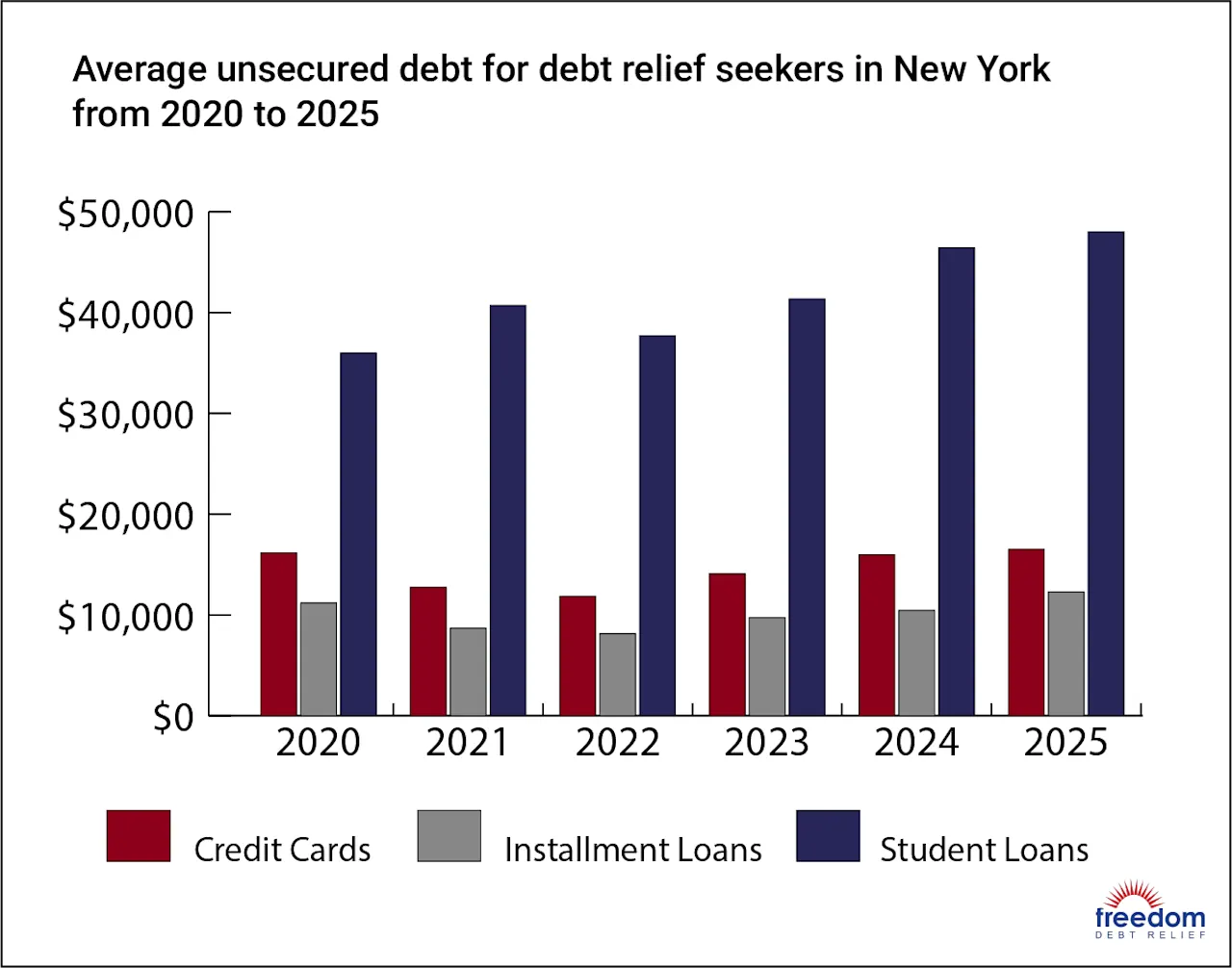
Debt balances are often associated with age and credit scores. As of June 2025, unsecured debt for New York debt relief seekers peaked among those aged 51-65, who averaged $87,069. This group is followed closely by the 65-plus age bracket, with an average of $82,642 as of the same date. While debt relief seekers with very good credit scores (740-799) carry the highest average unsecured debt as of June 2025 ($99,555), it’s those with exceptional scores (800-850) who had the highest balances in 2020, 2022, and 2023.
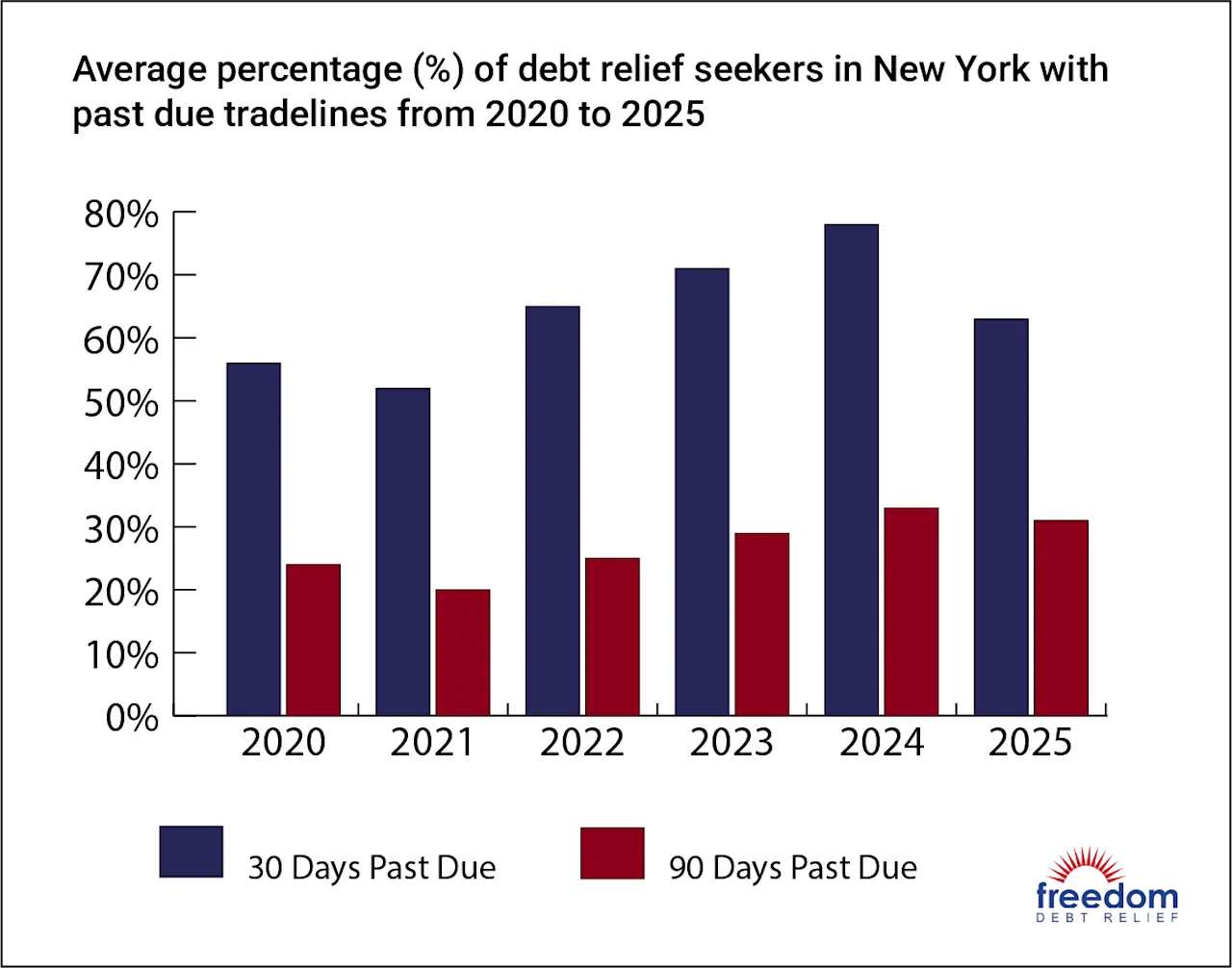
Since 2021, when debt accounts in collections hit 2.4, the numbers have steadily dropped to 1.5 in the first half of 2025. That’s lower than the debt collection account number of 1.9 among debt relief seekers nationwide.
What’s interesting is that the balances in collections among debt relief seekers have grown over the same period, from $2,599 in 2020 to $2,873 in June 2025. However, that’s still lower than the same group nationally, who had a June 2025 average balance in collections of $3,040.
New York credit card debt
Despite the relatively low collection rate in New York, the average New Yorker seeking debt relief carries credit card debt of $17,225 as of June 2025 (slightly higher than the average of $16,244 among the same group nationally), and their debt was spread across an average of eight credit cards. They had an average past-due balance of $6,142.
The average monthly payment on these credit cards was $508, meaning New Yorkers could spend years wading through high interest rates to pay down the balances. The average credit utilization was 71.0% among New York relief seekers as of June 2025, slightly lower than the rate of 73.5% among debt relief seekers nationwide in the same time period. High credit utilization can indicate that someone is having trouble managing their debt.
It’s those debt relief seekers 65 and over who carry the highest credit card balances, averaging $18,234 in June 2025. That’s down from 2020, when the average balance reached $20,361, but still exceeds the June 2025 national average of $16,244 for those seeking relief.
New York auto loan debt
As of the first half of 2025, debt relief seekers in New York have an average car payment of $717 and an average auto loan balance of $23,930. Both amounts have risen since 2020, when debt relief seekers’ average payment was $566 and the average balance sat at $18,095.
New York mortgage debt
Real estate has long been famously expensive in parts of New York. As of June 2025, debt relief seekers in New York averaged a monthly mortgage payment of $2,505 and a mortgage balance of $284,008. This is considerably higher than the national average payment of $1,989 and a balance of $239,406 among debt relief seekers in that time period.
New York installment loan debt
A loan repaid over time with a set number of scheduled payments is an installment loan. While installment loan debt in New York is lower than the national average, it’s climbed since 2020. The average debt relief seeker in New York had $10,575 in installment loan debt as of June 2025. That’s 16% lower than the national installment loan debt of $12,632 among debt relief seekers at that time.
The average monthly installment loan payment among New York debt relief seekers was $477 as of the first half of 2025, slightly lower than the national average among relief seekers in that period, a payment of $485.
New York student loan debt
Student loan debt has increased across the board, making it difficult for many of today’s borrowers to juggle it with other financial obligations. The average student loan debt among debt relief seekers as of June 2025 is $51,189, 2.5% higher than the average of $49,932 among relief seekers nationwide at that time. The average monthly student loan payment was $339, up from $251 in 2020.
New York Debt Delinquencies and Collections
While auto loan delinquencies are rarer in New York than nationwide, credit card and mortgage delinquencies are right in line with U.S. collection statistics. For example, 4.65% of credit card payments are at least 30 days past due (DPD) in Florida, while nationwide, that percentage is a nearly identical 4.66%.
The table below shows delinquency rates for New York auto loans, credit cards, and mortgages, with delinquency percentages at 30, 60, and 90 DPD.
Debt Delinquency Rates in New York
| Type of debt | 30+ DPD | 60+ DPD | 90+ DPD |
|---|---|---|---|
| Auto loan | 3.65% | 1.34% | N/A |
| Credit card | 4.65% | 3.24% | 2.34% |
| Mortgage | 2.99% | 1.57% | 1.10% |
Since 2020, average collection balances have risen slightly among New York debt relief seekers, from $2,599 to $2,873 in June 2025. This bucks a nationwide trend among relief seekers in which average collection balances dropped by nearly 21%, from $3,815 in 2020 to $3,040 in June 2025. Still, New York collection balances have remained lower than the national average.
New York Statute of Limitations
The statute of limitations in New York is the amount of time a creditor has to sue you for a debt. After the statute of limitations runs out, a creditor or debt collector can still sue you over past-due debt, but that debt is considered “time-barred,” and you shouldn’t have to pay it.
Statutes of limitations can vary by location and contract type, but in 2022, the New York statute of limitations for most types of debt was reduced from six years to three.
New York Statute of Limitations for Debt
| Type of debt contract | New York statute of limitations |
|---|---|
| Written contracts | 3 years |
| Oral contracts | 3 years |
| Promissory notes | 3 years |
| Open-ended accounts (such as credit cards) | 3 years |
What are the New York debt collection laws?
The best way to describe New York’s current debt collection laws may be up in the air. As of early 2026, debt collection is governed by a combination of federal and state laws. Several newer rules and regulations are now in effect, while others have been delayed.
Here are some of the consumer protections firmly in place and enforceable:
A debt collector must state in their initial communications that it’s illegal in the state of New York to sue for debts older than three years.
Debt collectors must disclose if they believe the statute of limitations has expired.
Debt collectors cannot use harassing, deceptive, or abusive tactics in an effort to get you to pay.
Debt collectors cannot make threats of violence, use obscene language, or contact you before 8 a.m. or after 9 p.m.
If you make the request, a debt collector must provide written verification of the debt.
It’s a good idea to speak with an attorney to learn more about your rights if approached by a debt collector, because some collection laws are currently up in the air, particularly in New York City, where implementation of some is on hold indefinitely.
Reviews and Testimonials from New York
I'm getting my debt paid off.
LeRoy Willkomm, US

Freedom dept relief has always been very informative in helping me to reach my financial goal. They are very friendly and caring always willing to answer any questions I may have. I highly recommend their program. Thank you, Lori.
Lori Provost, US
Se pudo arreglar el prblema gracias
Cesar Mayen, US
What's the REAL Deal With Debt Relief in New York?
New York Debt Relief
When faced with an overwhelming amount of debt, you may want to consider a debt relief program. In a debt settlement program, you make a monthly deposit into a dedicated settlement account (it’s opened by the debt relief company, but it’s yours, and under your control). Meanwhile, the debt relief company negotiates with creditors on your behalf. Debt relief is most appropriate for those who can’t keep up with current unsecured debt payments and can’t afford to repay the debts in full.
Though there are costs for debt settlement, a reputable debt settlement company will not ask you for any settlement fees upfront. Fees are paid only after there’s an agreement, you’ve approved it, and you’ve made a payment toward it. With debt settlement, it’s possible to get significant debt reduction. A formal debt settlement program typically takes as little as 24 to 48 months to complete.
If you’re looking for a debt relief program in New York, call Freedom Debt Relief at 800-910-0065. You can speak with a debt consultant about your financial situation, and potentially develop a plan that aligns with your income and expenses.
Are there New York State specific laws regulating debt settlement companies?
New York doesn’t specifically regulate debt settlement companies. But you still get national protections laid out by the FTC Telemarketing Sales Rule (TSR). The TSR lays out a few ground rules settlement companies must follow:
No upfront fees
Clear and transparent process and costs
No misleading advertisements or promises
Fees: Debt settlement companies mustn’t charge you until they’ve reached an agreement with your creditor and made at least one payment toward it. Avoid companies that ask you to pay fees upfront—these may be scams.
Transparent process and costs: Settlement companies must be clear about what will happen and how much it’ll cost. If you have questions, you should get clear answers.
No misleading advertising: Companies shouldn’t overpromise what they could save you. “Pennies on the dollar” promises are a big red flag. Creditors don’t have to settle, and success is never guaranteed.
What are the alternatives to debt relief for managing credit card debt in New York?
New York residents might consider some combination of these debt solutions:
DIY debt repayment strategies:
Debt snowball method (pay smallest debts first)
Debt avalanche method (pay highest interest first)
Hardship programs:
Offered directly by credit card companies
May reduce interest rates or waive fees
Contact creditors directly to inquire
Credit counseling:
Free financial education when you enroll in a DMP
Help creating a repayment plan
Help managing your debt until it’s paid off
Budgeting:
Create a budget that works for you
Cut unnecessary expenses
Increase income if possible
Balance transfer credit cards:
0% APR promotional period if you qualify
Consolidate multiple cards to one
Requires good credit
Personal loans:
Lower interest than credit cards, on average
Fixed repayment schedule
Requires decent credit
How to qualify for debt consolidation in New York State
To qualify for debt consolidation in New York, you typically need the following:
A fair or good credit score
Steady income
Debt-to-income ratio below 50%
A good credit score improves your chances of getting approved for debt consolidation loans. If your score isn’t high right now, you can work on it. The best way is to make timely payments.
Your debt-to-income ratio is the percentage of your income (before taxes) that goes to housing and debt payments each month. You can improve your DTI by earning more money or lowering your debts.
Is Debt Consolidation the Best Solution?
Any strategy that relieves your debt burden and helps you work toward a better financial future is worth exploring. Here are five of the most common types of debt relief, including consolidation:
Debt settlement: This involves an agreement with your creditor to accept less than the full amount you owe and forgive the rest. You can settle unsecured debts yourself, or work with a professional debt settlement company. Typical debt settlement programs take two to four years to complete.
Debt management plan (DMP): A DMP is a three- to five-year plan to fully repay your unsecured debt, administered by a nonprofit credit counseling agency. Your creditors may reduce interest rates or waive fees. Your credit counselor may in some cases help you learn more money management skills.
Bankruptcy: Chapter 7 bankruptcy wipes out unsecured debts in a few months. You might lose some of the things you own (they’re sold by the court, and the money is given to your creditors). If you earn too much to qualify for Chapter 7, you may be directed to Chapter 13 bankruptcy, which is a three- to five-year year repayment plan.
Debt consolidation: This debt solution combines multiple debts into a single debt, usually with better terms. For example, you might consolidate two $1,000 credit card debts with 20% APRs into a single $2,000 personal loan with a 14% APR and smaller monthly payments. Interest rates for debt consolidation are lower for those with credit scores in the “good” range or higher.
DIY debt relief: If you feel like you have enough to pay off your debts, but want more organization, you might also consider DIY debt relief. Two of the most popular debt repayment strategies are the avalanche and snowball methods. Each involves making minimum payments on all debts while directing extra funds to a single target debt. Once that debt is paid off, you roll the entire amount you were paying toward it to the next debt in line. Once that debt is paid off, you roll the amount you were paying toward those first two debts (and any extra) toward the third debt in line, and so on.
While the avalanche and snowball methods employ the same strategy of focusing on one debt at a time, the avalanche method focuses on paying the debt with the highest interest rate first and working your way down to the debt with the lowest interest rate. The snowball method focuses on paying off the smallest debt first and working your way up to the largest.
There’s no one-size-fits-all financial solution for debt. Instead, it depends entirely on your situation and what feels most comfortable to you. The important thing to know is that help is available if you need it.
Common Debt Relief Questions in New York
Here are some answers to questions you may be asking about finding debt relief in the Empire State.
What are the main types of debt relief programs available to New York residents?
Debt management plan: A three- to five-year plan to fully repay your unsecured debt, administered by a nonprofit credit counseling agency. Your creditors may reduce interest rates or waive fees. Your credit counselor can help you learn more money management skills.
Debt consolidation: Combine multiple debts into a single debt with better terms. For example, you might consolidate two $1,000 credit card debts with 20% APRs into a single $2,000 personal loan with a 14% APR and smaller monthly payments.
Debt settlement: An agreement with your creditor to accept less than the full amount you owe and forgive the rest. You can settle unsecured debts yourself or work with a professional debt settlement company. Typical debt settlement programs take three to four years to complete.
Bankruptcy: Chapter 7 bankruptcy wipes out unsecured debts in a few months. You might lose some of the things you own (to be sold by the court, and the money given to your creditors). If you earn too much to qualify for Chapter 7, you'll be directed to Chapter 13, which is a three- to five-year repayment plan.
How does New York debt relief affect your credit score?
DMPs: Could damage your credit initially. You'll likely be required to close your credit card accounts while they still have unpaid balances, which is likely to lower your credit score.
Debt settlement: Most people stop paying their creditors so they can save money for settlement offers. Missing payments causes credit score damage. Once you settle debts, they will be reported on your credit report as “settled,” which is better than a collection account but not as favorable as “paid as agreed.”
Bankruptcy: Chapter 7 bankruptcy typically stays on your credit report for 10 years, and Chapter 13 for 7 years.
When negative information hits your credit report, the number of points you lose often depends on your starting point. The higher your score is, the farther it could fall. If your score was already low, you might not experience as much of a drop.
It’s important to focus on choosing a debt solution that helps you become financially healthy. Dealing with your debt could put you in a much better position to build and maintain good credit later on.
New Yorkers can free up cash each month with Freedom Debt Relief
Ozzy S., Freedom client²
“Right away, I had more money each month because of program costs so much less than what I was paying on my minimums.”
Frequently Asked Questions
What is the process for filing for bankruptcy in New York?
Filing for bankruptcy in New York is an involved process. It’s recommended to work with an attorney.
Here are the steps for Chapter 7:
Enroll in mandatory credit counseling. Find agencies approved for credit counseling at the justice.gov website.
Fill out bankruptcy forms detailing all debts, assets, and financial information.
Pay the filing fee or apply for a waiver. As of June 2025, it costs $338 to file for Chapter 7 voluntary bankruptcy in New York.
Turn over your non-exempt assets to the court to sell. Non-exempt assets are things you’re not allowed to keep. The trustee has control over what possessions are sold.
Meet with creditors. Your trustee will hold a meeting where you’ll swear under oath regarding your financial situation, and clear up any concerns the trustee has.
Complete a 2-hour course on financial management, online or over the phone.
Receive a notice saying that the order wiping out your debts has been filed.
List of reputable non-profit credit counseling agencies in NYC
Government databases, consumer organizations, and state-specific programs can point you to reputable nonprofit credit counseling agencies in NYC.
Government databases: The U.S. Department of Justice Website offers a searchable database of approved credit counselors. NYC residents can filter by state and district to find the nearest counseling agencies.
Consumer organizations: The National Foundation for Credit Counseling connects you to certified credit counselors across the United States, including New York. It’s one of the oldest and most reputable nonprofit organizations out there.
State-specific programs: Call 311 or visit nyc.gov/talkmoney to book an appointment at an NYC Financial Empowerment Center for free financial counseling. Counselors can help you set up a bank account, contact lenders about a debt, and more.
Compare debt settlement vs. debt management plans in New York
Debt settlement is a way to clear a debt for less than you owe. Some creditors are willing to negotiate if you can’t afford to fully repay your debt.
Key facts:
For someone experiencing a hardship
Can DIY your own debt settlement or work with a professional debt settlement company
Programs typically last 3-4 years
Fees: 15% or more of debt enrolled in program
A debt management plan (DMP) is a structured repayment plan to fully pay off your debt, managed by a credit counselor. Creditors might agree to lower your interest rate or waive fees.
Key facts:
For someone who can afford all of their debt payments, and possibly more
Administered by nonprofit credit counseling agencies
Duration: 3-5 years
Fees: Small, because the credit counseling agency is funded by creditors
Debt settlement and debt management plans (DMPs) in New York are solutions that address different cases. Debt settlement is for someone with a financial hardship. DMPs are best if you can afford your debts but you’re overwhelmed and need help managing your finances for a while.
How to spot and report debt relief scams in New York?
Debt relief scams overpromise, mislead you, and ask you for money before they deliver results.
Red flags to watch out for:
Promises to eliminate your debt quickly or through a new government program
Pressure to decide whether to enroll in a debt relief program
Fees before results
Guarantees to eliminate debt or remove info from credit reports
Reputable debt relief programs won’t overpromise or mislead you. Doing so is illegal under federal law. Debt relief companies who make guarantees are probably scams.
How to report scammers:
Call 800-382-4357 or report the fraud to the FTC online.
Get in touch with the attorney general's office.
You can file a complaint about a non-compliant student debt relief company or an advertisement that you think is deceptive with the New York State Department of Financial Services.
Are there any New York State government programs for student loan debt relief?
Yes, the New York State Higher Education Services Corporation offers student loan debt relief programs. There are loan forgiveness programs for:
Attorneys
Licensed social workers in critical areas
Young farmers operating a farm in New York State
Participants in federal income-driven repayment plans
Nursing faculty in New York State
Child providers at licensed agencies
Teachers in struggling districts
The Education Debt Consumer Assistance Program (EDCAP) helps New Yorkers navigate the complicated student loan landscape. Through the program, you can get help applying for financial aid, getting out of debt, and more. It’s free and confidential.
End Your Debt
Find out how our program could help.
- One low monthly program deposit

- Settlements for less than owed
- Debt could be resolved in 24-48 months