

Mississippi Debt Relief
Rising debt is a problem for households across the country, but it's worse in Mississippi than in most other places. A higher percentage of consumers in Mississippi have fallen behind on their debt payments than in most of the U.S. That makes the need for debt relief in the state especially urgent.
It's not that households in Mississippi owe more money than those throughout the nation. Debt balances in the state are actually lower than the national average. However, the average annual wage in Mississippi is lower than in any other state. That means every dollar of debt cuts deeper into household budgets.
The average annual wage in Mississippi is $49,740. That's nearly 27% lower than the national average of $67,920. So, it's no wonder many people in Mississippi have a harder time keeping up with the rising cost of living.
Too often, the mismatch between low incomes and rising costs causes people in Mississippi to go into debt. The cost of debt only adds to their expenses, and can easily get out of hand.
The problems caused by debt in Mississippi are easy to see. The 677 average credit score is 38 points lower than the national average. It's lower than the average credit score of any other state. Consumers in Mississippi have higher late payment rates than the national average for auto loans, credit cards, mortgages and personal loans.
These struggles make debt relief a vital survival tool for many households in Mississippi.
Mississippians can free up cash each month with Freedom Debt Relief

Ozzy S., Freedom client²
“Right away, I had more money each month because of program costs so much less than what I was paying on my minimums.”

Excellent •
5-Year Debt Trends in Mississippi
Over the past five years, over 150,000 consumers in Mississippi have sought information about debt relief. The need for this kind of help is growing. As the chart below shows, for people seeking debt relief in Mississippi, the average monthly debt payment has now grown for four years in a row:
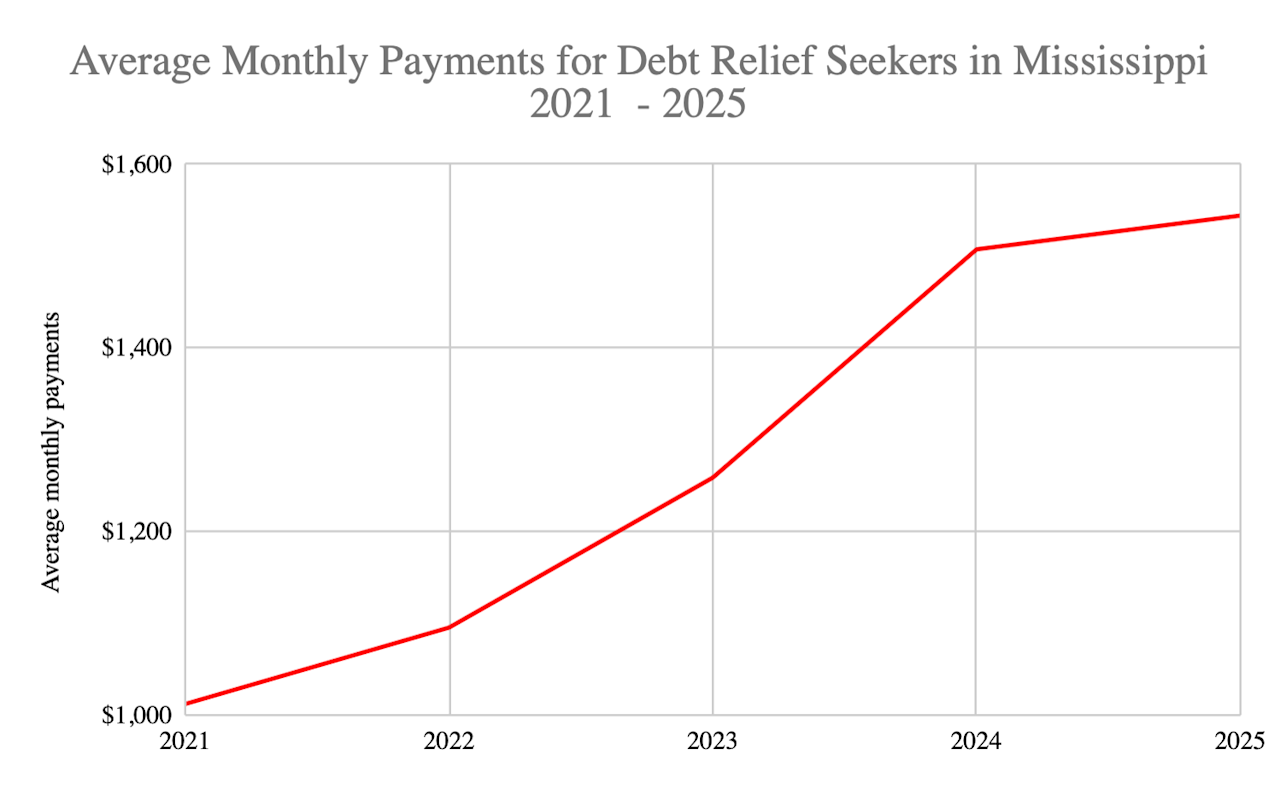
At $1,544, the average monthly debt payment is now 52.6% higher than it was in 2021. Meanwhile, the average wage reported by these consumers has risen by just 7.9%.
When debt payments grow faster than earnings, they become harder to afford every year. Here are some examples of the problems this is causing for the thousands of people in Mississippi who have had to look into debt relief:
The average debt-to-income (DTI) ratio has risen by 30.3% since 2021.
The average balance owed has grown for four straight years in every major category of debt: credit cards, auto loans, personal loans, and mortgages.
The average debt balance peaks just as people are approaching retirement, in the 51-to-65 age group.
Average DTI ratio also peaks in that pre-retirement age group. When debt payments are eating up a larger portion of income, it becomes harder to save for retirement.
Not even high earners are safe from debt problems. While there are fewer people earning over $200,000 seeking debt relief, those who do have the highest DTI ratio of any income group. With an average DTI ratio of 99.7%, those high-income debt relief seekers are seeing virtually all of their income go to debt payments.
Debt problems are common in Mississippi, but no two households are the same. The type of debt you have has a lot to do with how it affects you.
Mississippi credit card debt
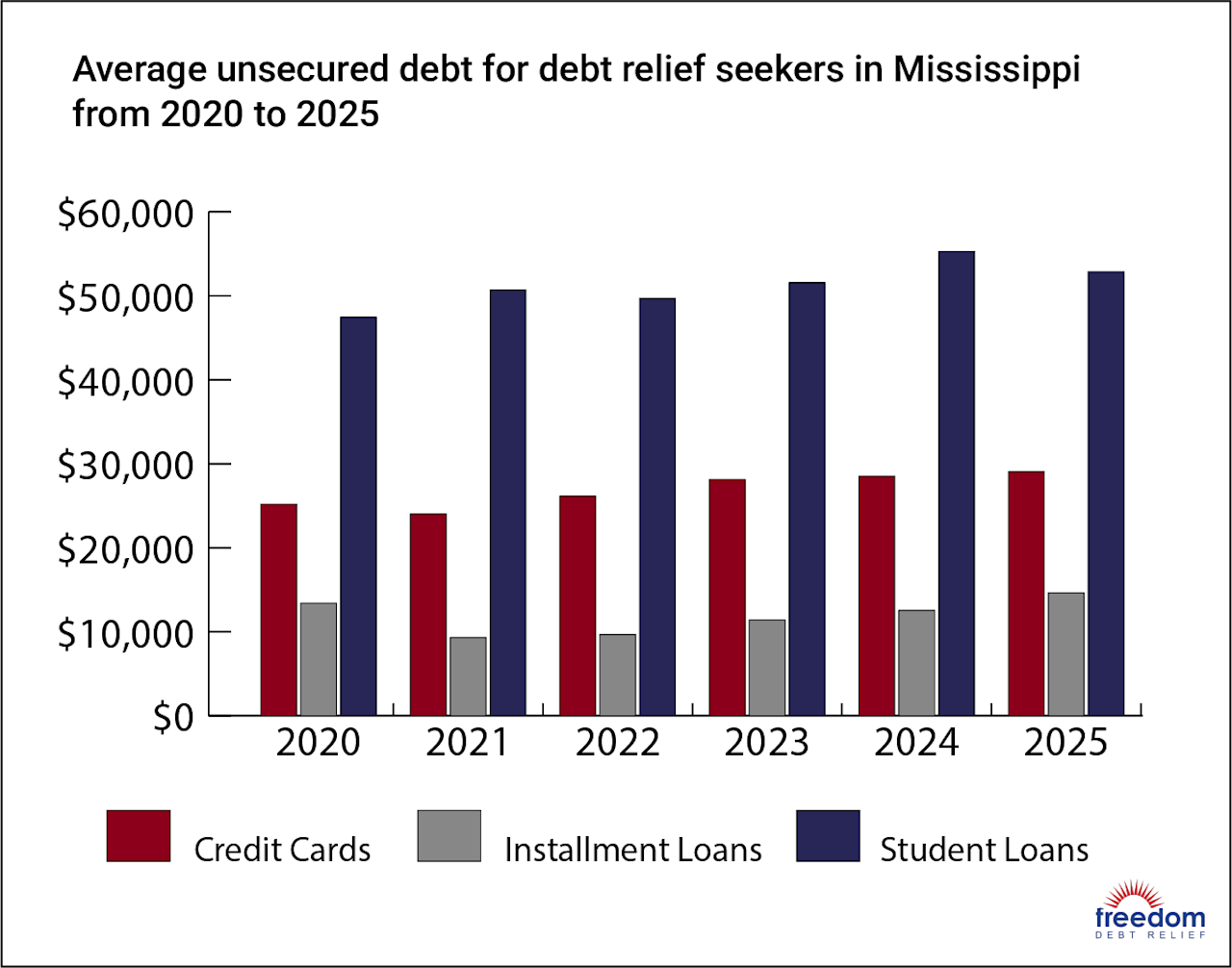
The average credit card balance for people seeking debt relief in Mississippi is $13,426. A little more than a third of that debt is past due.
That average credit card balance has risen for three straight years. Over that time, it has grown by 41.4%. The corresponding minimum monthly payments on that credit card debt have also risen for three years in a row. The total increase in minimum monthly payments is 28.9%.
One reason people get into trouble with credit card debt is that credit cards are so plentiful. The average debt-relief seeker in Mississippi has seven credit card accounts.
A problem with this easy availability is that credit card debt can be especially dangerous. For one thing, credit card debt is more expensive than other conventional forms of consumer debt. The average interest rate on credit card debt is 22.83%, and rates are often 10% higher for people with poor credit.
Another hazard posed by credit cards is that they typically have low minimum monthly payments. That might not sound dangerous, but these low payments can drag your debt out for a long time. As a result, you pay more interest. In fact, people often charge more in a month than the amount of their payment. When that happens, you can make payments regularly and still see your debt go up.
If you need credit card debt relief, one factor in your favor is that most credit cards are unsecured. That means debt settlement is often a possibility with credit card debt.
Mississippi auto loan debt
Auto loan debt has been growing steadily. With the average price of a new car recently passing $50,000, that's no surprise. Plus, with multi-car families now commonplace, people often carry more than one car loan. People seeking debt relief help report having an average of 1.5 auto loans, both as a national average and in Mississippi specifically.
Nationally, debt relief seekers with auto loan debt report owing an average total of $26,997. The average total monthly payment on that debt is $749. That average payment has risen by 26.2% over the past five years.
The story for auto loan debt is even worse in Mississippi. The average owed by debt relief seekers in the state is $29,069. The average monthly payment is $807, which is 30.1% higher than it was five years ago.
Unlike credit card debt, auto loans are usually secured debt. That means the debt is unlikely to be settled. If you can't repay the loan, you could lose your vehicle to repossession.
Mississippi mortgage debt
Debt relief seekers in Mississippi with a mortgage owe an average balance of $159,021. Their average monthly payment is $1,507.
Both of those figures are lower than the national averages. The problem is, the median home price in Mississippi is nearly $168,000 lower than it is nationally. The key with home loans is how much equity you have—the value of the home minus the amount owed on it. With sharply lower home values in Mississippi, lower mortgage balances don't necessarily mean larger amounts of equity.
The affordability of a mortgage depends on the monthly payment. The average monthly payment for debt relief seekers in Mississippi has risen by 45.6% over the past five years. That rapid growth makes it increasingly difficult for people in Mississippi to stay in their homes.
Since mortgages are secured by the property they're used to buy, they aren't good candidates for debt settlement. However, settlement of other debts can be helpful in freeing up money for mortgage payments.
Mississippi installment loan debt
Personal loans are a type of installment debt. That's debt with uniform monthly payments and a pre-defined repayment period. This type of debt is an unusually big problem for people seeking debt relief in Mississippi.
For debt relief seekers in Mississippi, the average installment debt balance is $14,637. This is 15.9% higher than the national average. The average amount of installment debt has now grown for four straight years.
Personal loans may be secured or unsecured. Since most often they are unsecured, this type of debt could be a good candidate for debt settlement.
Mississippi student loan debt
For many borrowers, student loan debt has become a much more urgent problem over the past year or so. That's because repayment requirements have resumed after being paused during the pandemic.
Nationally, late payment rates on student loan debt soared after the payment requirement resumed. Borrowers in Mississippi feel this burden more than most. Among debt relief seekers in the state, those with student loan debt report an average total balance of $52,865. This is 5.9% higher than the national average.
Most student loan debt comes from the federal government. This debt is not eligible to be settled. However, the government does offer debt relief in the form of income-driven repayment plans and debt forgiveness in certain situations. Contact your loan servicer or go to www.studentaid.gov for information.
Mississippi Debt Delinquencies and Collections
Think about debt problems as having different levels of seriousness:
It starts with accumulating more debt than you can afford to repay.
The next phase is when you start missing payments.
The problem escalates when you have accounts referred for collection.
When a creditor gives up on trying to collect a debt, they may refer it to a collection agency. This creates a negative notation on your credit record. In turn, it may subject you to aggressive efforts by the collection agency to collect on the debt.
How far down this road have debt relief seekers in Mississippi gone?
Since they owe an average amount of $26,002, they've already acquired a substantial amount of debt. The most common type of debt is credit card debt, which 61.9% of them report having. Of this debt, 35.9% of the balance owed is past due, so many people have reached the stage of missing payments.
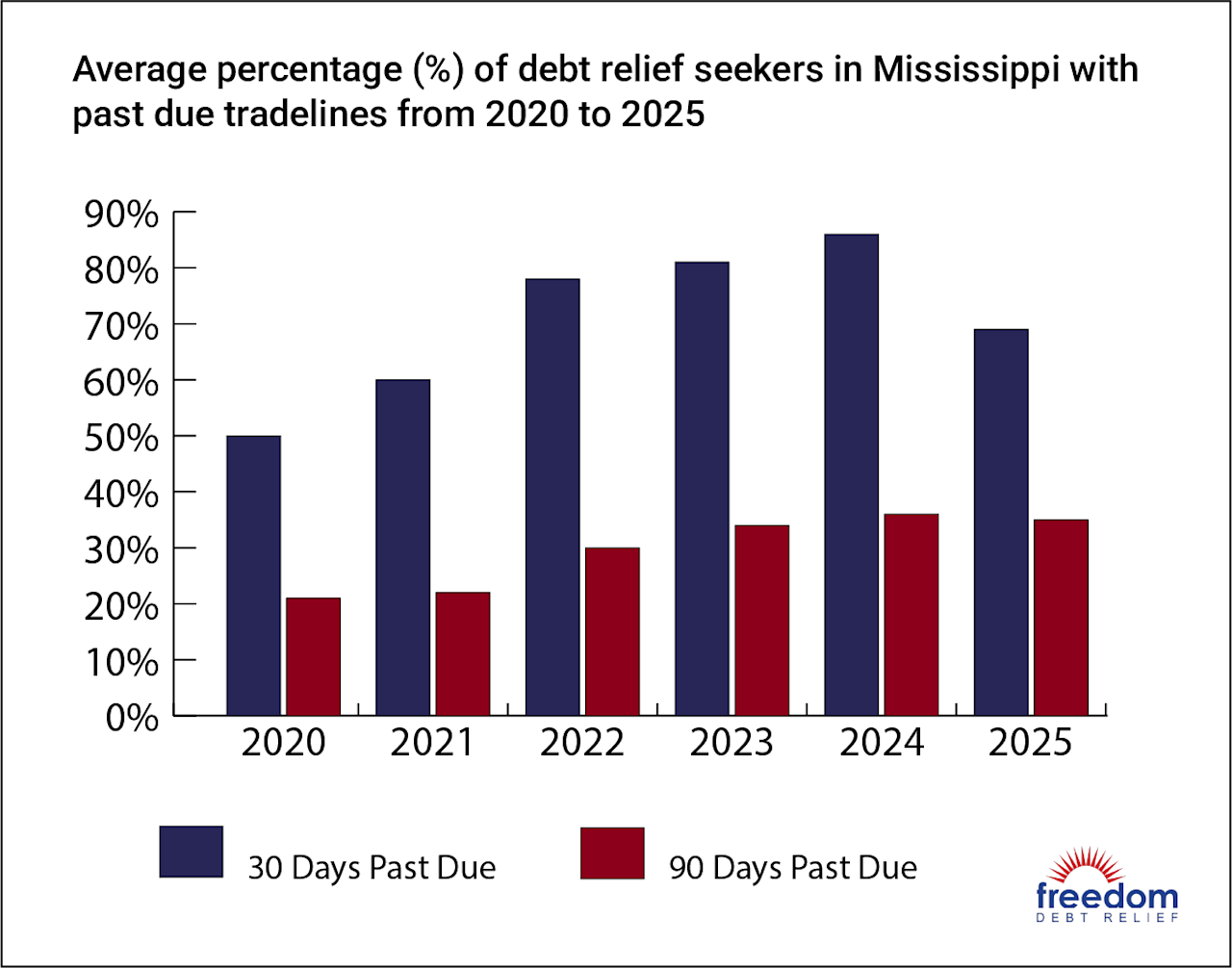
As for having accounts referred for collections, 13.2% have reached this stage. That's a little higher than the national average. On average, they have 1.7 accounts in collections, so they may have more than one agency hounding them for payment. And 85.6% of the balance in collection is past due, indicating that they're generally unable to keep up with these demands.
At some point along this path, it would be wise to get serious about debt relief. You can save yourself some aggravation by looking into it in the earlier stages of debt trouble, but it's never too late. Also, if you find yourself going down this path, you should get to know what rights you have to protect yourself from debt collectors.
Mississippi Statute of Limitations
A statute of limitations is a law setting the time period in which someone can take legal action against someone else. This type of law can apply to a variety of things, including debt collection.
Statutes of limitations for debt are set by state law. In Mississippi, the time limit for consumer credit is three years. The clock typically starts on the date of the last payment.
If the statute of limitations has expired, a creditor or collection agency has lost the right to sue you for the debt. However, that does not prevent them from trying to collect.
What are the Mississippi debt collection laws?
Borrowers in Mississippi are protected by the federal Fair Debt Collection Practices Act (FDCPA) This law prohibits debt collection companies from using unfair, abusive, or deceptive practices. Here are some of its main points:
The FDCPA covers debts that are primarily for personal, family, or household purposes, as opposed to business debts.
The FDCPA does not apply to the lenders themselves, but to collection agencies, debt buyers, and lawyers.
Under the FDCPA, debt collectors can only contact you between the hours of 8 a.m. and 9 p.m.
If you inform a debt collector that your employer does not allow you to take personal calls at work, they are prohibited from contacting you there.
Debt collectors cannot post publicly on social media about your debt.
Debt collectors may not harass you or your family by any form of communication.
If you advise a debt collector that you are represented by an attorney, they are required to contact that attorney instead of you.
Keep track of the details of any communications with debt collectors. That information may prove useful later on in legal proceedings or debt settlement negotiations.
Mississippi Debt Relief
Knowing your rights can give you some protection from debt collectors. Still, to get to the root of the problem, you should consider the various debt relief options that are available to you in Mississippi.
If you're struggling to pay your bills in general, you can find out whether you're eligible for public assistance through the Mississippi Department of Human Services. Also, you can find information about federal programs from the US Department of Health and Human Services.
Public assistance may help make ends meet, but it won't pay your debts. Fortunately, there are other options to help with that:
Use a debt repayment approach like the avalanche method to organize your payments for maximum efficiency.
Ask whether your credit card company will set up a hardship payment program for you. Credit card companies don't generally offer these publicly, but they may agree to special repayment terms if you can demonstrate a genuine need.
You could have a credit counselor set up a debt management plan (DMP) for you. There's a list of nonprofit credit counselors authorized to do business in Mississippi on the U.S. Department of Justice website.
If your credit is still healthy enough for you to qualify for new credit, you could use a personal loan, home equity loan, or balance transfer credit card to consolidate debts.
You may be able to negotiate a debt settlement with some creditors. You can either do this yourself or hire a debt relief specialist like Freedom Debt Relief to do it for you.
If none of the above seems like the answer to your problems, you should learn about your bankruptcy options. Ask an attorney licensed to practice in your state whether a Chapter 7 or a Chapter 13 bankruptcy makes sense in your situation.
Is Debt Consolidation the Best Solution?
If you're considering debt consolidation or debt settlement, it helps to know the pros and cons of each.
Debt consolidation involves taking out a new loan to pay off your credit cards, medical bills, or other unsecured debts.
One benefit is that this would replace multiple monthly payments with just one payment. Better yet, if you can get a lower interest rate on the new loan, you could save money as you pay down the debt. Besides a loan, you could also use a balance transfer credit card if you think you can pay off the debt within the timespan of the promotional interest rate, which could be a year or two.
Debt consolidation may be a good fit if:
Your credit is good enough to qualify for a cost-effective debt consolidation loan or balance transfer card.
You'd like to simplify monthly debt payments.
You are confident you could pay off the full amount you owe with better repayment terms. Debt consolidation won't reduce how much you owe. However, it may allow you to change terms like interest rates, minimum payments, and the repayment period.
As an alternative, debt settlement may be a way to reduce the amount you owe. This is done by negotiating with creditors. Debt settlement may be a good choice if:
You can't afford to fully repay your debts, even with better repayment terms.
You cannot qualify for a cost-effective consolidation loan or credit card.
You owe a lot of unsecured debt, like credit cards and medical bills.
If you're looking for a specialist to help you with debt settlement, choose one with the following:
Experience negotiating debt settlements in Mississippi. The laws involved with debt vary from state to state. Having someone who knows the rules in your state could help with the negotiation.
Professional accreditations. Look for certification from organizations such as the Association for Consumer Debt Relief and the International Association of Professional Debt Arbitrators.
An extensive track record of success. Ask about how long the firm has been doing business, the number of people they've helped, and the results they've gotten.
Positive customer ratings on Google, Trustpilot, and Best Company.
No upfront debt settlement costs. A debt settlement company can’t charge you fees for settling debts until after they negotiate an agreement and at least one payment has been made towards it.
What's the typical situation for someone enrolled in a debt relief program in Mississippi? Freedom Debt Relief reports that as of 2025, its average client in Mississippi had $22,028 enrolled in its programs.
Talking to a debt relief professional could help you decide whether debt settlement is a good fit for your situation.
Mississippians can free up cash each month with Freedom Debt Relief
Ozzy S., Freedom client²
“Right away, I had more money each month because of program costs so much less than what I was paying on my minimums.”
Excellent •
How does Chapter 7 bankruptcy work in Mississippi?
Chapter 7 bankruptcy involves selling things you own to pay off part of your debt. To qualify, you must have a relatively low income.
The income limit is based on the median income in the state. In 2025, the limit for a single person household was $52,797. This limit is adjusted for the size of your household—the bigger the household, the higher the limit.
Chapter 7 bankruptcy in Mississippi can be resolved in a matter of months. While the process may require you to sell off your assets, there are certain exemptions. These include:
Up to $75,000 worth of equity in your home, as long as it's under 150 acres.
Up to $30,000 of equity in a mobile or manufactured home.
Up to $10,000 worth of personal property, including your vehicle.
If you're over 70 years old, up to $50,000 worth of any personal property you choose.
The court will supervise selling off the assets you’re not allowed to keep. Then a bankruptcy judge will decide how to split the proceeds among your creditors. Once that's done, any remaining eligible debt will be erased.
There are some debts that you can't get rid of through bankruptcy. These include some tax debts and other government debt, as well as spousal and child support. Bankruptcy usually can’t wipe out student loans, either.
Bankruptcy rules are complex, and subject to change from time to time. Be sure to consult with an expert in your state before deciding whether bankruptcy makes sense for you.
How does a debt management plan affect credit score in Mississippi?
Just signing up for a debt management plan (DMP) in Mississippi shouldn’t directly affect your credit score. However, some parts of that plan may have an impact.
You may see some short-term negative credit impact if the DMP requires you to close credit card accounts. Reducing your available credit can immediately raise your credit utilization ratio. Also, closing older credit accounts may reduce the average age of your credit.
On the other hand, the DMP could help you manage your finances, keep up with your payments, and build a positive payment history. Payment history is the biggest factor in credit scores.
As part of the DMP, some creditors may agree to update your payment status to current from past due. This could help your score.
Are there nonprofit credit counseling services in Mississippi?
Yes, dozens of nonprofit credit counseling organizations have services available in Mississippi.
The U.S. Department of Justice has a list of nonprofit credit counselors authorized to offer services in Mississippi. Some of the credit counselors on this list may be outside the state, but all are approved to provide services to Mississippi residents. Services may be provided in person, online, or by telephone.
A credit counselor may suggest a debt management plan (DMP). With a DMP, you send a single payment every month to the counseling agency. The credit counselor then makes sure the money is distributed to your creditors. There’s typically a modest monthly fee for the DMP.
A DMP doesn’t reduce what you owe. However, the credit counselor may get some creditors to agree to lower your interest rate and/or waive some fees.
Even if a credit counselor works with a nonprofit and is on an approved list, you should still check their qualifications and background to make sure they're right for your needs.
What are the pros and cons of filing Chapter 13 bankruptcy in Mississippi?
Chapter 13 bankruptcy requires you to agree to a payment plan over a three- to five year- period.
Here is a breakdown of some of the pros and cons of Chapter 13 bankruptcy in Mississippi:
| Pros | Cons |
|---|---|
| Allows you to keep what you own | Five-year repayment period, three if you’re low income |
| Stops collections temporarily, could help you save your home from foreclosure | Requires you to pay all of your disposable income into the plan. The court will tell you how much to pay after accounting for your essential expenses. |
| Remaining debt may be discharged (forgiven) after completion of the payment plan | You must have a steady income to be eligible |
| Creditors can’t opt out | Will remain on your credit report for seven years from when you file |
End Your Debt
Find out how our program could help.
- One low monthly program deposit

- Settlements for less than owed
- Debt could be resolved in 24-48 months