



Debt Consolidation in Connecticut: Your Options
Key Takeaways:
Debt consolidation in Connecticut combines multiple debts into one monthly payment.
Applying for a consolidation loan generally involves a credit check.
Consolidation may lower the required monthly payment by replacing several payments with one.
The average Connecticut household has $66,590 in debt, according to the Center for Microeconomic Data. That figure includes mortgage debt, credit cards, auto loans, and student loans, and is slightly higher than the $63,340 Americans owe on average. Among people who seek debt relief in Connecticut, the average estimated debt was $33,468 in 2025.
Here's a quick look at how well people in Connecticut handle their debt:
The average FICO Score is 602, and residents use 70.7% of the credit limit on average.
Statewide, 18% of residents have at least one debt in collections and the average collection balance is $2,671.
Residents bring in $75,022 on average, but 40.5% of their gross pay goes to debt repayment each month.
Connecticut debt relief can offer solutions to people who struggle with credit cards and other debts. Let's look how debt levels have shifted over the last five years, and what options residents have to regain control of their finances.
Freedom Debt Relief does not provide debt settlement services for people in Connecticut. They may be referred to a third party provider or law firm.
Connecticuter can free up cash each month with Freedom Debt Relief

Ozzy S., Freedom client²
“Right away, I had more money each month because of program costs so much less than what I was paying on my minimums.”


5-Year Debt Trends in Connecticut
Between 2020 and 2025, Connecticut residents seeking relief for debt saw their average debt levels decrease, then increase, before dipping slightly again. Here's how estimated debt levels among debt relief seekers have changed over time.
Connecticut Average Household Debt
| Year | Average balance |
|---|---|
| 2020 | $26,541 |
| 2021 | $25,309 |
| 2022 | $25,779 |
| 2023 | $29,831 |
| 2024 | $34,942 |
| 2025 | $33,468 |
If you consider mortgage debt, student loans, credit cards, auto loans, and installment loans all together, Connecticut residents seeking debt relief face a much higher debt load. As of 2025, the average total debt owed came to $342,090—slightly below the average U.S. household debt, at $345,211.
Let's look at more five-year debt trends in Connecticut:
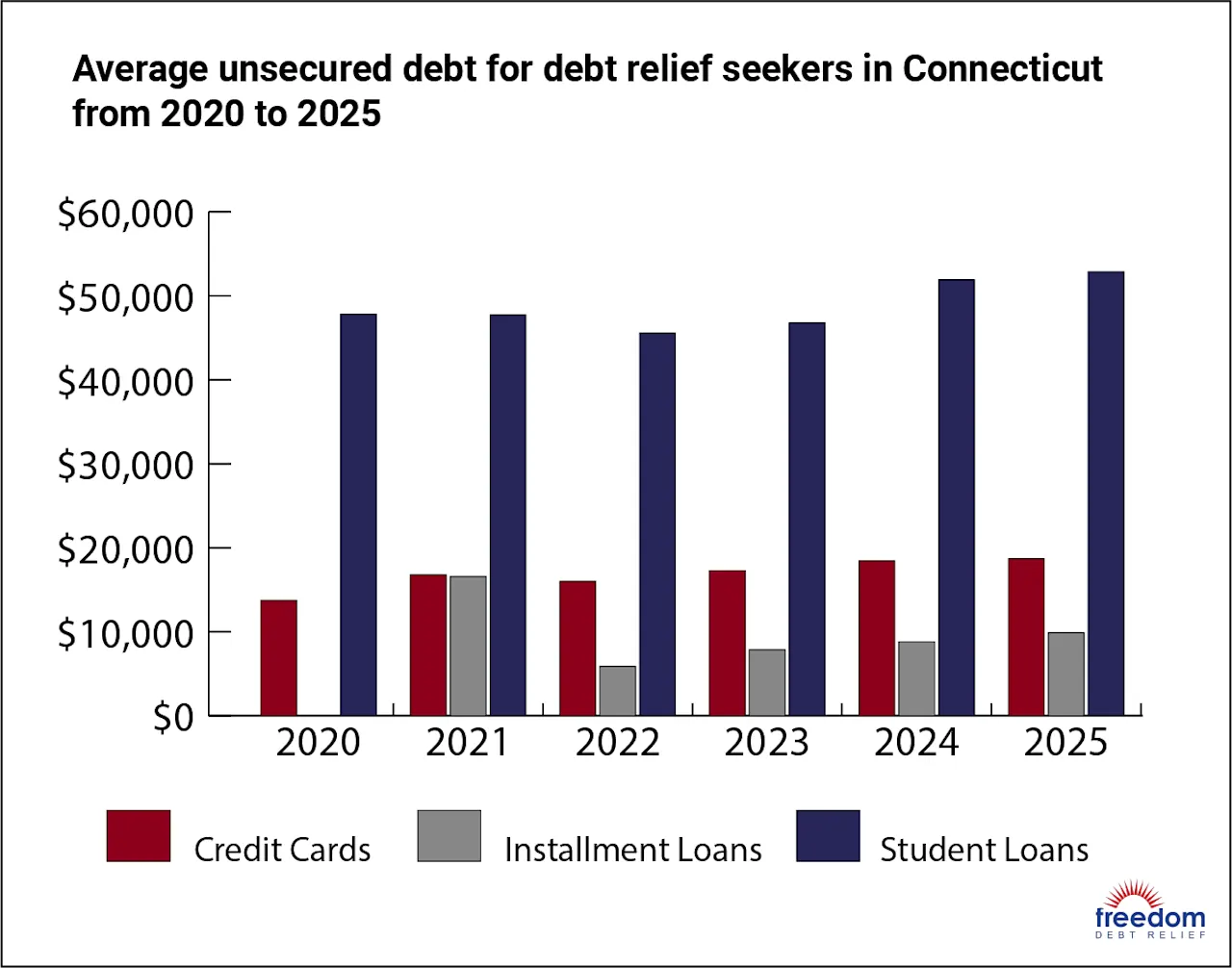
The average credit card debt was $18,721 in 2025, compared to $13,737 in 2020.
Residents 51 to 65 carry the most debt on average, owing $35,210 in 2025. In 2020, people 36 to 50 had the highest average debt, at $41,412, which suggests that many residents carry debt with them as they age.
While credit utilization dropped from 76.9% to 70.7%, as of 2025, minimum monthly debt payments rose from $$1,838 to $2,037.
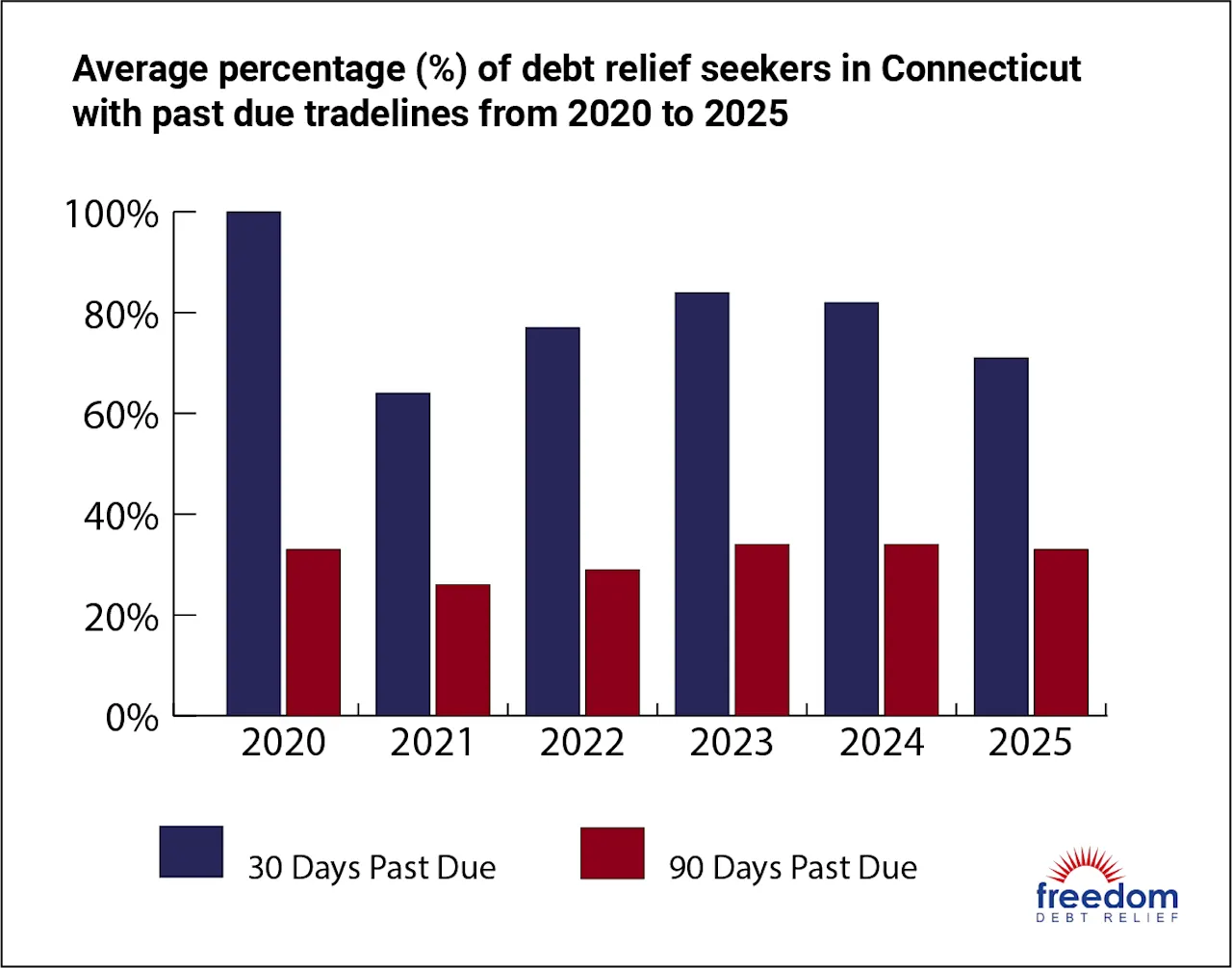
The percentage of balances past due by at least 30 days declined over the last five years, while the percentage of accounts 90 days past due held steady.
What's notable about the data is that most numbers, including average debt, credit utilization, and monthly payments dipped in 2022. Since then, debt levels are up, Connecticut residents seeking debt relief are using more of their available credit, and minimum payments have gotten higher.
Connecticut credit card debt
Credit cards make it easy to pay for things, but the balances can add up quickly. Here's what the typical credit card snapshot for a Connecticut resident seeking debt relief looks like:
Has 8.9 credit card accounts on average
Owes an average balance of $18,721
Pays $561 to their credit cards per month on average
Has a past due credit card balance of $6,461
That last point is significant because it suggests that some people, at least, struggle to keep up with their debt payments.
How do Connecticut's numbers compare to debt relief seekers in the rest of the country? Nationwide, credit card users are carrying an average balance of $16,244 across seven cards, and pay $489 on average per month. Of that balance, $5,793 is past due. Credit card utilization in Connecticut is slightly lower, at 70.7%, compared to 73.5% for debt relief seekers across the U.S. on average.
Who owes the most debt in Connecticut by age? Let's look at the breakdown.
Debt levels by age group in CT
| Age Group | Average Credit Card Debt | Average Total Debt |
|---|---|---|
| 18-25 | $9,372 | $23,019 |
| 26-35 | $15,047 | $30,446 |
| 36-50 | $19,136 | $34,252 |
| 51-65 | $19,516 | $35,210 |
| 65+ | $19,973 | $33,401 |
Connecticut auto loan debt
The average Connecticut resident seeking debt relief has 1.4 auto loans and owes $22,346. That's a significant jump from the $9,583 owed on average in 2020. Balances are highest among middle-aged and senior residents:
Among 36- to 50-year olds, the average auto loan balance is $23,983.
Residents 51 to 65 owe an average auto loan balance of $23,955.
Here's how Connecticut residents seeking debt relief compare to debt relief seekers in the rest of the U.S.
CT auto loan debt
| Connecticut Residents | U.S. Borrowers | |
|---|---|---|
| Total Balance | $22,346 | $26,697 |
| Monthly Payment | $671 | $749 |
| Average Number of Loans | 1.4 | 1.5 |
Car loans are generally viewed as bad debt since they're attached to assets that typically lose value over time instead of gaining it. An auto loan can become problematic if you're underwater, which means you owe more than your car is worth, or the payment is more than your budget can handle.
If you've fallen behind and the car has been repossessed, you could end up with what's called a deficiency balance. This is the difference between what the lender was able to auction or resell a repossessed car for and what's still owed to the loan. If you have a deficiency balance, you may be able to negotiate with the creditor you owe.
Connecticut mortgage debt
Connecticut residents who have mortgage debt owe $238,173 on average. The typical homeowner has just one home loan, which suggests that residents may not be tapping their home equity there via a home equity loan or HELOC.
Younger homeowners have the most mortgage debt, at $296,294 on average, but borrowers 65 and older still owed just over $207,000 on their homes in 2025. Since 2020, the average mortgage balance has jumped by approximately $103,000.
Here's how the mortgage debt for Connecticut residents seeking debt relief compares to the national average for people seeking debt relief.
CT mortgage debt
| Connecticut Residents | U.S. Borrowers | |
|---|---|---|
| Total Balance | $238,173 | $239,406 |
| Monthly Payment | $2,207 | $1,989 |
| Average Number of Loans | 1.2 | 1.2 |
These numbers make sense since Connecticut is a pricier place to buy. The average home value was $425,784 as of November 2025. That's substantially higher than the nationwide average of $360,727.
Connecticut installment loan debt
Installment loans are repaid over time in fixed installments. A personal loan is an example of an installment loan. Connecticut residents owe $9,901 in installment debt, as of 2025. That's nearly double the $5,883 that was owed on average in 2022 but it's less than the $16,576 reported in 2021.
A typical borrower has more than one loan, which could suggest that Connecticut residents seeking debt relief may rely on loans to fill financial gaps. Here's how the numbers compare to the debt relief seekers nationwide.
CT installment loan debt
| Connecticut Residents | U.S. Borrowers | |
|---|---|---|
| Total Balance | $9,901 | $12,632 |
| Monthly Payment | $495 | $485 |
| Average Number of Loans | 2.9 | 2.8 |
Unsecured installment loans may be candidates for negotiation. An unsecured loan isn't tied to any collateral, the way that a mortgage is tied to a home, for example.
Connecticut student loan debt
Connecticut is home to some notable universities, including Yale and Wesleyan University, both of which come with high price tags. On average, students and grads carry $52,589 in student loan debt spread across five loans.
High-income earners have the most student loan debt on average, at $109,561.
At the other end of the spectrum, low-income earners owe just $38,847 on average.
Since 2020, the average number of loans per borrower dropped from 7 to 5 but the average balance increased by $5,035.
Here's how Connecticut student loan debt stacks up against the averages for debt relief seekers nationwide.
CT student loan debt
| Connecticut Residents | U.S. Borrowers | |
|---|---|---|
| Total Balance | $52,859 | $49,932 |
| Monthly Payment | $343 | $313 |
| Average Number of Loans | 5 | 5 |
Connecticut Debt Delinquencies and Collections
When a debt goes unpaid long enough, it can be sent to collections. At that point, you may start getting calls or letters from a debt collector asking for payment.
Connecticut residents have slightly fewer collection accounts than the typical American, and they owe less to collection debt as well. That's encouraging, as it suggests that they may be better at keeping up with their debt payments.
CT debt collection accounts
| Connecticut Residents | U.S. Borrowers | |
|---|---|---|
| Average Number of Collection Accounts | 1.7 | 1.9 |
| Accounts Past Due 30 Days | 0.7 | 0.6 |
| Accounts Past Due 90 Days | 0.3 | 0.3 |
| Average Collection Balance | $2,671 | $3,040 |
| Average Collection Past Due Amount | $2,640 | $2,884 |
Collection balances in Connecticut have held fairly steady over the past five years. Balances dipped below $2,500 in 2022 and 2023, before beginning to climb again in 2024.
Connecticut Statute of Limitations
The Connecticut statute of limitations on debt determines how long a creditor has to sue you for an unpaid balance. Once the statute of limitations expires, you can no longer be sued for a debt, though you still legally owe it.
Different types of debt may have a different window in which a creditor can bring a debt lawsuit. Here's how long the statute of limitations applies to each type of debt in Connecticut.
Statute of limitations for debt in CT
| Type of Debt | Statute of Limitations |
|---|---|
| Credit cards | 6 years |
| Medical debts | 6 years |
| Auto loans | 4 years |
| Private student loans | 6 years |
| Mortgages | 10 years |
| Personal loans | 6 years |
| Judgments | 20 years |
| Oral contracts | 3 years |
| Promissory notes | 5 years |
| State tax debt | 15 years |
Connecticut allows a 20-year window for collection for judgments issued in Superior Court. If you're sued in small claims court, the statute of limitations drops to 10 years for any debt that results from a judgment.
What are the Connecticut debt collection laws?
Connecticut passed the Creditors' Collection Practices Act (CCPA) to protect residents from unfair and abusive debt collectors. Under the Act, debt collectors cannot:
Engage in abusive practices to try to collect a debt
Harass you
Use fraudulent or deceptive tactics to try to trick you into paying
Those restrictions mirror the Fair Debt Collection Practices Act (FDCPA). This federal law says that debt collectors cannot:
Threaten you with violence, call you repeatedly, or otherwise harass you
Call you before 8 a.m. or after 9 p.m.
Continue you to contact you if you've asked them not to
Threaten to have you arrested for a debt
Attempt to collect more than what's owed
Call you at work if you're not allowed to receive calls there
Threaten to sue you if they don't have plans to do so
If you think your rights have been violated under the FDCPA or the CCPA, you could file a lawsuit for damages. Keeping good records of any and all contact you have with a debt collector could help back up your claim if you decide to sue.
Connecticut Debt Relief
Debt relief means getting rid of debt for less than what you owe. Here's how the process typically works:
You have a hardship and can’t afford your debts.
You set aside money each month until you can afford to make an offer to your creditor.
Most people seeking debt relief struggle to save money while keeping up with their bills, so they choose to stop making their payments. If you stop making your payments, expect severe credit damage, collection activity, and possibly lawsuits against you. It’s important to keep open communication with your creditors during this time.
When you have enough to make a reasonable offer, you try to work out an agreement with your creditor. They aren’t legally obligated to negotiate with you, but many will if it’s clear that you’re struggling.
If you reach an agreement and get it in writing, you pay the agreed amount. The rest of the debt is forgiven.
That debt is now permanently resolved. Keep proof of the agreement and your payment(s).
Here’s our full guide on how to negotiate debt settlement on your own.
If you’re struggling and you want expert input, talk to Freedom Debt Relief. They may be able to connect you with a company that can help. Call 800-910-0065 to talk to a debt expert.
Freedom Debt Relief does not provide debt settlement services for people in Connecticut. They may be referred to a third party provider or law firm.
Is Debt Consolidation the Best Debt Solution?
There’s no one-size-fits-all financial solution for debt. Instead, it depends entirely on your situation and what feels most comfortable. Let’s dive into how debt consolidation works and compare it with debt settlement.
There’s more than one way to consolidate debt. For example:
Debt consolidation loan. Debt consolidation loans are personal loans. You borrow a lump sum, use it to pay multiple debts, and then repay the consolidation loan in monthly installments. The goal is to borrow the funds at a lower interest rate than you currently pay. Most personal loans for debt consolidation are unsecured, meaning you don’t have to risk anything of value by using it as collateral.
Home equity loan. A home equity loan allows you to borrow against the equity in your home and use the funds to pay off debt. Because home equity loans are secured by the home, they often have a lower interest rate compared to other options.
Cash-out mortgage refinance. This is a new mortgage that’s bigger than your current one. You use it to pay off your old mortgage and still have money left over that you could use for another purpose.
Who may benefit from debt consolidation vs. debt settlement
Typically, the consumer who benefits most from a debt consolidation loan has more manageable debt and a credit rating that’s high enough to qualify for a low interest rate.
On the other hand, a person with a financial hardship that makes their debts unaffordable may find debt settlement the better option.
How to qualify for debt consolidation in Connecticut
To qualify for debt consolidation in Connecticut, you typically need the following:
A fair or good credit score
Steady income
Debt-to-income ratio below 50%
A good credit score improves your chances of getting approved for debt consolidation loans. If your score isn’t high right now, you can work on it. The best way is to make on-time payments.
Your debt-to-income ratio (DTI) is the percentage of your income (before taxes) that goes to housing and debt payments each month. You can improve your DTI by earning more money or lowering your debts.
Connecticuter can free up cash each month with Freedom Debt Relief
Ozzy S., Freedom client²
“Right away, I had more money each month because of program costs so much less than what I was paying on my minimums.”
Frequently Asked Questions
How long before a debt becomes uncollectible in Connecticut?
The statute of limitations on debt in Connecticut makes credit card debts, personal loans, and medical debts uncollectible after six years. That means if you default on any of these debts, the creditor loses legal standing to take you to court over the balance. However, you still owe the debt legally.
Other types of debts may have a shorter or longer statute of limitations. Oral contracts can't be collected after three years, for example, but judgments issued by a Superior Court have a 20-year expiration date.
How bad does debt relief hurt credit?
Debt relief typically hurts your credit, but the damage isn't permanent. How far your credit scores drop is usually determined by where your score was before you sought debt relief. The biggest hit to your credit generally comes from late or missed payments. If you stop paying credit cards or other debts for any reason, those late payments are likely to drag your credit scores down.
It's possible to recover from credit score damage caused by debt relief. You can build up your score by paying bills on time, keeping credit card balances low, and limiting how often you apply for new credit.
What are the risks of debt settlement in Connecticut?
Debt settlement has some risks, no matter which state you're in. The biggest risks are:
Credit score damage. If you've stopped making payments to your debts while pursuing debt settlement, your credit score may drop.
Increased debt. Interest and fees can continue to pile up on your original debt balance until a settlement is reached.
Tax implications. Unless you're insolvent, which means you owe more than you own, you may owe taxes on forgiven debt.
No guarantees. Debt settlement has a great chance of success when you commit to the strategy and stay the course.
Scams are another threat. Debt settlement scams usually involve someone trying to get your personal information or cheat you out of money. A scammer may make claims that seem too good to be true, which is a red flag that you're not dealing with a legitimate company.
End Your Debt
Find out how our program could help.
- One low monthly program deposit

- Settlements for less than owed
- Debt could be resolved in 24-48 months