Montana Debt Relief by the Numbers: 5-Year Debt Trends
In Montana, the median family income for a single earner was $65,242 in 2024. For many Montana residents, that income doesn't cover everything they need, and that can lead to debt.
In fact, the average amount owed by adults in Montana was $57,000 in 2024, $4,700 more than the nationwide average debt balance. Unfortunately, that means many Montana residents are struggling with debt.
Freedom Debt Relief compiled statistics on the finances of those who sought its debt relief services, and these statistics show debt trending upward for Montana residents in the post-pandemic era.
Montanans can free up cash each month with Freedom Debt Relief

Ozzy S., Freedom client²
“Right away, I had more money each month because of program costs so much less than what I was paying on my minimums.”

Excellent •
5-Year Debt Trends in Montana
Montana residents seeking debt relief have fallen more deeply into debt after a small drop during 2021, possibly related to pandemic stimulus relief. In 2020, for example, the estimated debt among debt relief seekers was $23,484 in Montana, which fell to $21,619 in 2021. Their average debt has climbed each year since then, hitting $31,680 in 2024.
These trends mirror the national average among debt relief seekers, but Montana debt relief seekers have significantly more debt than the nationwide average of $26,348—$5,332 less than the average Montana debt relief seeker.
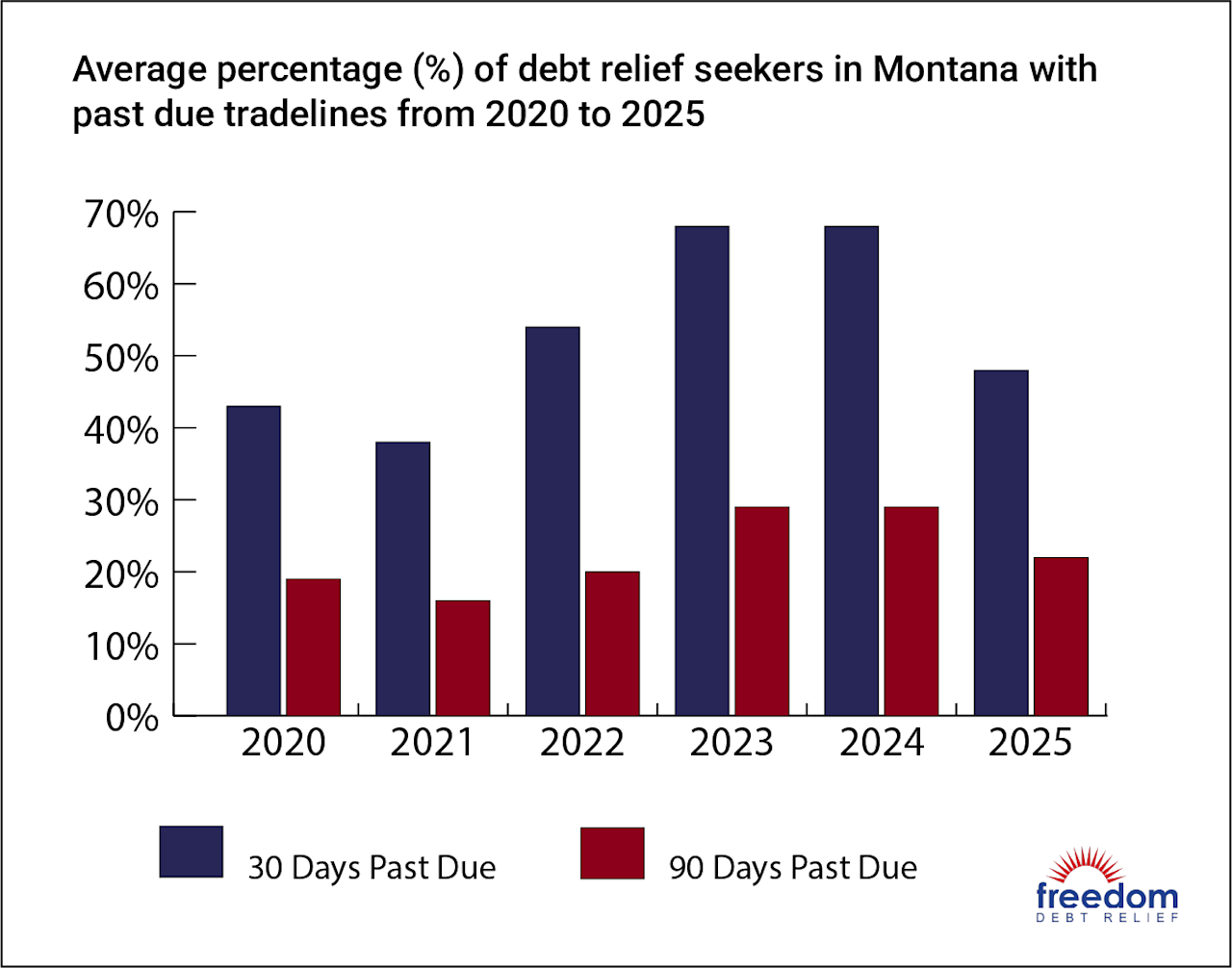
With debt balances increasing so much, it's not surprising that 70% of Montana residents seeking debt relief have debt that’s 30 days past due. The monthly minimum debt payment among Montana debt relief seekers ($1,739 in 2024) is also considerably higher than the monthly minimum of $1,468 among the same group in 2020.
Montana credit card debt
Credit card debt can often be a burden, because most cards have very high interest rates and low minimum payments. This combination can leave people trapped in debt for long periods, and in need of credit card debt relief.
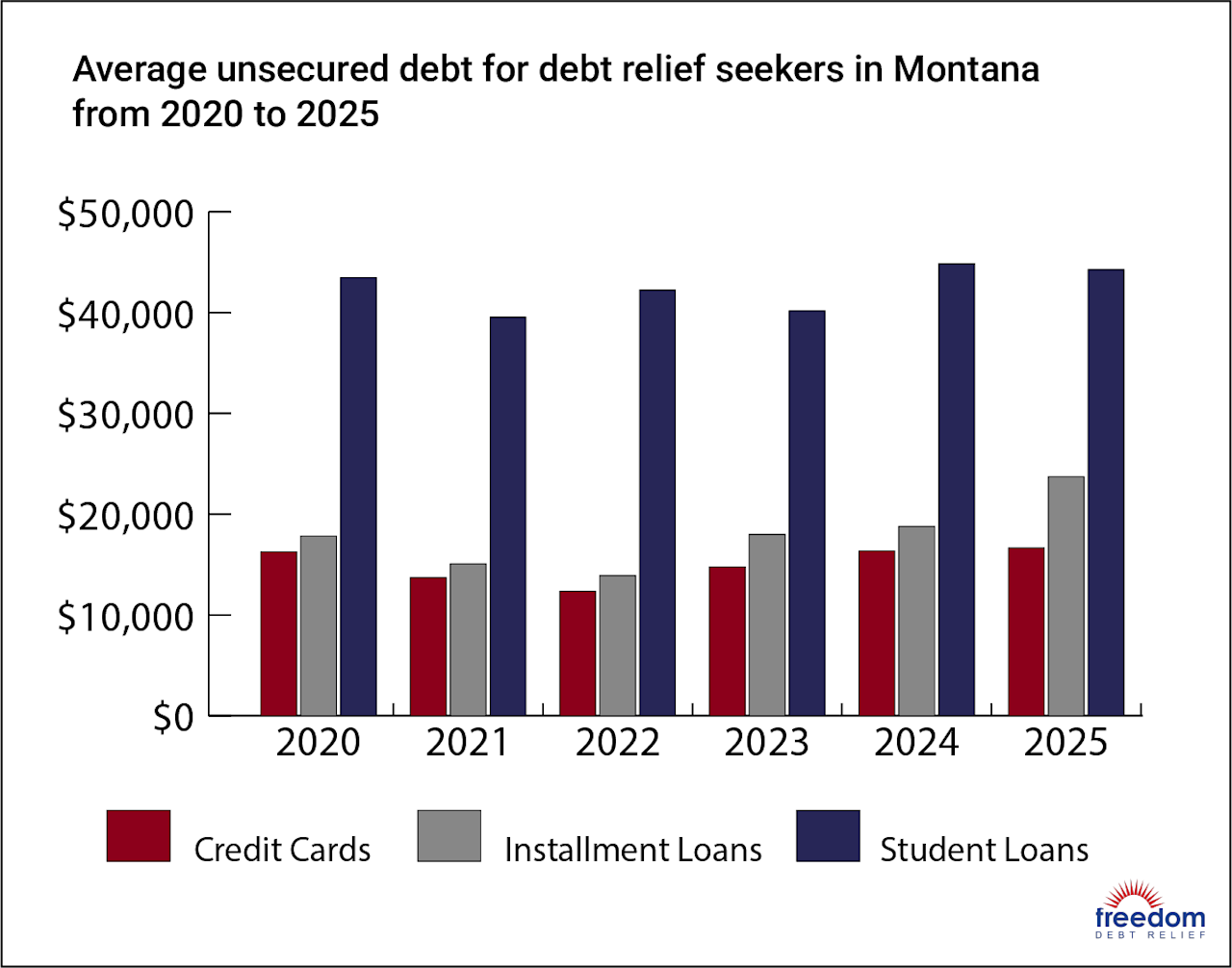
Unfortunately, Montana debt relief seekers have seen credit card balances increase dramatically after dropping to just $13,702 in 2021 and $12,369 in 2022, down from $16,262 in 2020. Pandemic stimulus relief may have helped people pay off their debts, but average balance among debt relief seekers climbed again to $16,347 in 2024, with inflation likely erasing the progress that many made.
Average credit card balances among Montana relief seekers are close to the national average of $16,244, although Montanans have fewer cards open, with just 6.9 compared to the national average among debt relief seekers of 7.4. Their state average credit card monthly payment is a bit higher than the national average among relief seekers, though, coming in at $502 compared to $489.
Montanans also have more past-due debt, with debt relief seekers reporting $6,170 past due compared to $5,793 nationwide.
Montana auto loan debt
Car loans tend to have lower interest rates than credit cards because they are secured debt (something of value serves as collateral for the loan), but as car prices have climbed nationwide, auto loans have become more of a burden.
Montana residents seeking debt relief now have an average of 1.5 auto loans, and average auto loan balances of $26,685 in 2024, up from $24,956 in 2020. Their average monthly payments have also gone from $579 in 2020 to $704 in 2024, with higher auto loan interest rates likely accounting for much of this increase. This is in line with debt relief seekers nationwide, who have an average auto loan balance of $26,997, and payments averaging $749.
Montana mortgage debt
Mortgage debts typically have lower interest rates than other kinds of debt because they are secured by the home you’re buying. Since you are paying toward a home, which is an asset, it's also not automatically considered “bad” to be in mortgage debt. However, the fact remains that mortgage bills are another obligation that can be hard to meet if you're struggling.
In Montana, debt relief seekers have mortgage balances very close to the national average among the same group. Their average balance in Montana was $239,666 in 2024, up from $182,126 in 2020, while relief seekers’ average balance nationwide in 2024 was $239,406.
As mortgage balances have gone up, the average monthly mortgage payment has gone from $1,330 in Montana in 2020 to $1,880 in 2024. This is a substantial increase that can make covering other costs harder as more income goes toward mortgage debt.
Montana installment loan debt
Installment loans, such as personal loans, are those that come with fixed monthly payments. Interest rates are usually lower than those of credit cards, but higher than on car loans or mortgages.
In 2024, Montana debt relief seekers had an $18,800 balance, while the nationwide average installment loan balance was $12,632. This debt balance has fluctuated in recent years, as it was $17,848 in 2020 before dipping in 2021 and 2022 (likely due to the effects of stimulus payments), then climbing to $18,000 in 2023.
Montana student loan debt
Student loans have long been a burden nationwide, with the average student loan balance among debt relief seekers across the United States totaling $49,932 in 2024, up from $42,151 in 2022. Montana debt relief seekers owe slightly less, with loan balances averaging $44,864 in 2024. Their monthly payments are also lower, averaging $248 compared to $313 nationwide. Montana debt relief seekers have a higher number of student loans than the nationwide average—5.1 versus 5.0, but the lower balances mean payments aren't as high.
Montana Debt Delinquencies and Collections
Many Montana residents have fallen behind on their debts, with 70% of debt relief seekers reporting accounts 30 days past due, and 30% reporting accounts 90 days past due in 2024. The number of accounts 30 days past due is below the nationwide average of 80% among relief seekers in 2024, but is on par with the 30% nationwide average for accounts 90 days past due.
Among debt relief seekers with past-due balances, the average amount in collections is $3,920 in 2024, considerably below the 2020 average of $8,297. Debt relief seekers now have 2.2 accounts in collections, compared to 4.8 in 2020, a significant change.
Montana Statute of Limitations
Debt collectors can sue to collect from you at any point, but are only likely to succeed for a limited time. After that point, your debt is considered “time-barred,” and suits can be thrown out on that basis. The table below shows the statute of limitations in Montana for debt.
| Type of Debt | Statute of Limitations |
|---|---|
| Debt based on written agreements, including mortgages | 8 years |
| Debt based on oral agreements and credit card debt | 5 years |
| Debt due on open accounts | 8 years |
| Judgments against you | 10 years |
Note that if you make any payments after the statute of limitations runs out, that restarts the clock. So be careful about interacting with creditors or collectors when the statute of limitations has expired or will soon.
What are the Montana debt collection laws?
The Montana Legal Services Association explains that the Fair Debt Collection Practices Act provides protection from unfair actions by debt collectors in the state. This is a federal law that applies in Montana and across the United States.
Under the law, collectors cannot:
Threaten to hurt you or damage your property
Call you very early or very late
Call you at work if your employer doesn't allow collection calls
Tell others about your debt (other than a credit bureau)
Pretend they are lawyers, or that they are taking legal action if they aren't
If you tell them to stop contacting you, they have to stop. If you request proof of the debt, they must provide it or stop trying to collect it. You can request a debt verification letter within 30 days of the time they contact you, which forces them to prove that you owe the debt.
Reviews and Testimonials from Montana
I was struggling to pay my personal loans I took out year prior to try to get ahead, but covid hit and next thing you know I felt so overwhelmed with money issues. I was Blessed one day I Googled debt relief companies, and researched and found FDR. I promise within a few days I was signing off on a new life! I did cry, it was such a huge relief, a burden I did to myslef, that i just couldn't defend. Just a year or 2 in and I can honestly say, I got my life back, family is much more stable and I can provide a better life style for all of us, which is a basic American middle class man. God Bless FDR each and every employee for how they help us get our lives back. Its okay we need help sometimes! Ask FDR they will! Thank You
Brandon R, US
I appreciate the help that you all doing for me with my accounts
customer, US
Khris was amazing in helping me to understand the process and finding the best solution that worked for my situation. Freedom was able to save me hundreds of dollars per month! Looking very forward to becoming debt free!
Ashley Hickman Hudak, US
Montana Debt Relief
Debt relief in the form of debt settlement means negotiating with creditors—on your own, or with help from a professional debt relief company—to get them to accept a lower amount as payment in full for a debt. When you work with a professional debt settlement company, you make an affordable deposit every month into a dedicated settlement account (which you own and control). When there’s enough money, expert negotiators try to work out agreements with your creditors. Once an agreement has been reached and you approve it, the creditor is paid from your dedicated account. A debt settlement program can be completed in as little as 24 to 48 months.
Montana residents seeking debt relief help owed an average of $28,955 in 2024.
Debt settlement is often a good option if you can’t keep up with payments and can’t afford to fully repay your debts. Contact Freedom Debt Relief to learn how we can help.
Is Debt Consolidation the Best Debt Solution?
Settlement isn’t your only debt relief option. Debt consolidation simply involves getting a new loan (usually with better terms and/or lower interest) to repay all of your existing debts. You need good enough credit to qualify for the new loan, and must be able to make the payments consistently.
DIY debt relief can be great if you mostly need organization. Two popular methods are the debt snowball and debt avalanche. Both involve prioritizing your debts, concentrating your efforts on one at a time while paying the minimums on all. With the snowball, you work on the smallest debt first. With the avalanche, it’s the highest-interest debt first.
Other options can provide more relief. For example, you could consider credit counseling and work with a counselor to create a debt management plan to make one monthly payment that's distributed to creditors based on what they agree to. The plan may involve lowering your rate or waiving fees.
Other choices include debt settlement or bankruptcy (Chapter 7 or Chapter 13). Debt settlement involves settling debt for less than the full amount due. Chapter 7 bankruptcy involves liquidating assets to pay debt and having some debt forgiven. It’s income-limited, and many people don't qualify. Chapter 13 requires you to enter into a three- to five-year payoff plan.
Consider how much debt you have and your income to see which option is best for you. Debt relief companies such as Freedom Debt Relief can also help you figure out what might work best.
Montanans can free up cash each month with Freedom Debt Relief
Ozzy S., Freedom client²
“Right away, I had more money each month because of program costs so much less than what I was paying on my minimums.”
Excellent •
How long before debt becomes uncollectible in Montana?
Debt becomes uncollectible in Montana when the statute of limitations has expired. The specific timeline depends on the type of debt. It is usually between five years (for credit cards) and 10 years for judgments against you. You might still get sued after that, but lawsuits are usually thrown out on the basis that the debt is “time-barred” and therefore uncollectible.
What are some things debt collectors are not allowed to do in Montana?
Debt collectors can't threaten you or use abusive language. They can't call you at work if your employer prohibits it, or call you early in the morning or late at night. The Fair Debt Collection Practices Act prohibits many types of harassment on the part of debt collectors, and if you think you’re being treated inappropriately, make sure you understand your rights.
How can you get rid of credit card debt in Montana?
You can get rid of credit card debt by paying what you owe in various ways, or you can explore debt relief options if you can't pay the debt on your own. These options might include debt settlement (which allows you to pay less than you owe and have the remaining balance forgiven) or a consolidation loan. Freedom Debt Relief can help you negotiate a reasonable settlement if your debt is too much to pay.
End Your Debt
Find out how our program could help.
- One low monthly program deposit

- Settlements for less than owed
- Debt could be resolved in 24-48 months