


Buy Now, Panic Later: The Debt People Don't Realize They're Carrying

ByRebecca Lake
UpdatedSep 17, 2026
- 40% of survey respondents had an active BNPL plan.
- Nearly a third of survey respondents opened a new BNPL plan or financing offer while still repaying an older one.
- 17% of survey respondents used BNPL for essentials like groceries, household bills, and gas.
- 45% of survey respondents regretted a free trial that rolled into a paid plan.
- 21% of survey respondents used BNPL to stretch their spending until the next paycheck.
- Only 20% of survey respondents who used BNPL and convenience financing felt more in control of their money.
Table of Contents
Free up cash each month with Freedom Debt Relief
Ozzy S., Freedom client²
“Right away, I had more money each month because of program costs so much less than what I was paying on my minimums.”


Buy now, pay later promises a simple trade: split a purchase into a few painless payments and move on. But those small plans have a way of quietly stacking into something bigger.
Freedom Debt Relief surveyed 1,010 U.S. adults about the newer forms of debt they carry, from buy now, pay later (BNPL) and store financing to subscriptions and free trials that turn into paid plans. The results showed how everyday convenience could build a second layer of debt that many people lose track of.
How Buy Now, Pay Later Becomes a Second Layer of Debt
Buy now, pay later has become a regular fixture in many household budgets.
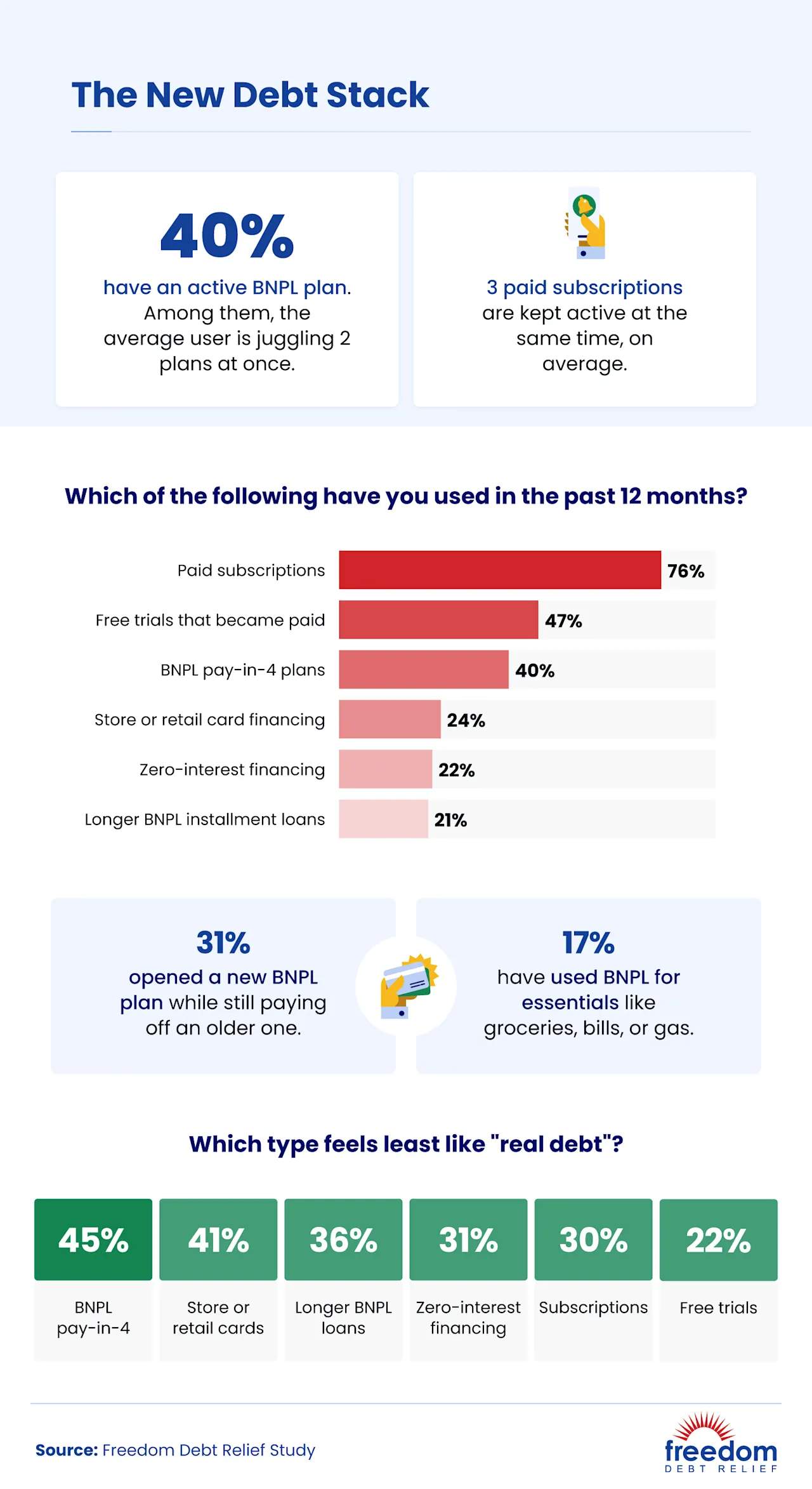
Two in five survey respondents (40%) carried an active BNPL plan, and the typical borrower managed two at once on top of three paid subscriptions. Millennials ranked highest, with 43% holding at least one open plan, followed closely by 40% of Gen Z and 39% of Gen X, while only 28% of baby boomers said the same. Credit card owners were far more likely to use BNPL than people without a card, at 42% versus 23%.
The plans also tend to pile up. Nearly a third of survey respondents (31%) opened a new BNPL plan or financing offer while still repaying an older one. That overlap was most common among millennials (35%) and Gen Z (31%), compared with 26% of Gen X and 22% of baby boomers.
For some households, BNPL has moved from extras to necessities, as 17% of survey respondents turned to BNPL for essentials like groceries, household bills, or gas. Younger generations leaned on it most, with 21% of Gen Z and 20% of millennials using BNPL this way, roughly double the rate of Gen X (12%) and baby boomers (9%).
When Small Payments Start to Overlap
For many, the strain shows up once several payments land in the same month.
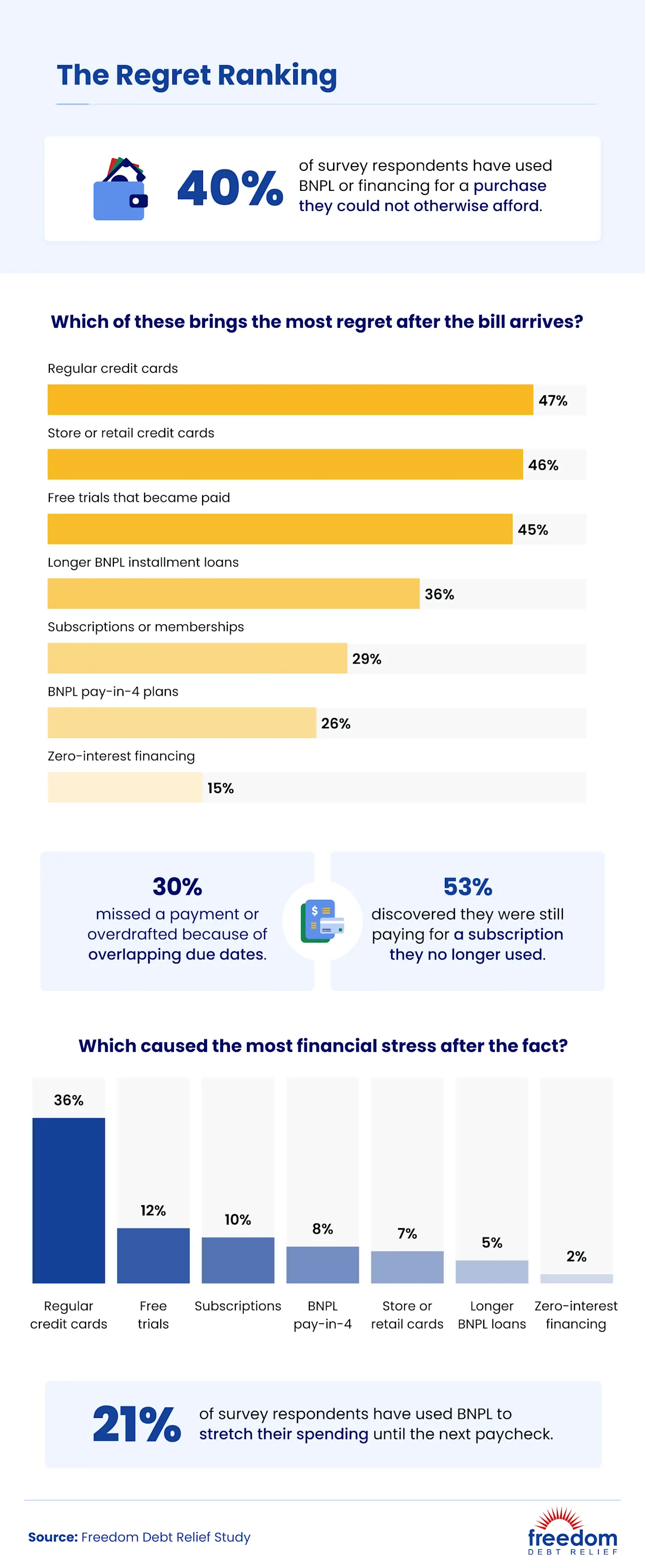
Among those who'd used them, 45% regretted a free trial that rolled into a paid plan, almost matching the 47% who felt the same about regular credit cards. Among Gen Z, 44% used BNPL or financing for a purchase they could not otherwise afford.
Subscriptions were easy to forget, with 62% of Gen Z and 56% of millennials still paying for one they no longer used, compared with 46% of Gen X and 41% of baby boomers.
Some have also started using these plans to bridge the gap between paychecks. More than one-fifth of survey respondents (21%) used BNPL to stretch their spending until payday, a habit concentrated among Gen Z (28%) and millennials (23%) and far less common among Gen X (16%) and baby boomers (10%).
How Many Lose Track of What They Owe
Convenience financing often blurs the total, leaving many people unsure of how much they actually owe.
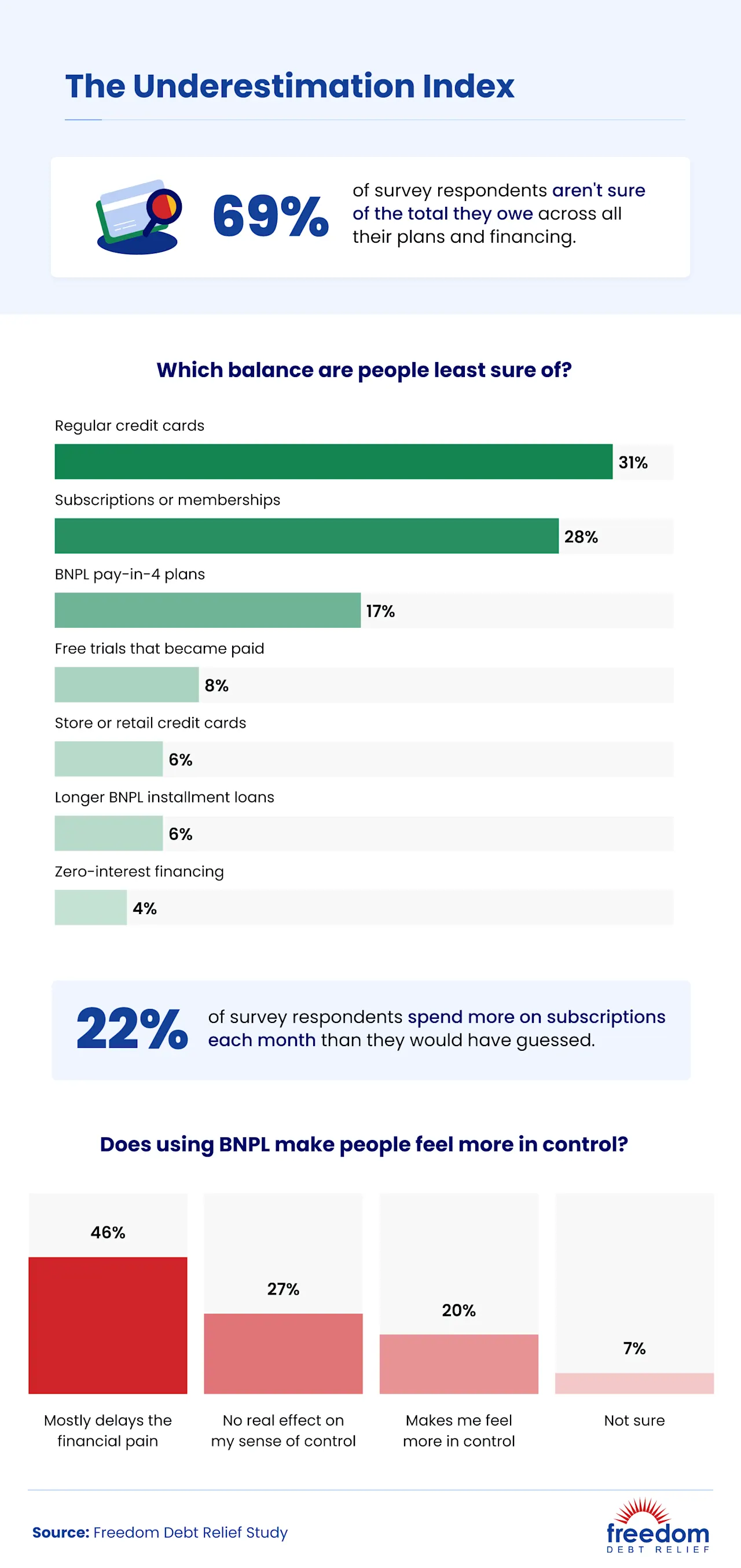
Only 20% of survey respondents who used BNPL and convenience financing felt more in control of their money. The gap between convenience and clarity was widest for younger adults. Uncertainty was highest among Gen Z, where 77% were unsure of the total they owed across their plans, compared with 72% of millennials, 62% of Gen X, and 53% of baby boomers.
What the Numbers Say About Everyday Debt
Buy now, pay later and other forms of convenience financing might make spending feel lighter in the moment, even as the payments add up in the background. The data showed how easily a few small plans could turn into a second layer of debt that you could struggle to track.
If you use tools like Buy Now, Pay Later plans, write down every open plan, its due date, and its balance before opening another. A clear picture of what you owe is the first step toward managing that debt.
Methodology
We surveyed 1,010 U.S. adults age 18 and older about the newer forms of debt and recurring payments they carry, including buy now, pay later (BNPL) pay-in-four plans, longer BNPL installment loans, store and retail card financing, zero-interest financing, paid subscriptions, and free trials that convert to paid plans, benchmarked against regular credit cards.
Respondents were distributed across genders and generations. The gender breakdown was women (55%) and men (43%), with the remainder non-binary or preferring not to answer. The generational breakdown was millennials (47%), Gen X (23%), Gen Z (20%), and baby boomers (10%). The survey also captured household income and credit card ownership, with 90% of respondents owning at least one credit card.
We conducted the survey in July 2026. All percentages are rounded to the nearest whole number, so some totals may not add up to exactly 100%.
About Freedom Debt Relief
Freedom Debt Relief is a debt relief company that works with people weighed down by unsecured debt, such as credit card balances, by negotiating with creditors to resolve what is owed for less than the full amount. Freedom Debt Relief is not a nonprofit and its services are not available in all states. To find out if debt relief is right for you, talk to a licensed debt consultant for a free debt assessment. Debt settlement may negatively impact your credit. Freedom Debt Relief is not a Credit Repair Organization and does not provide or offer services or advice to repair, modify, or improve your credit.
Fair use statement
Feel free to share these findings for noncommercial purposes. We only ask that you link back to this page so readers can reach the full report and that Freedom Debt Relief receives proper credit.
Author Information

Written by
Rebecca Lake
Rebecca Lake has over a decade of experience as a money expert, researching and writing hundreds of articles on retirement, investing, budgeting, banking, loans, saving money, and more. She has been published in over 20 online finance publications, including SoFi, Forbes, Chime, CreditCards.com, Investopedia, SmartAsset, Nerdwallet, Credit Sesame, LendingTree, and more.