


The Debt Journey Map: How American Debt Starts, Grows, and Ends

ByRebecca Lake
UpdatedSep 17, 2026
- Everyday credit card swipes on groceries, gas, and dining started more American debt than anything else.
- 60% of buy now, pay later (BNPL) users said installment purchases didn't feel like real debt.
- 43% of BNPL users were unaware that their installments could appear on their credit reports.
- The average person let the balance reach $4,980 before feeling they had to pay it back.
- Adding up the total was both the most common trigger for tackling debt and the step that the debt-free credited most.
Table of Contents
Free up cash each month with Freedom Debt Relief

Ozzy S., Freedom client²
“Right away, I had more money each month because of program costs so much less than what I was paying on my minimums.”


Few people can name the day their debt started. It rarely begins with a splurge. More often, it’s groceries, gas, and dinner going on a card that doesn’t get paid off. To trace the full arc, Freedom Debt Relief surveyed 1,013 Americans who carry debt now or have in the past.
Respondents told us where their debt began, what they told themselves as it grew, and which strategies, from DIY budgeting to a structured debt payoff program, helped them get out. Their answers challenge a few assumptions about how debt works, starting with how small the first step toward it usually is.
It usually begins with an ordinary swipe
We asked respondents to pinpoint the purchase or bill that started their debt. Most named something ordinary.
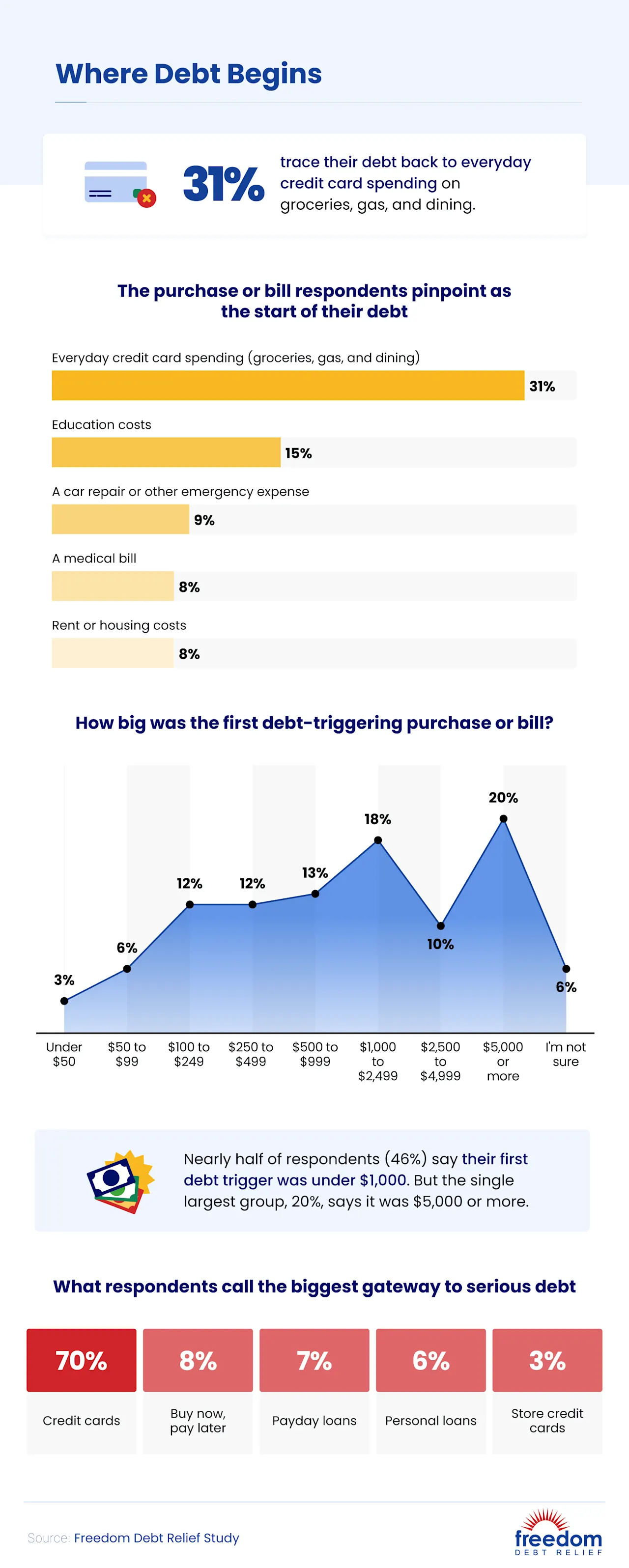
Everyday credit card spending on groceries, gas, and dining started more debt than anything else, cited by 31% of survey respondents in debt. That was more than double the next most common answer, education costs (15%), and it held steady across every generation. Emergencies played a smaller role, with car repairs (9%), medical bills (8%), and rent or housing (8%) all trailing well behind.
The purchase or bill that started the debt was usually small. Nearly half of respondents (46%) said it was under $1,000, and 9% put it under $100. Still, 20% said their first debt-triggering purchase or bill was $5,000 or more.
When we asked which product is the biggest gateway to serious debt, 70% said credit cards. That share fell with each younger generation, from 81% of baby boomers to 62% of Gen Z. Younger respondents were more likely to name newer products instead.
Among Gen Z, 14% named BNPL the biggest gateway, nearly five times the 3% of baby boomers who said the same. Another 12% of Gen Z named personal loans. Together, 26% of Gen Z picked one of these two newer products, compared to 8% of baby boomers. Gen Z was the only generation flagging BNPL this heavily, but 65% of respondents who have dealt with debt had used it.
We also asked about the small, recurring charges that piled up on credit cards. Groceries led at 21%, followed by food delivery at 19%. Social media shopping barely registered: only 1% named TikTok, Instagram, or Facebook Shop purchases, despite how visible that spending is.
BNPL was the biggest gateway to debt in Gen Z's opinion, and the 65% usage rate spanned every generation, which is why the habit earned its own examination.
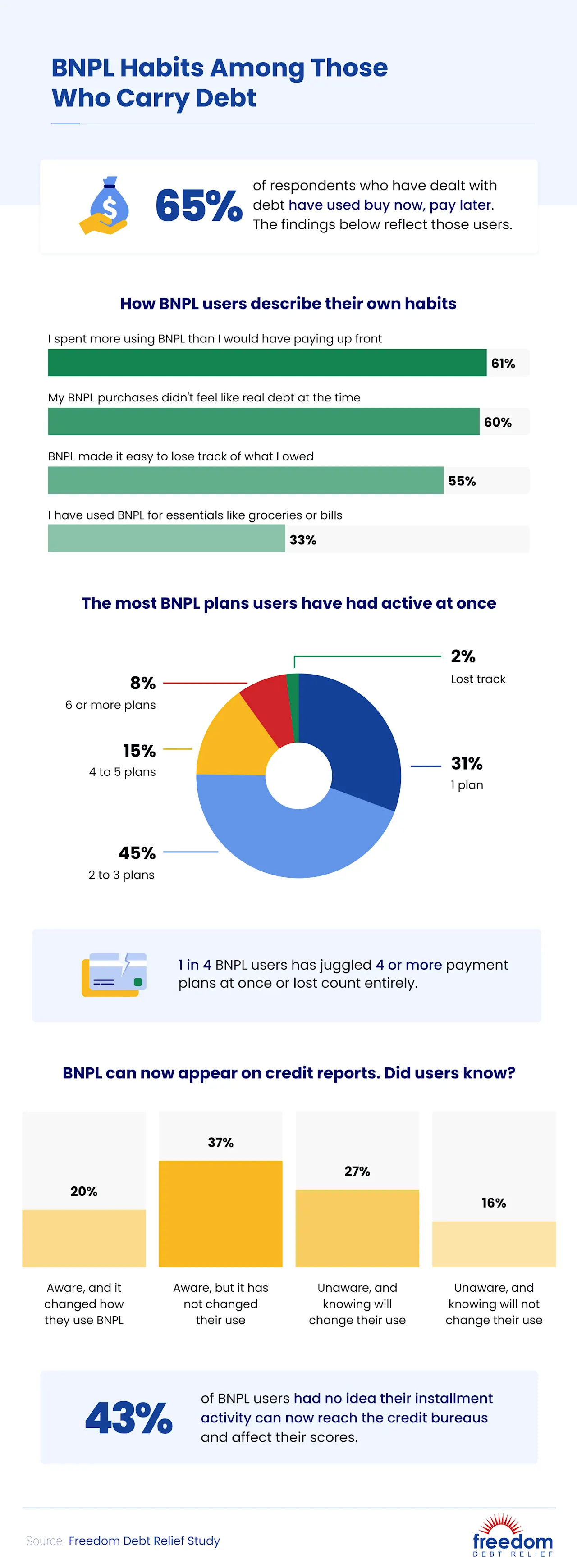
Three in five BNPL users (60%) said their installment purchases didn't feel like real debt at the time, and 61% said they spent more than they would have paying up front. More than half (55%) said the format made it easy to lose track of what they owed.
A quarter (25%) had four or more plans active at once or lost track entirely, with millennial users the heaviest stackers at 28%. One-third had put essentials like groceries or bills on installment plans, a share that climbed to 40% among Gen Z users and 38% among households earning under $35K.
The stakes are rising. In June 2025, FICO launched two scoring models that factor in BNPL data, and at least one provider has started reporting BNPL loans to the bureaus. Most major providers still don't report routine activity in the U.S., though any BNPL account that goes to collections can land on a credit report. Even so, 43% of users had no idea their BNPL activity could now reach their credit reports, a gap widest among baby boomer users (57%). Among users who did know, 47% said it had changed or would change how they use BNPL. BNPL accounts have always had the potential to show up on credit reports when delinquent or in default.
The fog of "this is temporary"
Between the first purchase and the moment it sank in, there was usually a long stretch of self-talk. Respondents remembered theirs clearly.
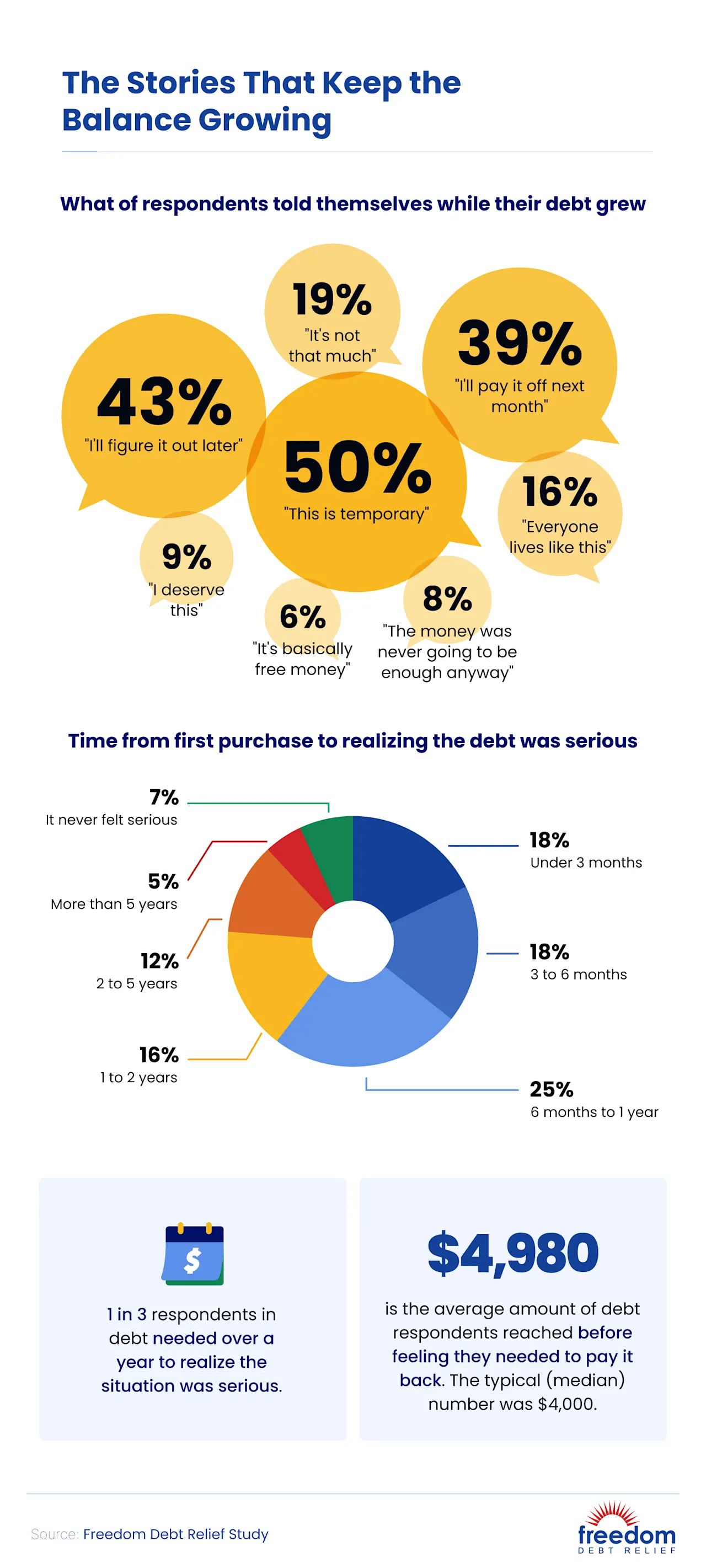
Half of respondents in debt told themselves "this is temporary" while the balance grew, followed by "I'll figure it out later" (43%) and "I'll pay it off next month" (39%). These deferral thoughts skewed young: 51% of Gen Z said "I'll figure it out later," compared to 27% of baby boomers.
One-third needed over a year to realize their debt was serious, and 7% said it never felt serious. On average, respondents let the balance reach $4,980 before feeling they needed to pay it back (median $4,000). That number grew with age, from $4,065 for Gen Z to $8,480 for baby boomers. Men reached $5,476 on average versus $4,638 for women.
Avoidance appeared in daily habits, too.
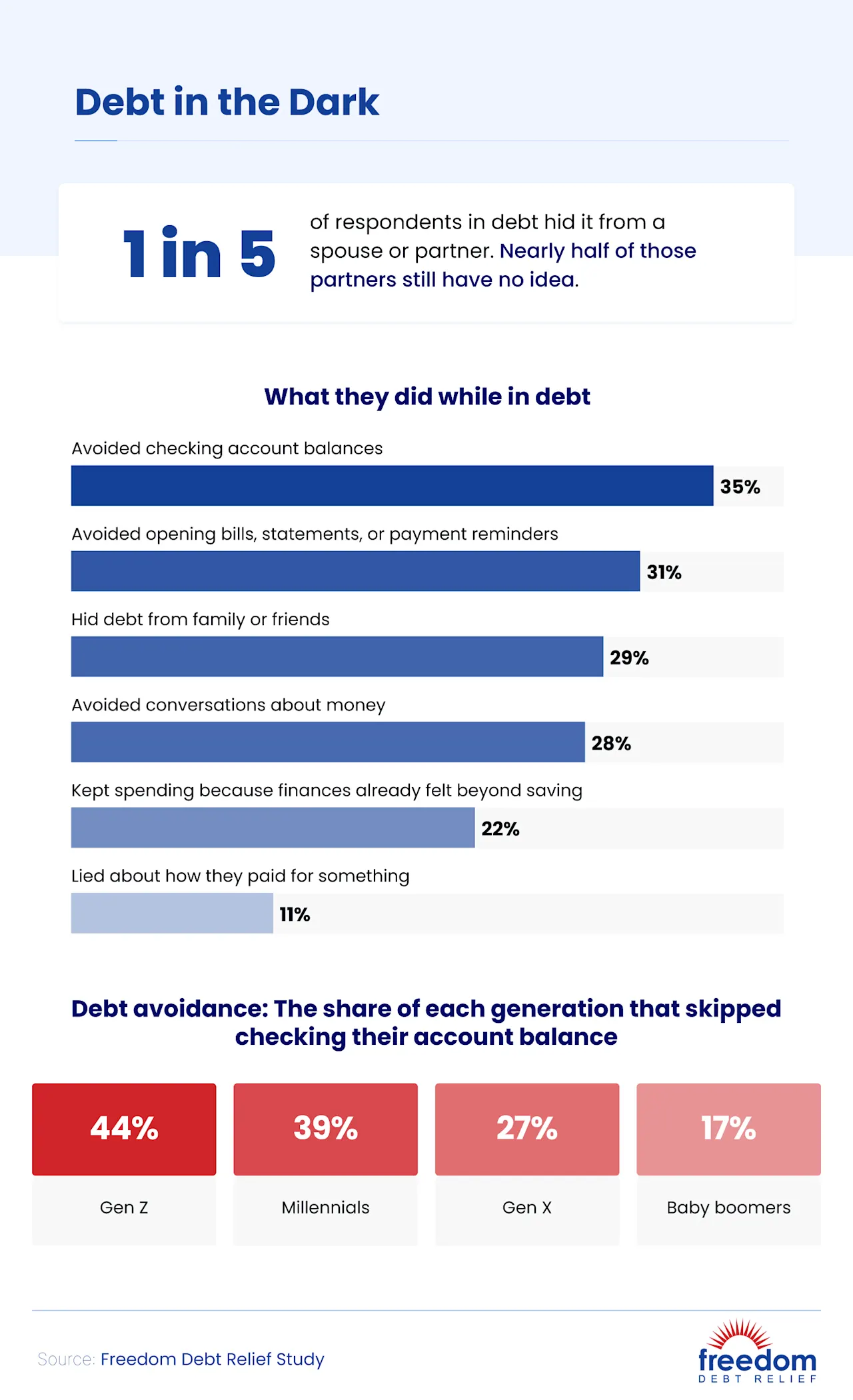
While in debt, 35% of respondents avoided checking their account balances, and 31% avoided opening bills or statements. Gen Z was the most likely to ignore their debt, at 44%, versus 17% of baby boomers. Nearly three in 10 (29%) hid debt from family or friends, and 22% kept spending because their finances already felt beyond saving.
The secrecy reached home, as 19% hid debt from a spouse or partner, and 9% said the partner still didn't know at the time of the survey. Among respondents currently with a partner, hiding was more common among couples not living together (32%) than among married respondents (25%).
Simple math sparks the turnaround
Turning points were simple and practical.
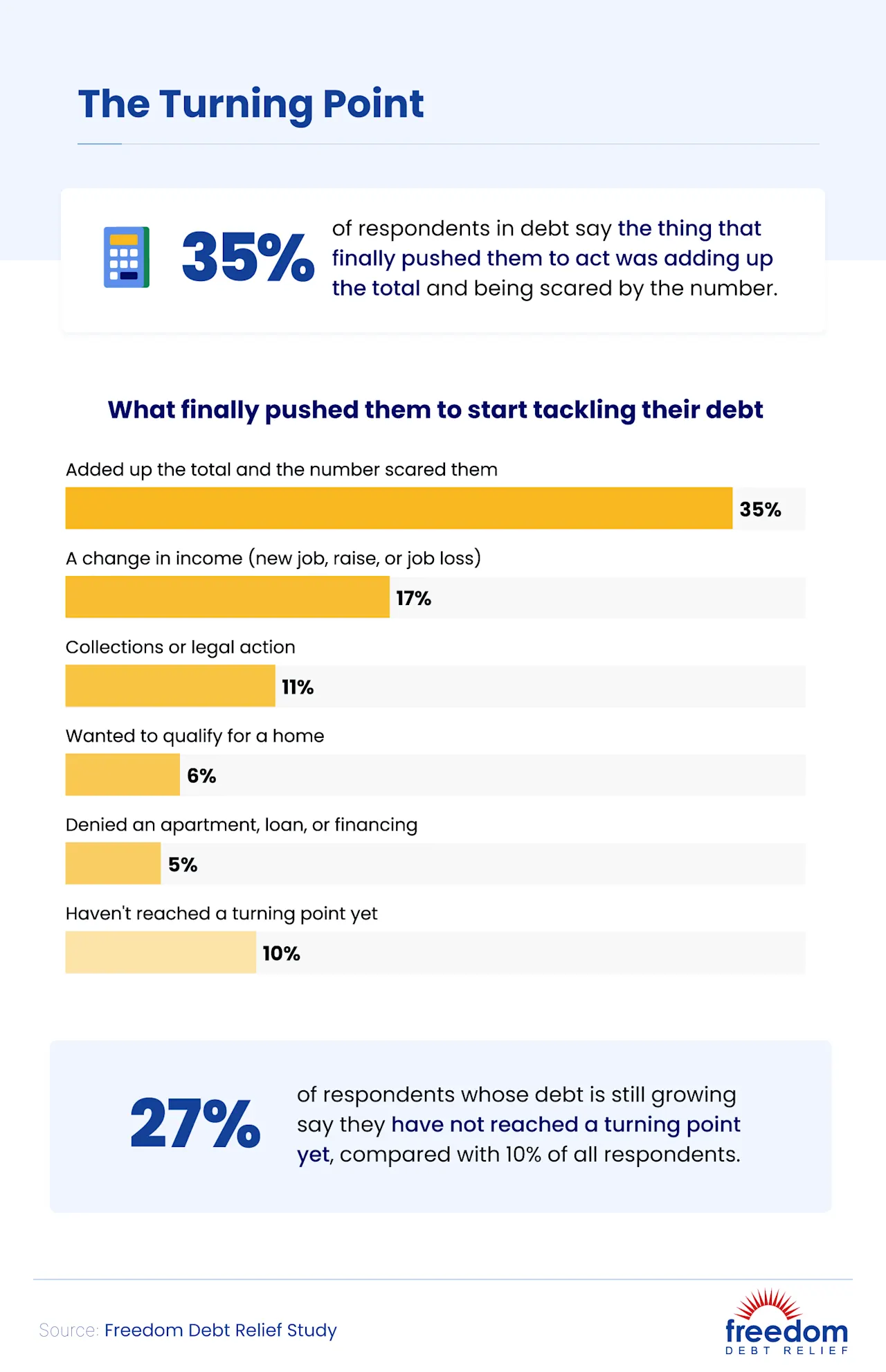
The most common push to start tackling debt was math. Just over a third (35%) added up the total and the number scared them. This was much more common than those who said a change in income (17%) and collections or legal action (11%).
The math trigger was strongest among Gen Z at 41%, versus 29% among baby boomers. Meanwhile, 10% of respondents hadn't reached a turning point yet, a share that climbed to 27% among those whose debt was still growing.
What worked after the turning point was similarly straightforward.
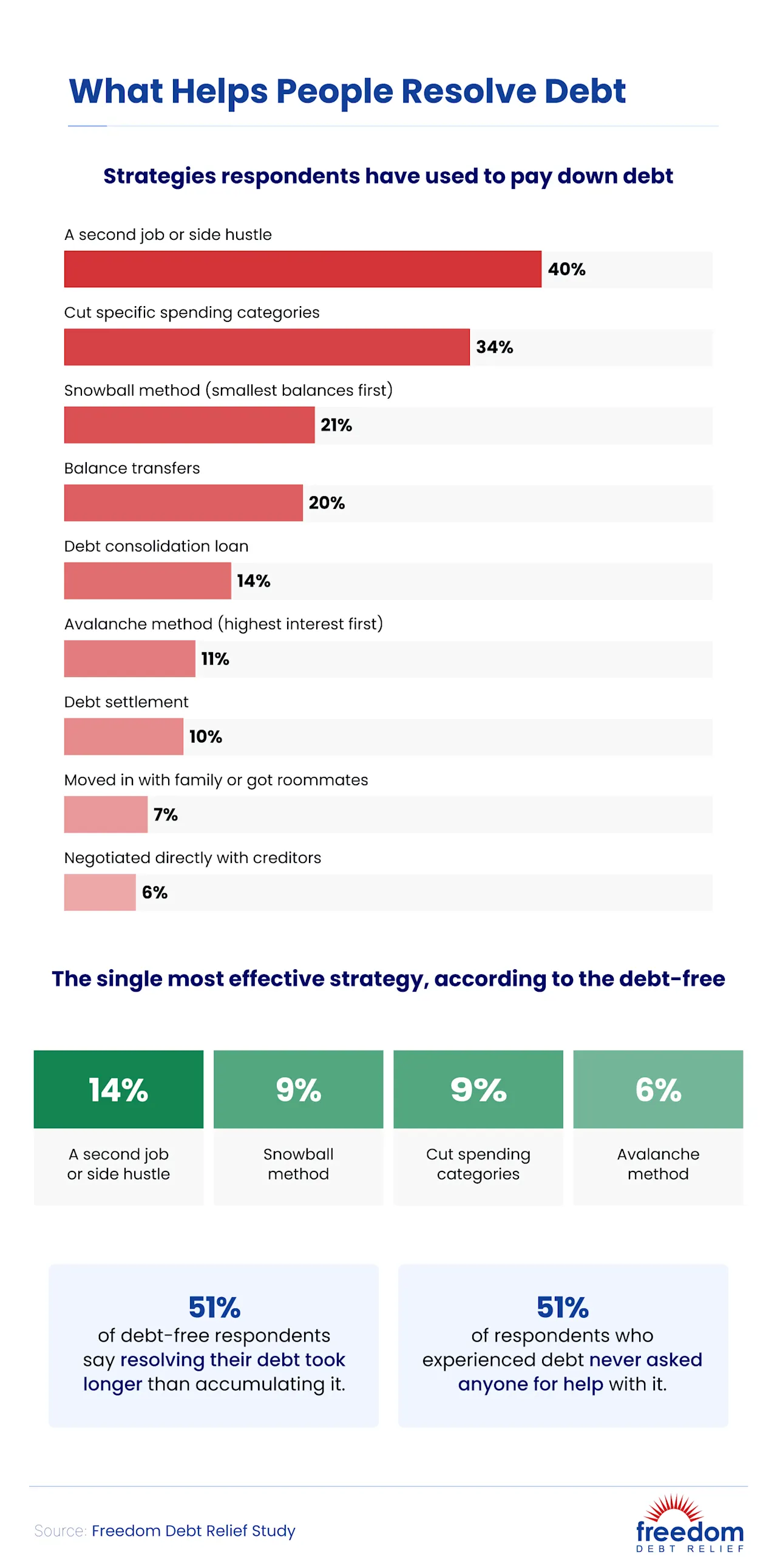
The actual methods were split between earning more and paying less. Four in 10 took a second job or side hustle, and 34% cut specific spending categories. Structured payoff tools came next:
21% used the snowball method.
20% tried a balance transfer.
14% took a debt consolidation loan.
11% used the avalanche method.
Getting a second job or pursuing a side hustle (14%) appeared to be the most successful strategy. Consolidation loans and balance transfers each drew 3% of those votes, but that ranking says more about reach than results. Only 14% of respondents used consolidation loans, and 20% used balance transfers, compared to the 49% who budgeted.
One in five respondents was debt-free at the time of the survey, and 51% of those who were said resolving debt took longer than getting into debt, including 22% who said it took more than twice as long. Just over half of survey respondents who experienced debt (51%) never asked anyone for help with it, and the silence deepened with age, from 42% of Gen Z up to 65% of baby boomers.
Adding it up beats everything else
The pattern across 1,013 stories was consistent. Debt began with ordinary spending, grew behind comfortable self-talk, and shrank once people finally added everything up. If you've been avoiding your own number, the most effective first step in our data costs nothing: write down the full total, then build a budget around it. If you're not sure what comes after that, a nonprofit credit counselor will review your budget with you at no charge and walk through the options.
Methodology
For this study, we surveyed 1,013 Americans who currently have debt or have had debt in the past. Respondents ranged in age from 18 to 81, with an average age of 41. Among them, 18% were Gen Z, 49% were millennials, 25% were Gen X, and 8% were baby boomers. Regarding gender, 57% identified as women, 41% identified as men, and 2% identified as non-binary or another gender. At the time of the survey, 20% of respondents were debt-free after carrying debt in the past, 53% were actively paying down their debt, 17% said their debt was holding steady, and 10% said their debt was still growing.
About Freedom Debt Relief
Freedom Debt Relief helps people resolve unsecured debt through negotiated settlement programs built around their budgets and goals. If your debt has stopped feeling temporary, learn how debt relief works and consider whether a program fits your situation.
Fair use statement
The findings and graphics in this study are available for noncommercial reuse. Please credit the research and link back to Freedom Debt Relief when sharing.
Freedom Debt Relief is not a Credit Repair Organization and does not provide or offer services or advice to repair, modify, or improve your credit. Debt settlement may negatively impact your credit.
Author Information

Written by
Rebecca Lake
Rebecca Lake has over a decade of experience as a money expert, researching and writing hundreds of articles on retirement, investing, budgeting, banking, loans, saving money, and more. She has been published in over 20 online finance publications, including SoFi, Forbes, Chime, CreditCards.com, Investopedia, SmartAsset, Nerdwallet, Credit Sesame, LendingTree, and more.