Kansas Debt Relief: What’s Changed in the Past Five Years?
Residents of the Sunflower State enjoy beautiful sunsets, waving fields of wheat, and a cost of living 13.5% lower than the national average. The average debt balance among Kansans is noticeably lower than the national average, too. An average Kansas resident owed about $45,300 in 2024—that’s almost 27% less than the national average debt balance of $61,700 (both figures come from the Federal Reserve Bank of New York).
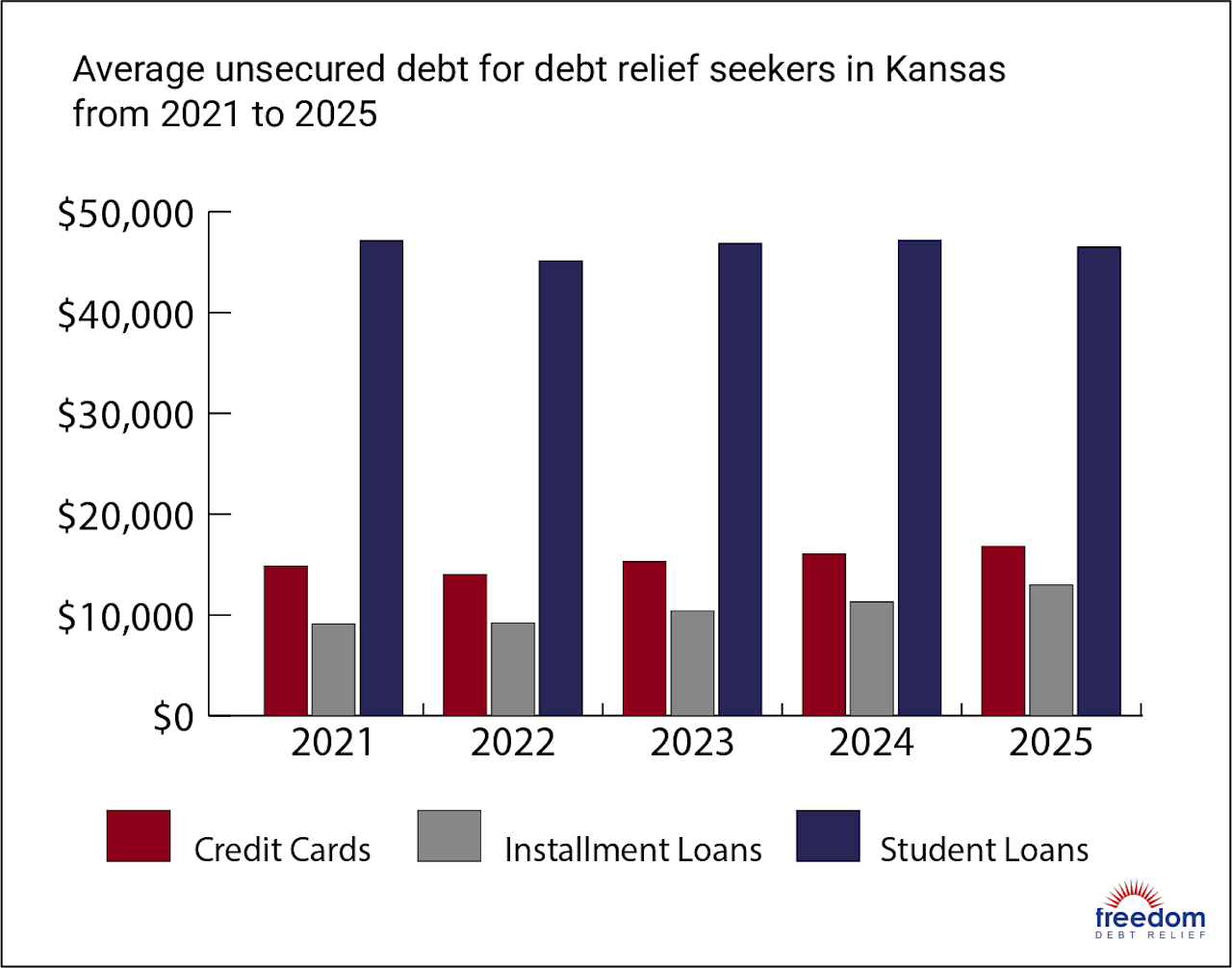
Freedom Debt Relief has collected data on debt relief seekers in Kansas, as well as across the country. Kansan debt relief seekers owed an average of $271,908 across both secured and unsecured debts in 2024. That year, the average unsecured debt balance (which included credit cards, medical bills, and personal loans) was $74,561, and that number has been on the rise.
The average debt-to-income ratio has also trended upward. In 2024, that figure sat at 34.7% among Kansas debt relief seekers, and in 2025 so far, looks like it’s continuing upward. A high DTI makes it difficult to fulfill your monthly debt obligations, cover your other bills, and save for the future. So despite that lower cost of living and lower average debt, some Kansans are likely having trouble paying down their balances. If you’re among them, a debt relief program is one potential option to find some breathing room. Let’s explore recent debt trends among Kansans and learn more about how they can tackle their debt.
Kansans can free up cash each month with Freedom Debt Relief
Ozzy S., Freedom client²
“Right away, I had more money each month because of program costs so much less than what I was paying on my minimums.”

Excellent •
5-Year Debt Trends in Kansas
Per Freedom Debt Relief’s data, Kansans who reached out for debt help owed almost 27% less combined (secured and unsecured) debt in 2024 than debt relief seekers across the U.S., at $271,908 vs. $344,454. However, when we look at Kansan debt figures from 2021 to the first half of 2025, we see the amount overall has increased—unsecured debt has risen by more than 7%, from $71,136 to $76,318.
Among Kansans who contacted Freedom Debt Relief earlier this year, those in the age range of 51 to 65 had the most unsecured debt, at $86,760. And those with FICO Scores in the “good” range (670-739) owed the most in 2025, with an average balance of $91,649.
If you’re struggling with debt and missing payments, you could end up with accounts in collections. Though Kansas debt relief seekers are struggling with accounts in collections, the average number of collections accounts has fallen since 2021, going from 6.4 accounts in collections to 2.2 between then and 2025. This is in line with figures for debt relief seekers across the country, who’ve seen their average number of collections accounts decline from 3.8 to 1.9.
Kansas credit card debt
Credit card debt is some of the worst for your finances, because the interest rates are high, averaging more than 20%, and the payments are designed to stretch out the debt for a long time. You may want to learn more about credit card debt relief programs if you’re in over your head with credit cards.
Among Kansans looking for help with debt, credit card balances have risen by 13% from 2021 to the first half of 2025, going from $14,874 to $16,813. Among debt relief seekers across the country, that figure trended upward too, going from $12,648 to $16,244 during the same period. The average number of credit accounts they had stood at 7.9 in 2021, and fell slightly to 7.4 as of June 2025.
Kansans were paying an average of $500 per month on their credit cards in 2025, and using 72.3% of their available credit. Such a high utilization is damaging to your credit score, and could indicate that you’re struggling to keep your head above water.
Kansas auto loan debt
Kansan debt relief seekers with auto loans are right on par with relief seekers across the country. For the last few years, the average number of auto loans per person has stood at 1.5 (no one owns half a car, but you can think of this figure as an average of three cars for every two people). The amount Kansan debt relief seekers owe on auto loan balances has fluctuated a little but mostly held steady, going from $26,488 in 2021 to $26,938 during the first half of 2025. Monthly payments have increased noticeably, however—from $636 to $733, perhaps owing to higher interest rates on auto loans.
Kansas mortgage debt
Generally speaking, most Americans own just one home—for debt relief seekers in Kansas, the average number of mortgage accounts per person has held steady at 1.1 (accounting for the small number who own additional homes). Their balances on those mortgages are noticeably smaller than those of debt relief seekers at the national level, however. In 2024, the average mortgage balance for Kansans was $170,703, compared to $241,535 for debt relief seekers overall. This figure was up from $147,310 in 2021.
Mortgage debt is usually secured by the home you’re using it to purchase, and it can’t be addressed through a debt relief program. That said, if you get help with unsecured debt, it can free up more cash in your budget to keep current on your mortgage.
Kansas installment loan debt
Installment loans are those with a set payoff date and regular monthly payments, like a personal loan. Balances among Kansan debt relief seekers have jumped by 43%, going from $9,115 in 2021 to $12,998 as of June 2025. Those figures applied to an average of 2.3 accounts in 2021 and 2.7 in 2025, perhaps indicating that Kansans are turning to installment loans to handle other debt.
How do Kansans stack up to debt relief seekers across the U.S.? The overall average balance in the first half of 2025 was $12,632, with a monthly payment of $484. Meanwhile, Kansan debt relief seekers paid an average $450 per month in that same time period.
Kansas student loan debt
The COVID-19 student loan payment pause has ended, and Kansans are back to paying student loans. From 2021 to June 2025, their average student loan balance dipped slightly from $47,147 to $46,506, on accounts numbering 5.1 in 2021 and 4.8 in June 2025. Meanwhile, for debt relief seekers overall, the average student loan balance rose from $43,622 in 2021 to $49,932 in June 2025, across 4.5 and 5.0 accounts, respectively.
Kansas Debt Delinquencies and Collections
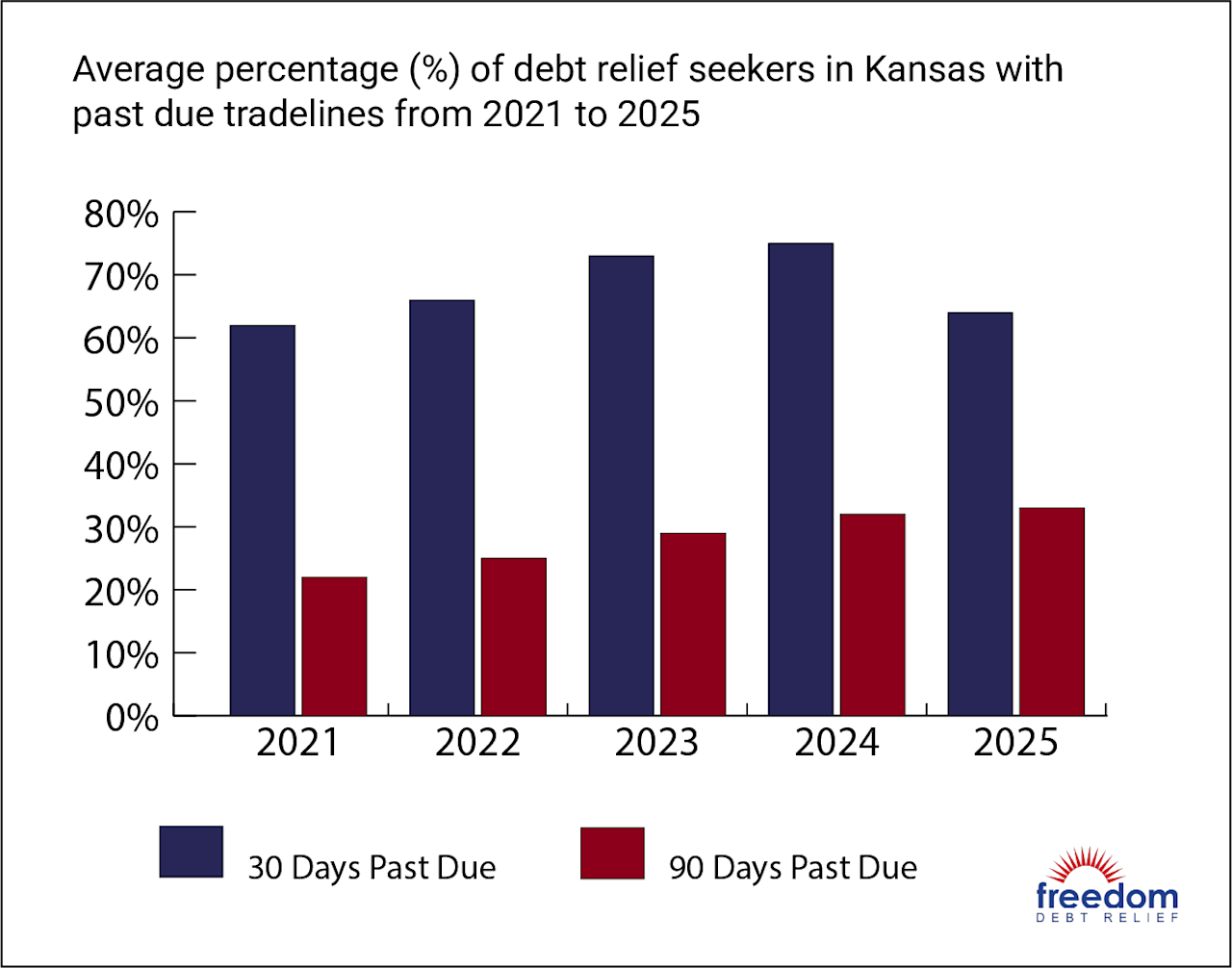
Having delinquent (past-due) debt is a sign of debt stress, and an indication that you’re struggling with your finances. Credit bureau TransUnion collected data on delinquent debt across the U.S. in September 2025, and per their findings, Kansans are doing better with this metric than Americans overall. Here’s a table showing average delinquency rates for auto loans, credit cards, and mortgages:
| Type of debt | 30-plus DPD | 60-plus DPD | 90-plus DPD |
|---|---|---|---|
| Auto loan | 4.34% | 1.65% | N/A |
| Credit card | 4.66% | 3.27% | 2.37% |
| Mortgage | 2.89% | 1.36% | 0.85% |
Here are the figures for Kansas specifically:
| Type of debt | 30-plus DPD | 60-plus DPD | 90-plus DPD |
|---|---|---|---|
| Auto loan | 3.28% | 1.21% | N/A |
| Credit card | 3.92% | 2.70% | 1.94% |
| Mortgage | 2.51% | 1.15% | 0.73% |
Kansans may have lower percentages of past-due debt overall, but some are still struggling with collection accounts. In June 2025, Kansans seeking debt relief help had an average of 2.2 accounts in collections, with an average overall collections balance of $3,667. Interestingly, those figures were higher than among debt relief seekers across the U.S., who had an average of $3,040 in collection balances held among 1.9 accounts.
Kansas Statute of Limitations
If you have debt, you might be comforted to know that debt isn’t considered legally collectible forever. The statute of limitations in your state (often three to 10 years, depending on where you live) determines how long your creditors have to take you to court and sue you to collect what you owe.
This isn’t to say they can’t sue you once the statute of limitations is passed—but if they try after that point, you can respond in court that the debt is now time-barred, and request that the lawsuit be tossed out by the judge.
The statute of limitations for debt in Kansas is as follows:
| Type of debt | Kansas statute of limitations |
|---|---|
| Written agreements, contracts, or promises | 5 years |
| Expressed or implied (not written) contracts, obligations, or liabilities | 3 years |
What are the Kansas debt collection laws?
Kansas residents are under the protection of the national Fair Debt Collection Practices Act (FDCPA), which tells debt collectors what they can and cannot do when pursuing payment for past-due debts. The FDCPA says debt collectors can only contact you between 8 a.m. and 9 p.m. It also says they can’t harass you or your family, or contact you at work if you tell them to stop. It’s important to note that the FDCPA only applies to third-party debt buyers and collectors, not your original creditors.
Kansas Debt Relief
Kansans have several options to cope with debt, including debt relief programs. These are best for people who are struggling to make debt payments and have suffered a financial hardship. The aim is to settle your debt for less than you owe. You can negotiate with creditors yourself, or hire a professional debt relief service to negotiate on your behalf.
Debt relief providers can’t charge you upfront fees for settling your debts. Doing so would violate federal law. A debt settlement professional can only charge you debt settlement fees after they negotiate an agreement with your creditor, you review and approve it, and at least one payment is made under the terms of the approved agreement.
Is Debt Consolidation the Best Debt Solution?
Here are your best options for dealing with debt in Kansas.
Debt settlement
If you’ve suffered a financial hardship and have no way to repay all you owe, a debt settlement program could be worth exploring. In this type of debt relief, you (or a company you hire) negotiate with your creditors to accept less than the full amount you owe and forgive the rest. Creditors might be willing to do this if you’re experiencing financial hardship and you can’t afford to fully repay your debt.
Debt consolidation
Consolidating your debts can help you get a break on interest while you fully repay your balances. A debt consolidation loan is often an unsecured personal loan or, if you own a home, a home equity loan or line of credit. You use this new loan to pay off credit cards, medical bills, and other debts, then pay off your debt consolidation loan. If you qualify for an interest rate lower than what you currently pay, you might save money on the new loan.
Bankruptcy
Bankruptcy is a legal process to get rid of debt. If you qualify for Chapter 7, your unsecured debts could be discharged (wiped out) entirely. The bankruptcy court could take some of your possessions to sell and pay your creditors. You won’t be left with nothing, but you’re not allowed to keep luxury goods, multiple cars, multiple homes, and so on. Each state has a different list of what you’re allowed to keep.
If you earn enough that you can afford monthly payments toward debt, a Chapter 13 bankruptcy might be a better fit. The court gives you a repayment plan lasting three or five years, and you keep your assets.
DIY debt payoff
If you’ve got sufficient income to pay off what you owe but need some help getting organized, creating a debt snowball or debt avalanche could put you on the road to debt freedom.
With both of these DIY debt payoff plans, you keep making minimum payments across all accounts except your lowest-balance debt (for the snowball) or highest-interest debt (for the avalanche). You send extra cash to just those debts. Once they are paid down, you refocus that extra money toward the next-lowest balance or the one with the next-highest interest rate. You rinse and repeat until you are sending all your extra money to your last remaining balance. And then when that reaches $0, you’re out of debt.
Debt management plan (DMP)
Your final option is to work with a credit counseling agency (these agencies are nonprofits funded by credit card companies) to enroll in a debt management plan. This could be a good choice if you can afford to repay what you owe but could use some professional help, accountability, and a set payment plan.
Kansans can free up cash each month with Freedom Debt Relief
Ozzy S., Freedom client²
“Right away, I had more money each month because of program costs so much less than what I was paying on my minimums.”
Excellent •
What are three risks associated with a debt relief program in Kansas?
Three potential risks of using a debt relief program in Kansas (or anywhere in the country) are credit score damage (although if you need debt relief, your credit score may already be lower than you’d want), potential tax consequences for settled debt, and creditors unwilling to negotiate.
Is it true that unpaid debt goes away after seven years?
No. Reports of unpaid debt are removed from your credit record after seven years, but the debt doesn’t actually go away. You always owe it. A creditor, debt collector, or debt buyer can pursue you for the money you owe, or take you to court. After the statute of limitations passes, creditors no longer have the right to come after you for the debt.
Is it worth doing a debt relief program?
It could be. If you’ve suffered a financial hardship and don’t have a way to repay what you owe, it might be worth exploring debt relief programs alongside other options like bankruptcy.
End Your Debt
Find out how our program could help.
- One low monthly program deposit

- Settlements for less than owed
- Debt could be resolved in 24-48 months