

Iowa Debt Relief Trends: A 5-Year Review
Just like a lot of other Americans, Iowans are searching for debt relief options to get on top of their finances and build a better future. There’s one particularly bright spot for residents of the Hawkeye State—according to data from the Federal Reserve Bank of New York, they owed significantly less in debt than average Americans overall. Iowans had an average of $46,900 in 2024, compared to $61,700 nationally—a difference of about 24%.
Despite this good news, some Iowa residents struggle to make debt payments, and reach out to debt relief companies like Freedom Debt Relief for help. We’ve collected data on Iowa debt relief seekers from 2020 to 2025, and it offers insights about the debt issues they face. The average household income for Iowa debt relief seekers in 2024 was $68,697, and they had an average combined debt load (unsecured and secured debts, including auto, student, mortgage, and credit cards) of $246,059 that year.
So what are the five-year debt trends in the Hawkeye State? And what are Iowans’ options for getting a better handle on debt and building a more secure future?
Iowans can free up cash each month with Freedom Debt Relief

Ozzy S., Freedom client²
“Right away, I had more money each month because of program costs so much less than what I was paying on my minimums.”

5-Year Debt Trends in Iowa
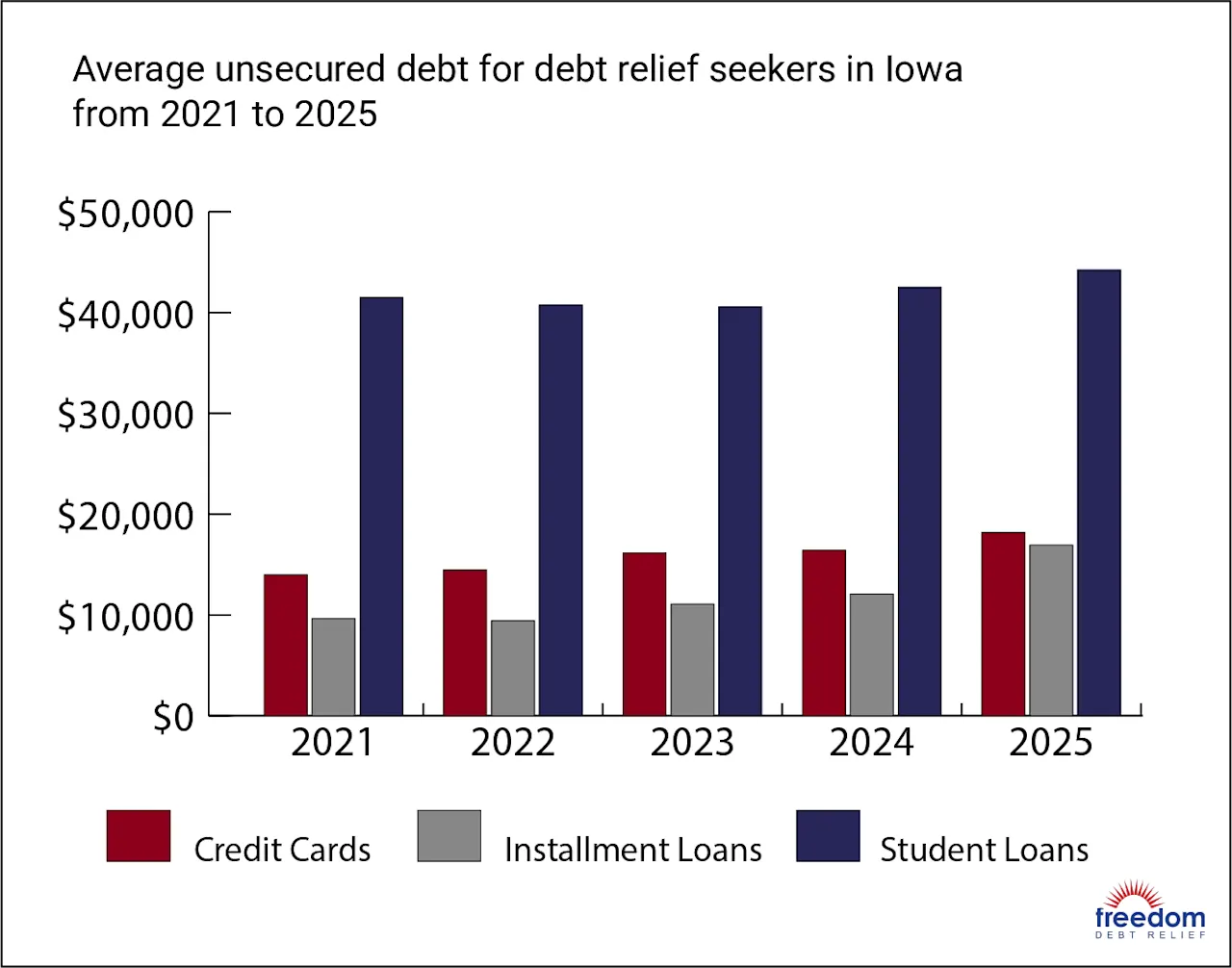
Among Iowa debt relief seekers, both unsecured and secured debt balances have grown noticeably in the last few years (unsecured debt is debt that doesn’t have collateral, and includes credit card balances, personal loans, and medical bills). From 2021 to the first half of 2025, the average unsecured balance has grown by almost 22%, going from $65,140 to $79,378—comparable to national figures. Over this same period, debt relief seekers across the U.S. saw a 21.5% increase in their unsecured debt balances, which grew from $64,852 to $78,808.
Among unsecured debt holders, Iowans with FICO Scores in the “good” range (670-739) had the highest balances in 2024, with an average total of $88,054. Age plays a role here too—Iowa debt relief seekers in the 51-65 age bracket owed the most, with an average balance of $75,005 in unsecured debt as of 2024.
If you miss debt payments, your account might be sent to collections. There’s good news here for Iowans. That’s in line with national debt relief seekers’ data. From 2021 to the first half of 2025, Iowan debt relief seekers’ number of accounts in collections fell from 3.4 to 2.0, while debt relief seekers overall saw their number of collection accounts fall from 3.8 to 1.9. The amounts of debt in collections among Iowans also fell over this same period, going from $3,644 in 2021 to just $2,507, a difference of 31% and a bigger decline than national debt relief seekers’ drop of about 26% over the same timeframe.
Iowa credit card debt
Credit card debt can be one of the most dangerous types for your finances. It’s one of the most expensive ways to borrow money, and it’s designed to last a long time and cost a lot of interest. In the U.S., we pay over 21% interest on average when we carry a balance on a credit card.
Iowans looking for debt relief options had an average credit card balance of $16,416 in 2024, a climb of over 17% from $13,982 in 2021. In 2024, they had an average of 7.9 cards. Among all debt relief seekers, that same period saw an increase of almost 24%, from an average balance of $12,648 to $15,636 across 7.6 cards.
Iowans are also struggling with credit utilization—debt relief seekers in the Hawkeye State had an average credit utilization of 75% in 2024. If your credit utilization is this high, you are close to maxing out your credit cards, and it’s a signal you could be in over your head with your debt. Seeking credit card debt relief could be a good move under these circumstances.
Iowa auto loan debt
Many Americans need a vehicle to get to work and accomplish other tasks, and given how expensive they’ve become, financing is often the only option to buy one. Iowa debt relief seekers had an average of 1.5 auto loan accounts in 2024 (so about three cars for each two people), the same figure as debt relief seekers overall.
Debt relief seekers across the country were paying $726 per month toward their auto loans in 2024, while Iowans paid $587. In terms of average balances, Iowans owed a bit less: $24,807 for Iowans, and $26,839 for debt relief seekers overall.
Iowa mortgage debt
Home prices have soared in the wake of the COVID-19 pandemic, and a lot of Americans are sitting on large mortgage balances as a result. In 2024, debt relief seekers across the country had mortgage balances of $241,535, and average monthly payments of $1,949 across 1.1 mortgage accounts per person.
In Iowa, debt relief seekers had an average mortgage balance of $150,249 in 2024, and a monthly payment of $1,320. Those figures grew from an average balance of $120,184 and monthly payment of $977 in 2021, pointing to higher home prices, but lower costs overall in the Hawkeye State. Interestingly, the average number of mortgage accounts per person in Iowa fell from 1.2 to 1.1, to line up with the average among debt relief seekers nationwide.
Iowa installment loan debt
Installment loans, such as personal loans, are paid off with set monthly payments over a set payment term. The average balance and number of open accounts for these grew from 2021 to 2024 among Iowans seeking debt relief, going from $9,643 to $12,080 and from an average of 2.6 loans to 2.7. Their monthly payments on installment loans in 2024 averaged $185.
Across all U.S. debt relief seekers, the story was similar—the average number of loans rose a little bit from 2.7 to 2.9, and the average balance grew from $8,581 to $10,582. In 2024, the average monthly payment was $436, so Iowans are paying significantly less for their installment loan debt.
Iowa student loan debt
Education costs have risen along with the cost of just about everything else, and Iowan debt relief seekers are feeling the pinch here, too. In 2021, they had an average student loan balance of $40,750 across 4.9 loan accounts, and by 2024, those figures had risen to $42,505 and 5.7 accounts. The average monthly student loan payment was $147 in 2024, a jump of 194% from 2021’s $50 figure. This makes sense, since the COVID-19 student loan payment pause ended in October 2023.
Student loan debt figures rose among debt relief seekers overall too, going from $43,622 across 4.5 accounts in 2021 to $49,861 across 5.4 accounts in 2024. Monthly payments rose too, by nearly 24%—from $241 to $298.
Iowa Debt Delinquencies and Collections
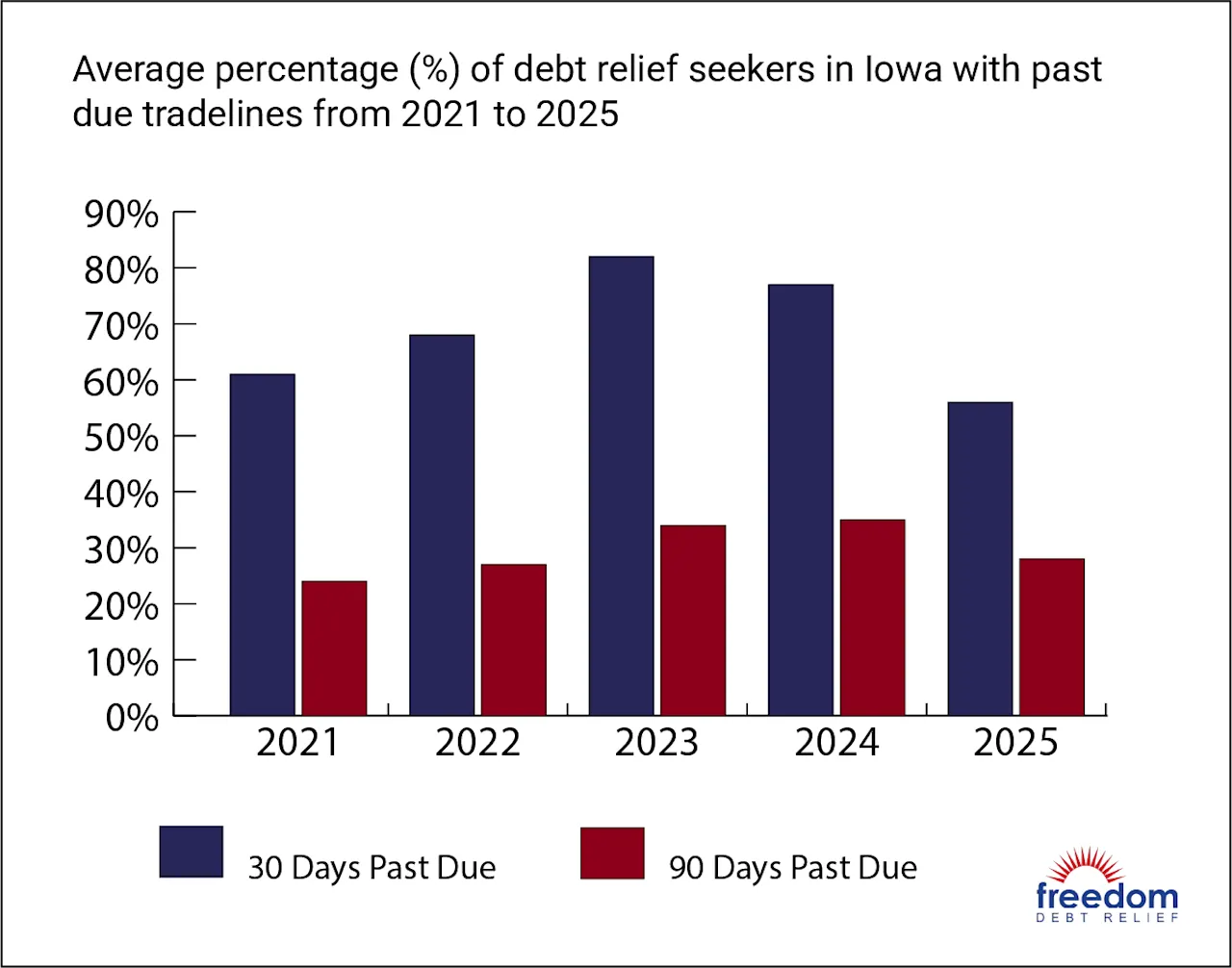
Debt that is late by at least 30 days is referred to as delinquent, and if you have delinquent debt, it’s a sign that you’re struggling to manage your balances. Credit bureau TransUnion collected national and state debt delinquency data in September 2025; here are the national average delinquency rates:
Average Delinquency Rates for Debt Across the U.S.
| Type of debt | 30-plus DPD | 60-plus DPD | 90-plus DPD |
|---|---|---|---|
| Auto loan | 4.34% | 1.65% | N/A |
| Credit card | 4.66% | 3.27% | 2.37% |
| Mortgage | 2.89% | 1.36% | 0.85% |
Here are the debt delinquency figures for the Hawkeye State:
Debt Deliquency in Iowa
| Type of debt | 30-plus DPD | 60-plus DPD | 90-plus DPD |
|---|---|---|---|
| Auto loan | 3.03% | 1.21% | N/A |
| Credit card | 3.47% | 2.38% | 1.69% |
| Mortgage | 2.50% | 1.19% | 0.75% |
Iowan debt relief seekers have seen both their balances and their number of accounts in collections fall since 2021. In 2021, the average balance in collections was $3,644 across 3.4 accounts, but in 2024, those figures had fallen to $2,715 and 2.1. Across all U.S. debt relief seekers, the numbers have fallen as well, going from $4,094 and 3.8 accounts in 2021 to $3,183 and 2.0 in 2024.
Iowa Statute of Limitations
Debt isn’t considered legally collectible forever. The statute of limitations for debt varies by state, generally ranging from three to 10 years. If the statute of limitations for your debt is up, your debt is considered “time-barred,” so if a creditor or debt collector sues you to collect it, you can request that the lawsuit be thrown out, as the claim is invalid.
The statute of limitations in Iowa is informed by debt type and how the debt is recorded:
Iowa Statute of Limitations for Debt
| Type of debt | Iowa statute of limitations |
|---|---|
| Written contracts (personal loans, mortgages, auto loans) | 10 years |
| Oral agreements | 5 years |
| Promissory notes | 5 years |
| Open accounts (credit cards, store accounts, revolving credit) | 5 years |
| Judgments | 20 years |
What are the Iowa debt collection laws?
Iowans fall under the protection of the national Fair Debt Collection Practices Act (FDCPA), and also the state-specific Iowa Fair Debt Collection Practices Act (IFDCPA), which offers more provisions for Iowa consumers’ protection. The FDCPA tells debt collectors when they can contact you (generally between 8 a.m. and 9 p.m.) and where they can contact you (not at work if you ask them not to call there). It also states that if you tell a debt collector not to contact you or your family again, they must stop contacting you. The FDCPA only applies to third-party debt collectors and debt buyers, not your original creditors.
The IFDCPA includes additional requirements. It says debt collectors must send written notices before taking legal action against an Iowan who owes money. It also limits collectors’ ability to charge fees, prohibits harassing behavior, and informs Iowans of their right to ask for debt validation or dispute a debt they believe they don’t owe. Communication from the debt collector must be in English or the debtor’s preferred language if the debt collector has that information.
Reviews and Testimonials from Iowa
Customer service was fast, easy to understand, and very supportive.
Cheri Silva, US

Cynthia was patient, knowledgeable and most of al kind. After speaking with her I felt like this was the best path for me in eliminating my debt and getting a fresh start. She was amazing.
Shelley, US
The company has a good team. They are doing great work. I like the way that they are working. They have a good cordination. They are solving my financial issue. I appreciate for everything they are doing for me. I will say thank you.
Guillermo San Vicente, US
Iowa Debt Relief
Iowans having trouble paying off unsecured debt have options to handle it, including debt relief programs. These are best suited to people who can’t fully repay what they owe, and are struggling with financial hardship. A professional debt relief company could negotiate with your creditors to settle your debt for less than you owe, or you could handle the negotiations yourself. Before a creditor will forgive part of your debt, you’ll need to make them an offer they’re willing to accept. Often, that means a lump sum of money.
If you opt for a debt relief program, they’ll help you get a dedicated account set up (that you own and control) where you’ll build up funds to offer your creditors. You make an affordable monthly deposit. When there’s enough, a professional debt negotiator will try to work out an agreement with your creditor. If they succeed, the agreement will be presented to you for approval. Once you’ve approved the agreement, your creditor is paid from your dedicated account. The debt settlement company’s fee is also paid from your dedicated account.
A reputable debt relief company won’t charge you upfront fees for their debt settlement services. It’s possible to complete a debt relief program in as little as two to four years. Your monthly deposit amount could be lower than the total of your current minimum monthly payments.
Looking for debt relief services in the Hawkeye State? In 2024, Iowans working with Freedom Debt Relief enrolled an average of $27,030 with the program.
Is Debt Consolidation the Best Debt Solution?
Here’s a look at your debt relief options in Iowa, or anywhere across the United States.
Debt settlement
Many people get in trouble with debt thanks to financial hardship, and struggle to find a way out. A debt settlement program could be the right choice if this is your situation. Debt settlement involves negotiating with your creditors on your own, or hiring a company to handle it for you.
The goal is to reach an agreement to pay less than you owe to get rid of your debts.
Debt consolidation
If you want to simplify your debt repayment and perhaps get a break on interest, a debt consolidation loan could be worth exploring. If you qualify, you could use a personal loan, home equity loan, or home equity line of credit, to pay off higher-interest debts (like credit cards). Then you focus on paying off your debt consolidation loan. If you have a credit score that’s at least in the fair range, you might qualify for a lower interest rate with debt consolidation.
Bankruptcy
Bankruptcy is legal protection from your creditors. Some people can walk away from their unsecured debts entirely. If you file Chapter 7 (which is income-limited), most of your unsecured debts (like credit cards, personal loans, and medical bills) could be wiped out altogether. The tradeoff is that you might have to give up some of the things you own. The court could sell them to repay your creditors.
For a Chapter 13 bankruptcy, you enter a three- to five-year plan to pay down what you owe. You don’t have to give up assets.
DIY debt payoff
If you have sufficient income to repay what you owe and need help getting organized, a DIY debt payoff plan could be the fit for you. Your options include creating a debt snowball or a debt avalanche.
To snowball your debt payoff, you send any extra money to your smallest debt first, and make minimum payments across the rest of your balances. Once that first debt is down to $0, you roll the payment to the next-smallest balance. As you pay off debts, your payment gets bigger and bigger, until you are sending all the cash to your largest debt.
A debt avalanche could cost you a little less in interest, but it could take longer to see that first $0 balance. You send extra money to the highest-interest debt first, while making minimum payments on the others. Once that’s paid off, you send the biggest payment to the debt with the next-highest interest rate, and so on.
The debt avalanche could save you on interest, and the debt snowball could be the fastest way to your first debt payoff.
Debt management plan
Need more help to get on track with your debt payoff? A debt management plan (DMP) could be worth checking out. In this debt relief method, you sign up with a credit counseling agency (nonprofit organizations funded by the credit card companies) to create a DMP. You fully repay your unsecured debts over three to five years of regular monthly payments. The credit counselor may be able to negotiate a lower interest rate on your debts.
Iowans can free up cash each month with Freedom Debt Relief
Ozzy S., Freedom client²
“Right away, I had more money each month because of program costs so much less than what I was paying on my minimums.”
Frequently Asked Questions
Is it worth doing a debt relief program?
It could be. If you’ve been through a financial hardship and don’t have a way to repay what you owe in unsecured debt (like credit cards, personal loans, and medical bills), a debt relief program could be worth exploring. You do need to be able to afford a monthly payment to build up funds to offer creditors to settle debts. If you can’t manage any payment, Chapter 7 bankruptcy may be a better fit for you.
How long before a debt is uncollectible in Iowa?
In Iowa, the statute of limitations for most kinds of debt is five years. After that time passes, the debt is time-barred. That means the owner of the debt has no legal grounds to come after you for payment. If they sue you for a time-barred debt, you could explain the age of the debt to the judge and ask them to throw out the case. The time starts on the date your debt became delinquent, which could be 180 after the original payment due date. If you’re not sure whether a debt is time-barred, talk to an Iowa attorney who specializes in debt lawsuits.
Can you go to jail for debt in Iowa?
No. You can’t be imprisoned for debt in any state, including Iowa. You can be sued for debt, and your wages can be garnished to repay what you owe. If you receive a summons for a debt lawsuit, it’s very important to respond and go to court to talk to the judge and to your creditor.
End Your Debt
Find out how our program could help.
- One low monthly program deposit

- Settlements for less than owed
- Debt could be resolved in 24-48 months