

Debt Consolidation in Arkansas: How It Works
Key Takeaways:
Debt consolidation in Arkansas rolls multiple balances into a single monthly payment.
Applying for a consolidation loan generally involves a credit check.
Consolidation may lower the required monthly payment by replacing several payments with one, though the balance owed stays the same.
Interest rates on a consolidation loan generally depend on credit profile, so the rate offered varies from one applicant to another.
How big an issue is debt in Arkansas? We dove into five years’ worth of data to find answers, drawing from surveys of folks who reached out to Freedom Debt Relief (FDR).
Let’s start with the basics. In Arkansas, what does the average debt relief seeker’s situation look like? And how does that compare to the average among debt relief seekers country-wide?
Credit score: The typical Arkansas debt relief seeker had an average FICO Score of 571 in 2024. That translates to the “poor” category, about 10 points below the cutoff for “fair.” That cutoff happens to be where the typical U.S. debt relief seeker falls, at about 581 points.
Estimated debt: Arkansas seekers averaged $26,645 of debt in 2024. That’s about the same as the $26,573 average debt owed by the typical U.S. seeker.
Predicted income: Arkansas seekers averaged a predicted income of $63,117 in 2024. That’s about 10% less than the average among debt relief seekers nationwide, which was $69,121.
Overdue collection accounts: In 2024, Arkansas seekers averaged $2,384 in overdue collection accounts. This is much less than the nationwide seekers’ average of $3,061.
In short, Arkansans who reach out to Freedom Debt Relief average lower FICO Scores, similar balances, lower incomes, and less money in overdue accounts than those in the rest of the nation who reach out. Now we know where the typical Arkansas seeker stands relative to the nationwide average, let’s dive deeper into the data.
Arkansans can free up cash each month with Freedom Debt Relief

Ozzy S., Freedom client²
“Right away, I had more money each month because of program costs so much less than what I was paying on my minimums.”

5-Year Debt Trends in Arkansas
Debt among relief-seekers in Arkansas is trending upward, in line with national trends. From 2020 to 2024, total debt for the state bottomed out at $19,170 in 2022, the same year the Federal Reserve began hiking interest rates. Since then, it has risen to $26,645.
Among Arkansas debt relief seekers, debt rises slightly with age and sharply by income bracket. For example, in 2024, the estimated debt of moderate ($40,000 to $75,000) and middle ($75,000 to $125,000) earners was $22,889 and $32,476, respectively. The trend in Arkansas: the more you earn, the more you owe.
Arkansas high-earners who seek debt relief average greater debt-to-income (DTI) ratios. (Lower DTI usually means you’re more financially stable.) Moderate, middle, and middle-high ($125,000 to $200,000) earners average DTIs of 0.26, 0.34, and 0.49 respectively.
Arkansas credit card debt
Credit card debt among debt relief seekers in Arkansas is trending upward, in line with the national trend. The average credit card balance in Arkansas bottomed out at $9,731 in 2022. By 2024, it had risen to $13,069, jumping 25% in just two years.
The average credit utilization ratio among Arkansans was 79.9%, about four points more than the national average among relief-seekers. High utilization can hurt your credit score.
The number of credit cards averaged 7.6, down from 2020 peaks. There are pros and cons to opening a lot of cards. More cards means more flexibility and higher limits. Seven is a lot of cards to track, though—it could get overwhelming.
Average monthly payment amounts for debt relief seekers with credit card debt are trending up—larger balances and higher rates translate to bigger monthly bills. Credit card debt snowballs quickly, and minimum payments are low, so it’s easy to get in over your head. That’s why many Arkansas residents seek out credit card debt relief.
Arkansas auto loan debt
Auto loan debt among debt relief seekers in Arkansas is trending up, in line with the trend among debt relief seekers nationwide—as of 2024, that average auto loan balance was $29,583. That’s a few thousand dollars more than the national average among debt relief seekers.
In Arkansas and elsewhere, average monthly payments are also trending up. Payments have risen since at least 2020. The state’s average monthly payments among debt seekers was $779 in 2024, about $50 more than the average among seekers nationwide.
Arkansas residents surveyed owe more car loans on average. In 2024, the average number of open loans was 1.6, slightly higher than national numbers.
Arkansas mortgage debt
Mortgage debt among relief-seekers in Arkansas has trended upward since 2021. Balances dipped from 2020 to 2021, the period during which the U.S. government handed out stimulus payments. In 2024, the average balance among the same group was $156,350.
Average monthly payments followed a similar trend, dipping from 2020 to 2021, and trending up since. Among debt relief seekers, Arkansas homeowners pay about 35% less monthly than the national average (the Arkansas average is $1,272, and the national average is $1,949).
Arkansas installment loan debt
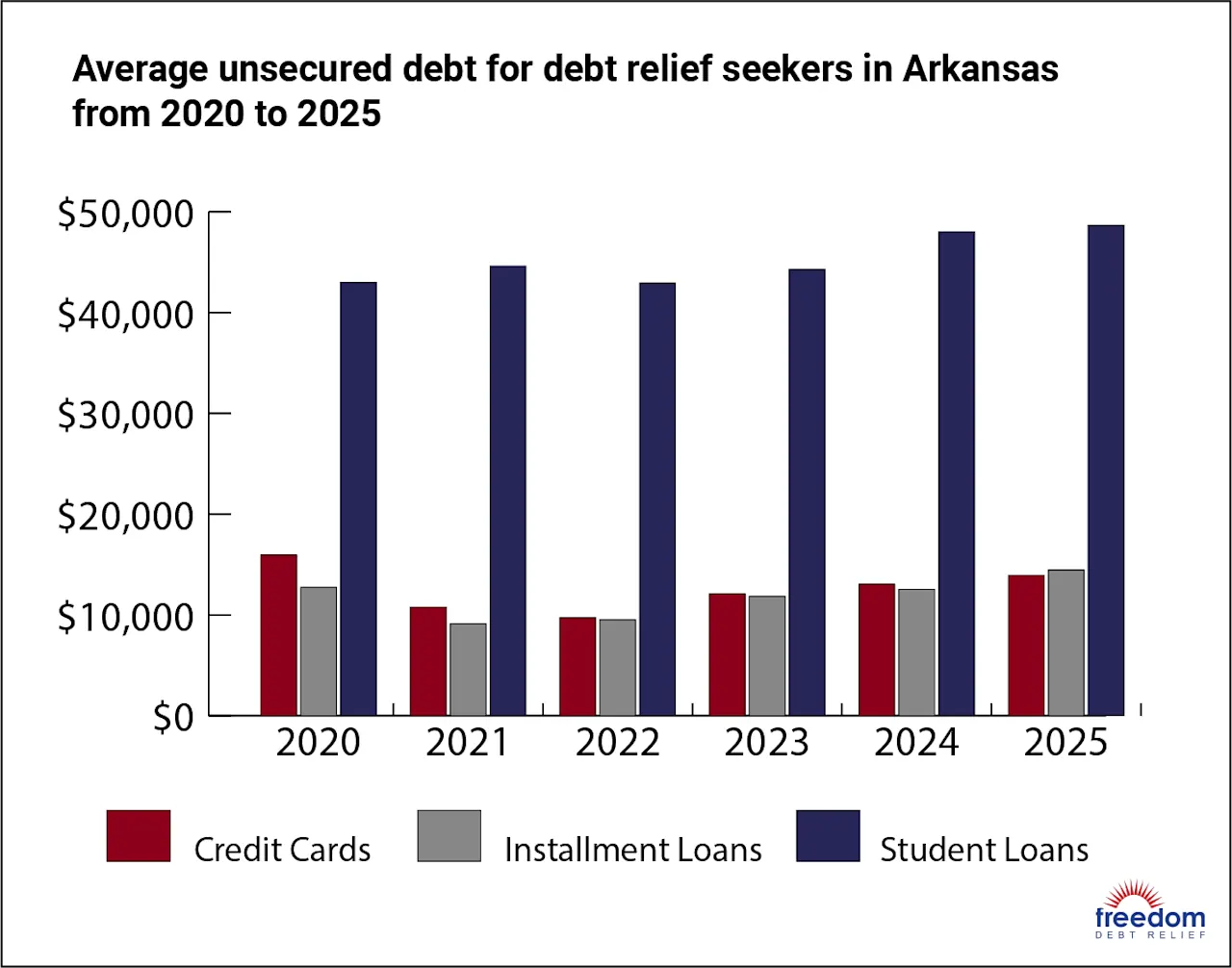
Installment loan, or personal loan, debt among debt relief seekers in Arkansas bottomed out in 2021, and has trended up since. Despite lower balances overall, installment loan balances among Arkansans in the survey are $12,546 with an average monthly payment of $528, compared to the national debt relief seekers’ average of $10,582 with an average payment of $436.
Arkansas student loan debt
Student loan debt among Arkansas relief-seekers is trending up, in line with national trends. The biggest jump was from 2023 to 2024, when the average loan balance jumped from $44,289 to $48,030, slightly less than the average balance among the same group nationwide.
Arkansas Debt Delinquencies and Collections
Debt delinquency rates in Arkansas are above the national average for auto loans, bankcards (credit cards), and mortgages, according to TransUnion data from September 2025. Credit cards are where Arkansas residents struggle the most, with 5.89% being at least 30 days past due (DPD), compared to 4.66% nationwide.
The table below gives delinquency rates for Arkansas auto loans, credit cards, and mortgages, with the percentage that are 30, 60, and 90 days past due.
Debt Delinquency Rates in Arkansas
| Type of debt | 30-plus DPD | 60-plus DPD | 90-plus DPD |
|---|---|---|---|
| Auto loan | 5.00% | 1.91% | n/a |
| Credit card | 5.89% | 4.21% | 3.07% |
| Mortgage | 3.46% | 1.61% | 1.01% |
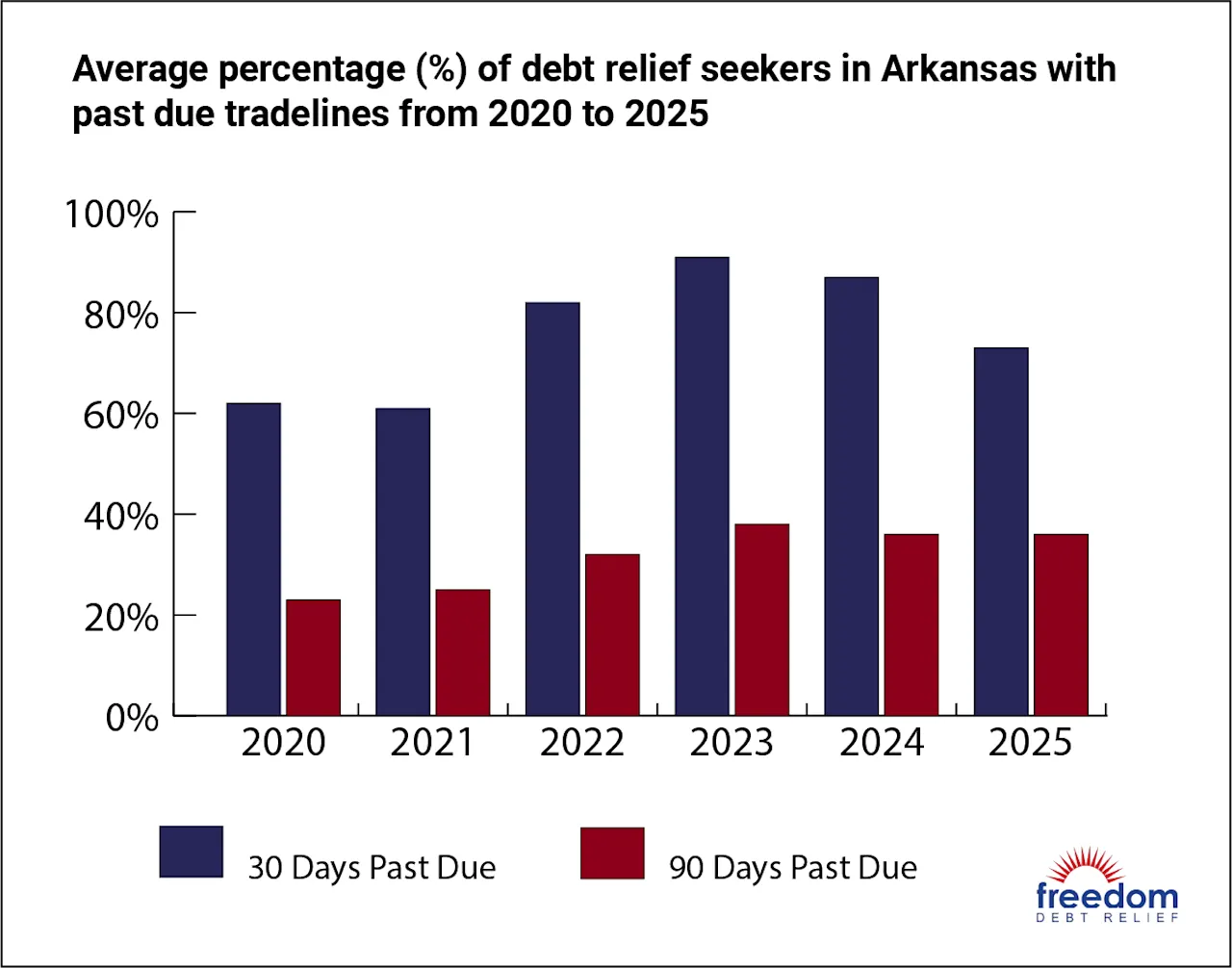
In 2024, Arkansas residents seeking debt relief were more likely to have overdue accounts than they were in 2022 and 2023. However, 2025 data indicates this trend may be reversing. Accounts 30 days past due average 0.7, below 2022 levels.
Despite a potential down-trend in the number of overdue accounts, Arkansas debt relief seekers have more money in collections. Since dipping dramatically from 2021 to 2022, the average collections balance has risen from $2,305 in 2022 to $2,515 in 2024, and to $2,544 as of this writing.
Arkansas Statute of Limitations
The statute of limitations is the deadline for filing a lawsuit to collect a debt. After the statute of limitations has passed, any legal claim is invalid. Though you could still get sued after the deadline, you could ask the judge to throw out the lawsuit because the debt would be considered “time-barred.”
The statute of limitations varies by state and type of debt contract. The statute of limitations in Arkansas is shortest for oral contracts and open-ended accounts that are not in writing, including credit card accounts without written agreements.
Statute of Limitations for Debt in Arkansas
| Type of debt contract | Arkansas statute of limitations |
|---|---|
| Written contracts | 5 years |
| Oral contracts | 3 years |
| Promissory notes | 5 years |
| Open-ended accounts (such as credit cards) | 3 years |
Note that courts may default to the three-year limit for the statute of limitations on credit cards unless you bring proof of a written agreement between you and the creditor.
What are Arkansas collection laws?
Arkansas passed the Arkansas Fair Debt Collection Practices Act (AFDCPA) in 2009. It provides protections for consumers. These protections mirror the Fair Debt Collection Practices Act (FDCPA), plus a couple of extras:
Third-party collectors operating in the state must be licensed in Arkansas.
You can file a complaint directly with the Arkansas State Board of Collection Agencies (ASBCA). This may be faster than going through the Consumer Finance Protection Bureau (CFPB), a large federal agency.
State and federal laws agree on many points. Collectors cannot:
Call you before 8 a.m. or after 9 p.m.
Contact you at work if they know your employer forbids it
Harass, abuse, or use profane language
Make false statements (e.g., claiming to be police)
Threaten legal action they don’t plan to take
Reviews and Testimonials from Arkansas
I'm very thankful, I'm making a difference in my credit.
Nathaniel Reed, US

Ryan was persistent in getting in touch with me I graduated from the program and needed to close out things when I finally called him he was very nice and understanding and was so happy for me for finishing the program. Thank you
MomCarmen Gonzalez, US
She was very helpful and understanding.
aslan50, US
Arkansas Debt Relief
Debt relief may be a good fit if you have a financial hardship and can’t afford to fully repay your debts. Debt settlement is when you (or a representative) negotiate with a creditor or debt collector to settle a debt for less than you owe.
Here’s how it works when you hire a professional debt settlement company like Freedom Debt Relief. Your representative sets up a dedicated account that you own and control. You contribute an affordable amount every month to the account. Your representative negotiates with your creditor or debt collectors. If they reach an agreement, it’s presented to you for approval. If you approve, your creditor is paid from your dedicated account. The debt settlement company’s fee is paid from the same account.
It’s against the law for debt settlement companies to charge upfront debt settlement fees. They can only charge you after they negotiate an agreement, you approve it, and at least one payment has been made to the creditor.
In 2024, over a thousand debt relief seekers in Arkansas enrolled an average of $21,169 of debt in their Freedom Debt Relief program. Most had an average credit utilization ratio of about 80%, which means their credit card balances were around 80% of their credit limits.
Interested in more info? Call 800-910-0065 to talk to an FDR specialist about the possibility of enrolling in a debt relief program. The program may be a fit, depending on your circumstances. It’s possible to complete a debt settlement program in as little as two to four years.
Is Debt Consolidation the Best Debt Solution?
Debt consolidation means using a new loan to pay off multiple smaller debts.
Based on Freedom Debt Relief’s June 2025 Credit Card Utilization Data, the average credit card utilization of people looking for debt relief in Arkansas is 80%. By comparison (per Experian data), the U.S. average in 2024 was 29%.
High credit utilization lowers credit scores and increases costs. If you have high credit card utilization, there are steps you can take to lower it. For example, one solution could be debt consolidation. The best solution for you depends on how much debt you have, your overall financial situation, and how quickly you’d like to clear up debt.
Arkansas debt consolidation loans
It’s time to beat your debt. And luckily, there are many paths that could lead to debt freedom, including debt consolidation. Arkansas residents with high debt could be eligible for secured loans from reputable lenders.
Secured loans use high-value assets (like your home) as a guarantee. That guarantee usually means the lender can charge less compared to other types of loans. The risk with a secured debt is that if you don’t repay your loan, you could lose your asset. There’s a risk/reward element to debt consolidation, but if you can comfortably stay on top of your payments, the risk may be worthwhile.
If you have no collateral to borrow against, you could still apply for an unsecured loan, like a typical personal loan. However, because your lender is taking on more risk when they extend you credit with an unsecured loan, these loans often have a higher interest rate. If you can’t find a good interest rate, another solution might be a better fit.
Arkansas residents can call Freedom Debt Relief at 800-910-0065 for a free debt evaluation to find out whether debt consolidation is right for their situation.
Find your debt solution
Here are a few common ways to get rid of overwhelming debt:
Debt settlement. Negotiate (on your own or with professional help) to settle a debt for less than you owe. This can be the best choice if your debt is overwhelming and Chapter 7 bankruptcy isn’t a fit.
Debt consolidation. Consolidate multiple debts into a new loan, one with a new APR and term. Ideally, this loan has a lower APR, so you pay less in total interest and make lower monthly payments.
Bankruptcy. Chapter 7 bankruptcy lets you walk away from most unsecured debts. There are income limits, and you might have to give up some of the things you own. For example, you’re typically not allowed to keep multiple cars.
DIY debt payoff. Pay off debt with a debt repayment strategy. One of the best is the snowball method. With the snowball, you pay off debts from smallest to largest balance, building up momentum as you go. Or check out the debt avalanche, a similar method that goes from highest-interest balance to lowest.
Debt management plan. Enroll in a debt management plan (DMP) through a credit counselor. You make monthly payments toward your debts. While enrolled, you may get a lower rate or waived fees. You probably can’t use your credit cards until after you complete the plan.
Arkansans can free up cash each month with Freedom Debt Relief
Ozzy S., Freedom client²
“Right away, I had more money each month because of program costs so much less than what I was paying on my minimums.”
Frequently Asked Questions
How much debt do I need to qualify for a debt relief program?
Most professional debt relief companies require you to have at least $7,500 to $10,000 in unsecured debts to qualify. Unsecured debts are debts without collateral or something of value backing them up, such as credit card or personal loan debt.
Can I qualify for debt relief if I'm still making minimum payments?
Yes, you can qualify for debt relief even if you're not behind on your debt. However, creditors may be less willing to negotiate if they think you can afford to make your payments. It may also be harder to save up money for negotiation if you're still making debt payments.
Do I need good credit to qualify for debt relief?
No. You don't need good credit or even fair credit to qualify for debt relief through debt settlement. You only need to be experiencing financial hardship that means you can't afford your debts.
End Your Debt
Find out how our program could help.
- One low monthly program deposit

- Settlements for less than owed
- Debt could be resolved in 24-48 months