
Maine Debt Relief by the Numbers: 5-Year Debt Trends
Maine’s cost of living is comparable to its Northeast neighbors, slightly higher than the national average. It’s similar to states like New Jersey and Vermont, where housing prices are high. Even with its housing shortage, it’s cheaper to live in Maine than in New York or Massachusetts, on average. The Pine Tree State ranks 29th for cost of living, according to U.S. News & World Report.
In 2024, median household income in Maine was $90,730, according to the Federal Reserve Bank of St. Louis. That puts it comfortably above the U.S. median of $83,730, indicating some Maine residents enjoy a high standard of living. Among Maine residents who sought debt relief with Freedom Debt Relief, income averaged $69,805, significantly less than the typical Maine resident.
In the first half of 2025, a debt relief seeker in Maine had an average debt of $316,754, of which $88,980 was unsecured. Compared to U.S. debt relief seekers overall, Maine residents have lower debt balances but a greater portion of unsecured debt. For debt relief seekers nationwide, the average total debt balance is $345,211 with $78,808 of that unsecured debt. Installment loan balances in particular rose sharply from 2024 to 2025.
The debt-to-income (DTI) ratio of Mainers looking for relief from debt rose steadily in 2021 and climbed to 39.8% in the first half of 2025, up from 30.7%. A rising DTI signals that residents may be more vulnerable to economic shocks. An ideal DTI is considered to be 35% or less of your income.
A few numbers to note:
The typical Maine debt relief seeker had an average FICO Score of 596 in 2024, which translates to a “fair” credit score. That’s 15 points higher than the national average among people looking for debt relief.
In 2024, Maine debt relief seekers averaged $4,585 in overdue collection accounts. That’s about $1,500 more than the typical person looking for debt relief.
Among debt relief seekers in Maine, credit card utilization averaged 72.0% in the first half of 2025.
We’re taking a look at debt trends in Maine over the past five years and different directions across debt types. We’ll also dive into the options for Maine residents to regain control over their financial lives.
Mainer can free up cash each month with Freedom Debt Relief

Ozzy S., Freedom client²
“Right away, I had more money each month because of program costs so much less than what I was paying on my minimums.”

Excellent •
5-Year Debt Trends in Maine
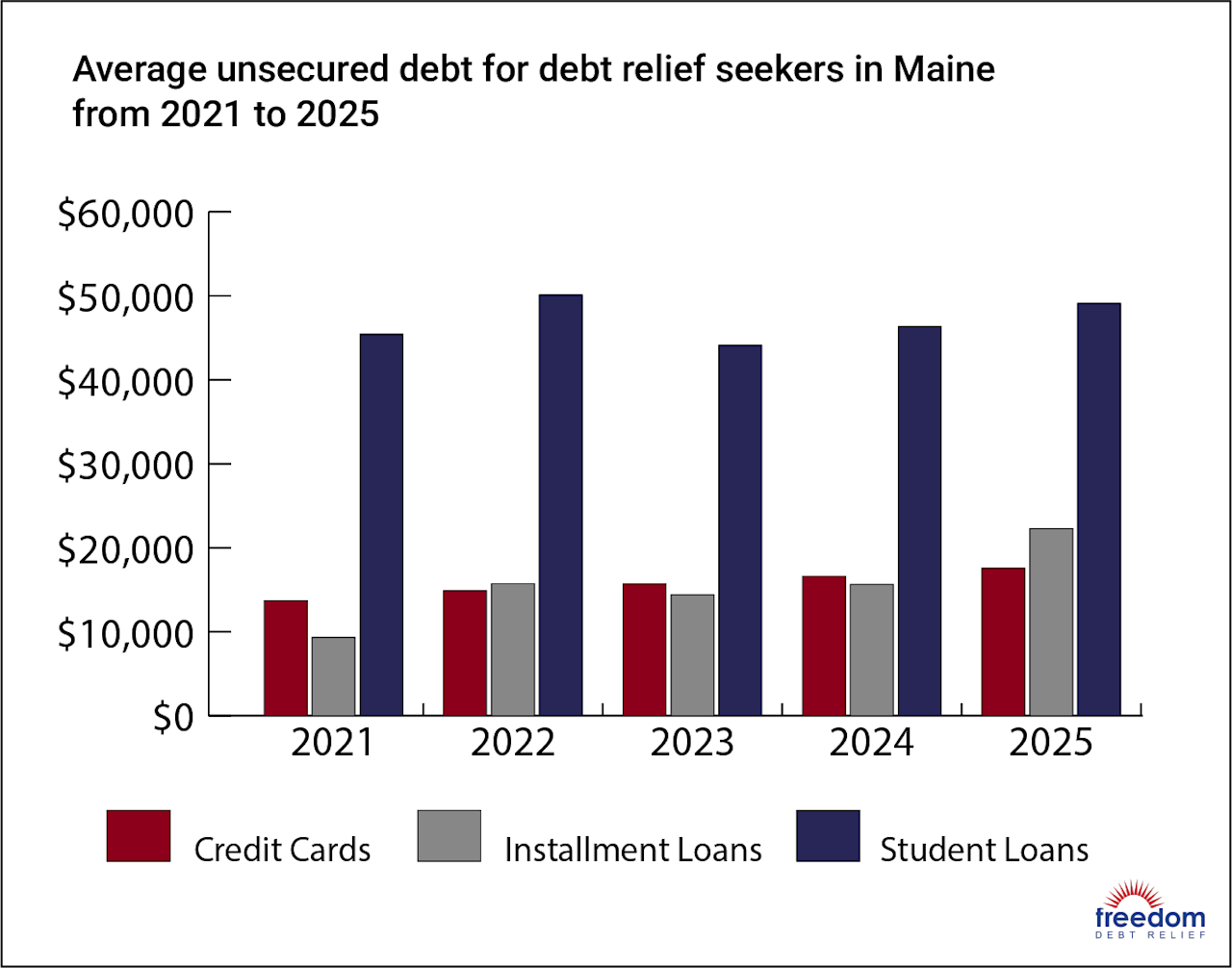
Debt among debt relief seekers in Maine is rising, as it is across the nation. Total unsecured debt for the state bottomed at $22,181 in 2021. Since then, the average among debt relief seekers has climbed to $31,781. Part of this increase could be because the Federal Reserve made the first of several rate raises starting in March 2022, which made debt more expensive.
Among Maine residents seeking debt relief, debt peaks between age 36 and 50, when people tend to take out mortgages and spend significantly on child care. As in most states, debt levels also rise along with income. For example, in 2024, moderate earners seeking debt relief, people with salaries between $40,000 and $74,999 had an average unsecured debt of $26,449. In the next income bracket, people earning between $75,000 and $124,999 had debt levels about $13,000 higher.
On average, high-earners who seek debt relief have greater debt-to-income (DTI) ratios. A higher DTI could mean you’re more vulnerable to financial shocks, since more of your money is going to debt pay-off. The average Maine debt-relief seeker earning $125,000 to $199,999 had an average debt-to-income ratio of 49%. In general, you want to keep your ratio below 36%. When it’s higher you may struggle to handle surprise expenses.
Maine credit card debt
Credit card debt among Maine debt relief seekers is ticking up. Between 2021 and 2024, the average credit card balance rose from $13,709 to $16,614, in part due to higher interest rates. The Consumer Financial Protection Bureau tracked a sharp rise in credit card APRs from 2013 to 2023. A higher APR makes credit card balances more expensive to carry, contributing to debt issues.
Average credit utilization for debt relief seekers was 74% in 2024, similar to the national average among people seeking help for debt, and far from ideal. Experts recommend you keep utilization below 30%. High utilization hurts your credit score.
The number of open credit card accounts averaged 8.1 among debt relief seekers in Maine, down from 2023 peaks. Opening so many cards has pros and cons. On the one hand, more cards means more flexibility and higher limits. But eight is a lot of cards to keep track of, and you might find it overwhelming. The average American has fewer than four cards.
Among debt relief seekers with credit card debt, average monthly payments are trending up. Bigger balances and higher rates mean bigger monthly bills. Credit card debt snowballs quickly and minimum payments are set deceptively low, so it’s easy to get in over your head. It’s why many Maine residents seek credit card debt relief.
Maine auto loan debt
Auto loan debt among Maine residents looking for help with their debt is rising. As of 2024, the typical auto loan balance was $25,248, about $1,000 less than the average for debt relief seekers nationwide. Maine ranks 16th for best state to buy a car, according to National Business Capital, which cited better used car deals as a major contributing factor. Average monthly auto payments among people looking for help with debt in Maine are also rising, hitting $675 in 2024. That’s less than debt relief seekers nationwide pay, on average.
Maine mortgage debt
U.S. home prices have skyrocketed since 2020, and Maine is no exception. The median price of a home in Maine was just over $400,000 in January 2026 according to Zillow estimates. Mortgage debt among seekers of debt relief in Maine has gone up since 2021, moving in lockstep with national trends.
Despite pricier-than-typical homes in the state, Maine seekers of debt relief carry smaller mortgage balances than debt relief seekers nationwide. In 2024, the average home loan balance was $192,610, about $50,000 under the national average among debt relief seekers. Among debt relief seekers, Maine homeowners pay about 20% less monthly than the typical U.S. homeowner looking for help with debt.
Maine’s housing shortage could partly account for atypical trends among debt relief seekers. When homes are scarce and demand outstrips supply, prices rise and homeownership becomes less affordable. New buyers could be locked out of the market. Of those who reached out to Freedom Debt Relief in 2024 for help with mortgage debt, most were at least 36 years old.
Maine installment loan debt
Installment loan debt among Maine debt relief seekers dropped in 2022 and then rose in the following years. As of 2024, average installment loan balances in the state were significantly higher at $15,647 than the average for debt relief seekers nationwide, at $10,582. In 2025, the average installment balance of Maine debt relief seekers spiked, rising to $22,295.
Possibly because of higher-than-average balances, Maine seekers of debt relief have larger monthly payments than people seeking debt relief in the U.S. overall. The average monthly payment on an open installment loan account was $480 compared to $436 nationwide.
Maine student loan debt
Student loan debt balances for Maine debt relief seekers dropped over 2022 to 2023, which is unusual. Since 2023 it’s been going up, just like it has across the nation. This may be related to Maine's recently implemented Student Loan Repayment Tax Credit (SLRTC). For tax years beginning in 2022, Maine's SLRTC program offers an annual, refundable tax credit to eligible residents making student loan payments.
Maine Debt Delinquencies and Collections
Debt delinquency rates in Maine are healthier than the national average for auto loans, credit cards, and mortgages, according to TransUnion. Credit cards are where Maine residents struggle the most, with 3.49% at least 30 days past due.
Here are the delinquency rates for Maine auto loans, credit cards, and mortgages that are 30, 60, and 90 days late.
| Type of debt | 30+ Days Past Due | 60+ Days Past Due | 90+ Days Past Due |
|---|---|---|---|
| Auto loan | 2.74% | 1.03% | n/a |
| Credit card | 3.49% | 2.40% | 1.73% |
| Mortgage | 2.75% | 1.31% | 0.92% |
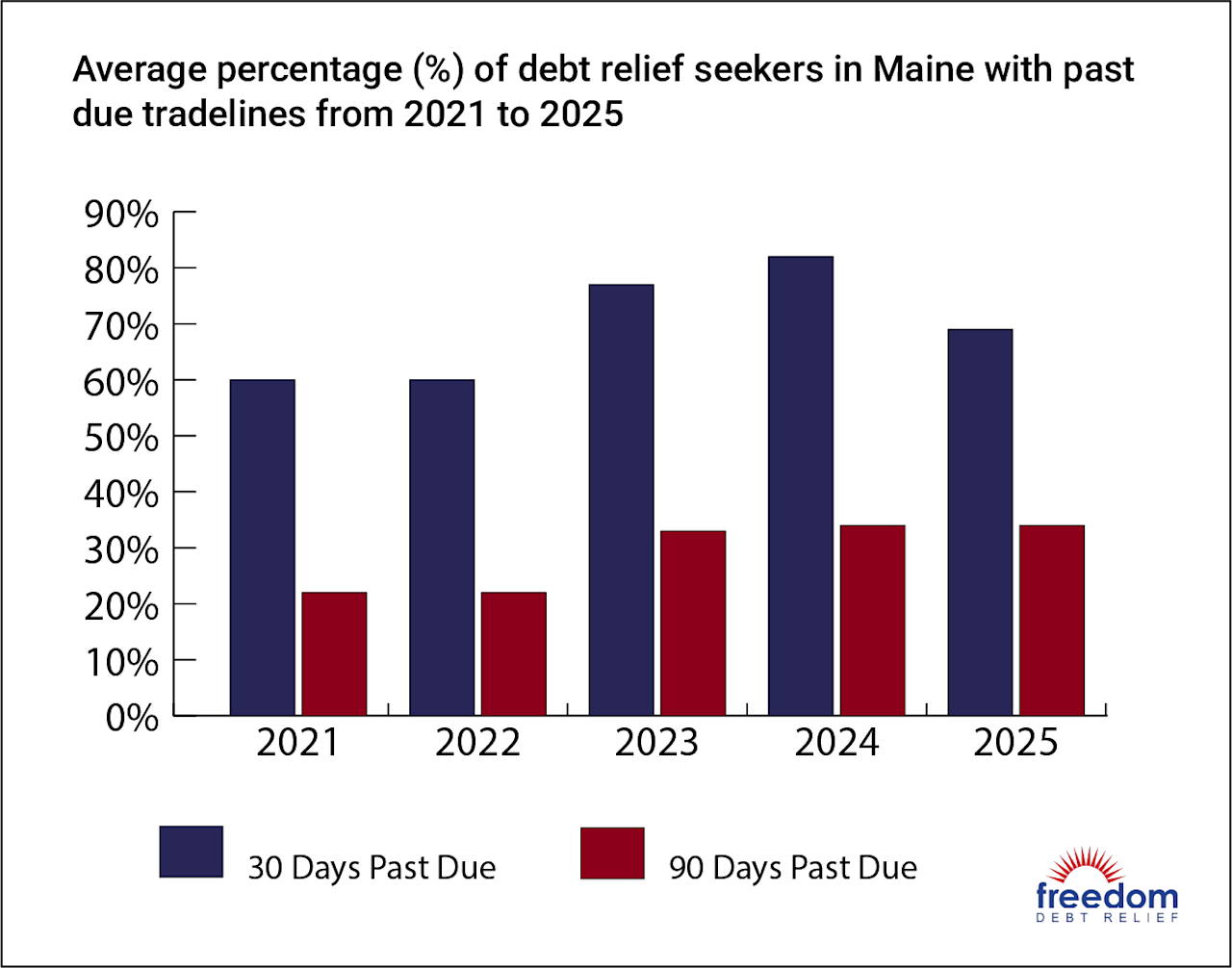
Maine residents looking for debt relief in 2024 were more likely to have overdue accounts than they were between 2020 and 2022. Data from 2025 indicates this trend may be reversing. Accounts 30 days past due average 0.7%, below 2024 levels.
Maine Statute of Limitations
A statute of limitations spells out how long creditors and debt collectors can hold you accountable for overdue debt. Once the statute of limitations passes, the debt collector or creditor loses the right to win a lawsuit against you for the debt. The debt becomes time-barred.
If a collector sues you after the statute of limitations has expired, you could prove the debt is time-barred to win the case.
Statutes of limitations vary by state and how the agreement is structured. The statute of limitations in Maine is six years for most types of debt contracts.
| Type of debt | Maine statute of limitations |
|---|---|
| Written contracts | 6 years |
| Oral contracts | 6 years |
| Promissory notes | 6 years |
| Open-ended accounts (such as credit cards) | 6 years |
What are Maine debt collection laws?
Maine residents are protected by the Maine Fair Debt Collection Practices Act (MFDCPA), which works alongside the federal Fair Debt Collection Practices Act (FDCPA). Collectors cannot:
Call you before 8 a.m. or after 9 p.m.
Contact you at work if they know your employer forbids it
Harass, abuse, or use profane language
Make false statements, such as claiming to be police or attorneys
Threaten legal action they don’t plan to take
In addition, the state provides special protections to residents:
Only income above minimum wage can be garnished.
Debt buyers must go above and beyond federal regulations to prove you owe debt. For example, they must list prior debt owners, transfer dates, and separate fees/interest charges from principal.
Any third-party debt collector operating in Maine must be licensed by the Maine Bureau of Consumer Credit Protection.
Maine Debt Relief
While checking out debt relief, take a look at other Maine programs. The state offers hardship programs, student loan help, and more to residents.
| Resource | Best for | Phone / Website |
|---|---|---|
| Bureau of Consumer Credit Protection | Reporting harassment | 1-800-332-8529 |
| U.S. Department of Justice | Finding credit counselors | justice.gov/ust/list-credit-counseling-agencies-approved-pursuant-11-usc-111 |
| Foreclosure Prevention Program Hotline | Advice and assistance in preventing foreclosure | 1-888-664-2569 |
| Pine Tree Legal Assistance | Free legal aid | ptla.org |
| FAME | Free student loan advice and resources | famemaine.com |
| General Assistance | Emergency rent/food/heat | Call your town office |
Debt relief could be ideal when you can’t keep up with debt payments. Debt relief, or debt settlement, is when you (or a representative) negotiate with a creditor or debt collector to settle a debt for less than you owe.
Call 800-910-0065 to talk to a Freedom Debt Relief specialist about your options in Maine.
Is Debt Consolidation the Best Debt Solution?
Debt consolidation could bring down monthly payments and shrink how much you owe.
Based on Freedom Debt Relief’s June 2025 Credit Card Utilization Data, Maine residents looking for debt relief have an average credit card utilization of 72%. That’s far higher than the average credit card utilization for Americans in general: 29%, according to Experian.
High credit card utilization points to a greater likelihood of needing debt relief services. If your own number is higher than you’d like, you can take steps to change your situation.
Debt consolidation—moving multiple debts into a single account—could make it easier to pay off debts. By consolidating into a loan with a lower rate, you could save on interest fees (if you don’t take longer to repay the debt).
Debt consolidation might not be your best option if you:
Can’t qualify for a lower rate on a new loan
Have more debt than you can realistically pay
If you want to simplify your monthly payments and your credit is good or excellent, debt consolidation might be the solution for you.
Find your solution
Debt consolidation is one of many options. Here are some other ways to get rid of debt:
Debt settlement. Settle a debt for less than you owe by negotiating with creditors. Debt settlement could be a good solution when your debt is overwhelming because of a financial hardship. It could also be worth considering as an alternative to Chapter 13 bankruptcy if Chapter 7 isn’t an option for you. You can start by reaching out to a debt settlement company and talking through options. Or, you could DIY a settlement by reaching out to your creditors directly. Settlement companies charge fees for settling your debts, but you might prefer their expertise and experience in handling negotiations.
Debt consolidation. You can consolidate multiple debts with a single new loan with a new APR and term. If you can get a consolidation loan with a lower APR, you’ll pay less and possibly have lower monthly payments. Other benefits of consolidation include adjusting term lengths and simplifying payments. Debt consolidation may be the right option if you have good enough credit to qualify for a new, lower APR and your debt is an amount you can handle reasonably.
Bankruptcy. Declare Chapter 7 bankruptcy to wipe your slate clean of eligible debts. Upon successful completion, you’ll no longer be responsible for most unsecured debts, including credit card debt.
DIY debt payoff. Two popular debt repayment strategies are the snowball and the avalanche methods. With the snowball, you pay off debts from smallest to largest balance, building up momentum. Quick wins when you clear out a balance are motivating. The avalanche has you pay off debts in order of APR, from highest to lowest. You generally save more money with the avalanche, but it can take more discipline as it may take longer to get to that satisfying first payoff.
Debt management plan (DMP). Enroll in a debt management plan (DMP) through a credit counseling agency. You’ll work with an accredited credit counselor to make monthly payments toward your debts. While enrolled, you may get a lower rate or waived fees, and you generally can’t use your enrolled accounts. A DMP could make debts slightly easier to manage, and you get the benefit of professional guidance. The set-up and management fees for a DMPs are typically low cost, and initial credit counseling sessions are usually free. You need to be able to afford a payment designed to fully pay off your unsecured debts within three to five years.
Mainer can free up cash each month with Freedom Debt Relief
Ozzy S., Freedom client²
“Right away, I had more money each month because of program costs so much less than what I was paying on my minimums.”
Excellent •
How long before a debt becomes uncollectible in Maine?
Debt in Maine typically becomes uncollectible in six years. Once the statute of limitations is passed, you can cite it to ward off debt collection claims in court. Debt that has passed the six-year statute of limitations is considered time-barred debt. If you’re sued for a time-barred debt, you could ask the judge to throw out the lawsuit.
What is debt consolidation and how does it work in Maine?
Debt consolidation lets you consolidate multiple debts into a single new loan. Ideally, this new debt would have a lower interest rate. You might use a balance transfer to consolidate debt onto a new credit card with a 0% introductory APR. Or you might consolidate debts into a single personal loan with a set repayment term (and predictable monthly payment) that better meets your financial needs.
Banks and credit unions offer debt consolidation loans. If you’d rather avoid opening a new line of credit, you may be able to enroll in a debt management plan (DMP) with the help of a nonprofit credit counselor. A DMP sometimes offers better rates than what you’re getting right now. While enrolled in the DMP and making monthly payments toward your debt, you can’t use credit cards enrolled in the program. Typically, upon completion of the program, these accounts are closed permanently.
Can debt collectors garnish wages in Maine?
Yes, debt collectors can garnish wages in Maine. Lenders must take you to court and win the suit. If a collector obtains a court judgment, they can ask for permission to garnish your wages, which Maine limits:
If your weekly income is below 40 times the minimum wage, your wages can’t be garnished.
If you earn more, debt collectors can garnish income above that threshold or 25% of your total disposable earnings, whichever is less.
Minimum wage means either state or federal, whichever is higher.
End Your Debt
Find out how our program could help.
- One low monthly program deposit

- Settlements for less than owed
- Debt could be resolved in 24-48 months