



Delaware Debt Relief By the Numbers: 5-Year Debt Trends
Delaware is something of an outlier East Coast state. Its cost of living is just slightly higher than average but nowhere as pricey as neighboring New Jersey and Maryland. Instead of sales tax, Delaware taxes gross receipts, so at the point of purchase, the customer pays zero. Housing is slightly higher than the national average, according to Zillow sales data, and property taxes are lower than in nearby states. With its median household income around $85,000, just above the U.S. median ($78,538 in 2022), many First State residents can enjoy a comfortable standard of living.
In the first half of 2025, Delaware residents seeking debt relief carried an average total balance of $362,790, of which $87,877 is unsecured debt (such as credit cards and personal loans). Both figures are substantially higher than the numbers for U.S. debt relief seekers overall. For debt relief seekers throughout the country, the average total debt balance is $345,211 with $78,808 in unsecured debt.
Delaware debt seeker credit scores have been steadily dropping since 2020, when the average FICO Score among this group was 609. In the first half of 2025 scores had slipped to 586, a bit lower than the 592 average FICO Score for debt relief seekers across the country. Both averages fall into the 580-669 range considered fair by FICO.
Here are some other numbers that show how debt affects Delaware residents who are seeking debt relief:
Delaware residents seeking debt relief had an average $32,475 of debt in 2024, with a monthly minimum payment of $1,779.
The average resident looking for debt relief has $3,289 in collections, slightly higher than the typical U.S. debt relief seeker, at $3,061.
Delaware residents seeking debt relief use 73.4% of the credit limit on average.
Our data shows changes in debt levels over the last five years. We’ll look at different categories of debt and dive into the options residents have to regain financial control.
Delawareans can free up cash each month with Freedom Debt Relief

Ozzy S., Freedom client²
“Right away, I had more money each month because of program costs so much less than what I was paying on my minimums.”

5-Year Debt Trends in Delaware
Debt balances among Delaware residents seeking debt relief are rising, as they are for debt relief seekers nationwide. In 2021, the average debt balance for a debt relief seeker in Delaware was a relatively low $22,869—not much higher than the national average for debt relief seekers of $21,363 and actually slightly down from the previous year. Three years later, that average debt balance in Delaware had ballooned to $32,475, well above the average for people seeking debt relief nationwide.
Debt peaks between the ages of 36 and 65 and also rises sharply by income bracket. For example, in 2024, residents seeking debt relief who earned $40,000 to $74,999 had an average $26,25 debt balance. Those in the $75,000 to $124,900 range carried a balance of $40,187.
High-earners who seek debt relief also have higher debt-to-income (DTI) ratios. That higher DTI means more of a person’s income is going toward debt payments, a sign of possible financial instability.
In 2024, Delaware debt relief seekers with upper-middle incomes ($125,000 to $199.999) had an average DTI of 49%. High-income earners ($200,000 and up) seeking debt relief had an average DTI of 70%.
When your DTI is up around 49%, that could indicate that your budget is maxed out. You’ve got 51% of your income to cover everything other than your debts.
When your DTI is up around 70%, you might be in a situation where making your debt payments leaves you unable to afford your basic necessities.
Delaware credit card debt
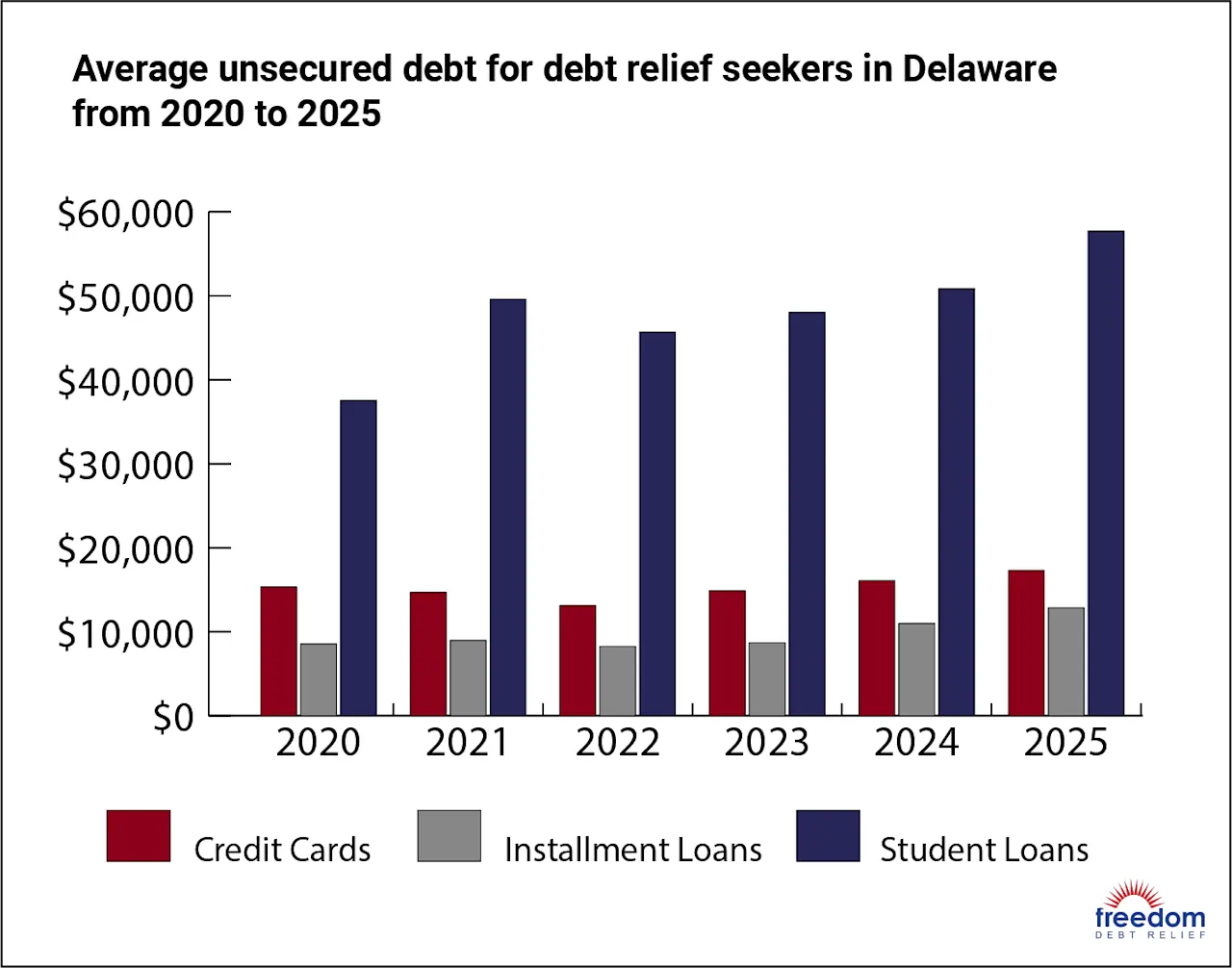
Just as they are throughout the U.S., credit card debt balances for Delaware debt relief seekers are increasing. Average balances in Delaware are higher than for debt relief seekers across the country—and rising.
In 2022, the average credit card balance was $13,110. By 2024, it had grown to $16,074—a 22% increase in two years.
Average credit utilization was 76.8%, similar to the national average among people seeking debt relief, and far above ideal. High utilization hurts your credit score.
The average debt relief seeker in Delaware has 7.9 accounts, slightly down from the peak 8.3 in 2023. Having so many credit cards has pros and cons. On the one hand, more cards means more flexibility and higher spending limits. On the other hand, eight cards can be a bit of a stretch to keep track of. It means more monthly payments and more temptation to spend. Some spenders might find it overwhelming.
People seeking debt relief who have credit card debt are paying higher average monthly payments. Bigger balances and higher rates translate to bigger monthly bills. Credit card debt can snowball quickly, and low minimum payments make it easy to get in over your head. If that’s your situation, you might want to check out your options for credit card debt relief.
Delaware auto loan debt
As in other parts of the country, auto loan debt has steadily risen for Delaware residents over the past five years. Auto debt often makes up the second largest debt balance for most people, right behind mortgage debt, and Delaware is no different.
But Delaware residents seeking debt relief actually have a somewhat easier time than debt relief seekers nationwide. In 2024, debt relief seekers in Delaware had an average monthly car payment of $695 on an average auto loan balance of $25,519. Both amounts have risen moderately since the beginning of the decade, but they’re both lower than the national average for people seeking debt relief. Nationwide, debt relief seekers paid an average $726 a month on an average auto loan balance of $26,839.
Delaware mortgage debt
Nationwide, home buying has become more expensive, and Delaware reflects that trend. Mortgage balances among debt relief seekers in Delaware hit a high in 2024, with an average balance of $241,328. The annual data for 2025 isn’t complete yet, and already mortgage balances have outpaced the previous year, at $248,152.
Average monthly payments spiked to $2,942 in 2021, dipping immediately and then steadily rising each year. Among those seeking debt relief, With 2024’s average monthly payment of $1,753, Delaware homeowners paid nearly 12% less monthly than debt relief seekers nationally, $1,949.
Delaware installment loan debt
Average balances for installment loans among debt relief seekers in Delaware dropped in 2022 as they did for U.S. debt relief seekers in general. eIn 2024, installment loan balances in Delaware were just about $400 more than the average of $10,582 for debt relief seekers nationwide.
Despite balances that are slightly higher than average, Delaware debt relief seekers have monthly installment loan payments that are lower than the nationwide average for debt relief seekers. Monthly payments have been creeping up since 2020, from $299 to $431 in the first half of 2025. For U.S. debt relief seekers overall, the average monthly payment on an installment loan is $485.
Delaware student loan debt
Student loan debt among Delaware debt relief seekers is spiraling upward, outpacing the growth nationwide for U.S. debt relief seekers. From 2021 to the first half of 2025, the average student loan balance in Delaware increased by nearly $20,000, spiking from $37,542 to $57,705. That rise was fueled in part by the biggest jump from 2020 to 2021, when the average loan balance skyrocketed from $37,542 to $49,598.
One possible driver of these swelling student loan balances could be payment size. Even with larger-than-average balances, Delaware debt relief seekers are making average monthly payments that are only slightly higher than the average for debt relief seekers across the country. In 2024, the average monthly student loan payment was $303 in Delaware, and $298 nationwide.
Delaware Debt Delinquencies and Collections
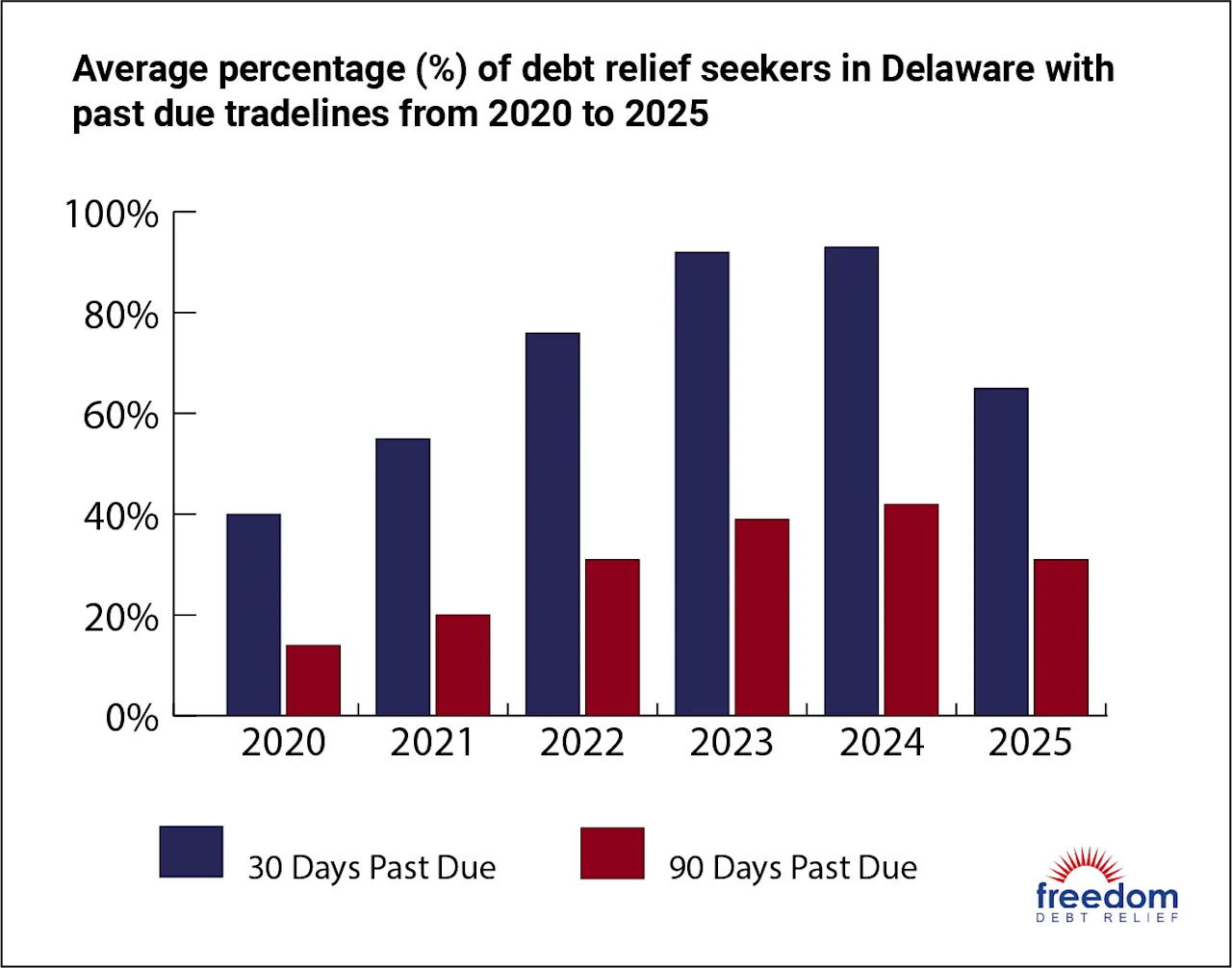
Debt delinquency rates in Delaware are above the national average for auto loans, bankcards (credit cards), and mortgages, according to data from the credit bureau TransUnion. Credit card debt is the area where Delaware residents seeking debt relief struggle the most, with 5.17% at least 30 days past due (DPD) compared to 4.66% of debt relief seekers nationwide.
Typical borrowers often have multiple loans, suggesting that Delaware residents seeking debt relief could be turning to loans to fill financial gaps. Here's how the numbers compare to the debt relief seekers in the rest of the U.S.
Average Accounts in Collections in Delaware vs. U.S. Overall
| Delaware Residents | U.S. Borrowers | |
|---|---|---|
| Average Number of Collection Accounts | 2.2 | 1.9 |
| Accounts Past Due 30 Days | 0.6 | 0.6 |
| Accounts Past Due 90 Days | 0.3 | 0.3 |
| Average Collection Balance | $3,952 | $3,040 |
| Average Collection Past Due Amount | $3,871 | $2,884 |
Collection balances in Delaware have been steady over the past five years with minor changes. Balances dipped below $3,400 in 2022 and 2023, before climbing again in 2023.
Delaware Statute of Limitations
The Delaware statute of limitations is the amount of time that creditors and debt collectors are allowed to sue you for an overdue debt. Once the statute of limitations runs out, the debt is considered time-barred and the creditor has no legal tools to collect.
For example, if a debt collector sues you and you’re able to prove the debt is time-barred, you could win the case.
Statutes of limitations vary by state and type of debt contract. The longest statute of limitations in Delaware applies to promissory notes, which are used for different types of loans, including student loans and mortgages.
DE Statute of Limitations for Debt
| Type of debt contract | Delaware statute of limitations |
|---|---|
| Written contracts | 3 years |
| Oral contracts | 3 years |
| Promissory notes | 6 years |
| Open-ended accounts (such as credit cards) | 3 years |
What are the Delaware debt collection laws?
The Fair Debt Collection Practices Act (FDCPA) protects Delaware residents from unfair or abusive treatment by debt collectors. Collectors can’t:
Call you before 8 a.m. or after 9 p.m.
Contact you at work if they know your employer forbids it
Harass, abuse, or use profane language
Make false statements, such as claiming to be police or attorneys
Threaten legal action they don’t plan to take
In addition, Delaware provides special protections to residents:
Bank account seizures are banned at Delaware banks.
Wage garnishment is capped at 15%.
Debt collectors can’t report medical debt to Equifax, Experian, or TransUnion.
Reviews and Testimonials from Delaware
You have helped me every step of the way, and keeping ping updated and thoroughly explaining everything to me.
Ruleidy Nunez, US

Everyone keeps me up to date. Very helpful
Carol Mcmullen, US
the messages we receive to checking how are our accounts doing?
Maria A Carrillo, US
Delaware Debt Relief
While you’re exploring debt relief options, make sure you learn about financial hardship programs offering financial assistance and advice for Delaware residents. Here are some examples:
Financial wellness resources. Delaware offers free support, financial literacy classes, and savings for debt, housing, and retirement.
Mortgage relief. The Delaware Mortgage Relief Program assists eligible homeowners who experienced a COVID-19-related financial hardship that resulted in mortgage delinquency or forbearance.
Rental assistance. Delaware has a State Rental Assistance Program (SRAP) for low-income renters.
Credit counseling. The U.S. Department of Justice has a search tool to find approved credit counselors in Delaware.
Debt relief could be ideal when you can’t keep up with debt payments and you don’t qualify for Chapter 7 bankruptcy. In debt relief or debt settlement, you (or a representative) negotiate with a creditor or debt collector to settle a debt for less than you owe.
Here’s how it works if you choose a company like Freedom Debt Relief. You open a dedicated account that you own and control where you contribute monthly. The company negotiates with your creditors or debt collectors. Once they reach an agreement, it’s presented to you for your approval. If you approve, your creditor is paid from your settlement account. You should only pay debt settlement fees after they successfully negotiate a debt, you approve the agreement, and at least one payment is made.
In 2024, debt relief seekers in Delaware enrolled an average of $29,358 of debt in a settlement program. When they enrolled, their average credit utilization ratio was 76.8%.
For more information, call 800-910-0065 to talk to a Debt Consultant about enrolling in a Delaware debt relief program. Debt relief programs could help you get significant debt reduction in as little as 24 to 48 months.
Is Debt Consolidation the Best Debt Solution?
People wind up in debt for a variety of reasons, and these different circumstances could call for different debt solutions.
Here’s a rundown of the choices you might want to look into. Get to know each strategy so you can make an informed decision that fits your circumstances—and start on your journey to becoming debt-free.
Debt consolidation loan
One possible solution is debt consolidation. A debt consolidation loan lets you use a new loan to repay multiple smaller debts. The goal is to get a lower APR. Possible benefits include fewer monthly payments, lower interest charges, a lower total monthly payment, or more time to pay. Debt consolidation could work if you qualify for a new loan with better terms than your current debts.
Debt settlement
Settle a debt for less than you owe by negotiating with creditors. This strategy is generally best when your debt is overwhelming and you don’t qualify for Chapter 7 bankruptcy. Debt settlement is for someone experiencing financial hardship who can’t afford to fully repay their debts.
Bankruptcy
Bankruptcy is legal protection from creditors. Chapter 7 bankruptcy could wipe out your eligible unsecured debts in a few months. Upon successful completion, you’ll no longer be held accountable for eligible debts, including credit card debt.
DIY debt payoff
Pay off your debts with a DIY strategy. Two popular methods are the debt snowball and the debt avalanche. You arrange your debts by balance size or interest rate, and put all your extra money toward one target debt while making minimum payments on the other balances.
Debt management plan
Enroll in a debt management plan (DMP) through a credit counselor. You’ll make monthly payments toward your debts (credit card, personal loans, or medical bills). While enrolled, you may get a lower rate or waived fees, but you probably have to close your credit card accounts.
Debt Relief Solutions in Delaware
In addition to debt consolidation, there are a number of relief solutions in your area. Delaware is home to a number of companies. To find your path to financial freedom, just follow these steps:
Call Freedom Debt Relief at 800-910-0065. You’ll receive a free debt evaluation. Our Certified Debt Consultants can help you discover whether you’re a candidate for debt settlement.
Choose a debt solution. Our Certified Debt Consultants will consider all the details of your financial situation and advise you on the best way forward when they give you the free evaluation.
Follow through to financial liberation. No matter what you choose—debt consolidation, debt settlement, debt counseling, or any other solution, the most important part is that you follow the plan in a consistent manner. It’s possible to resolve massive debt. And the rewards that come from being debt-free will be all the sweeter.
Delawareans can free up cash each month with Freedom Debt Relief
Ozzy S., Freedom client²
“Right away, I had more money each month because of program costs so much less than what I was paying on my minimums.”
Frequently Asked Questions
Is there really a debt relief program from the government?
Yes, but for credit card debt, the only government program would be bankruptcy, if you qualify. The government offers debt relief for certain types of debt, like student loan forgiveness programs and IRS tax debt settlement programs. However, the government doesn't have a general-purpose debt relief program that you can use with any type of debt.
What is the statute of limitations on credit card debt in Delaware?
The statute of limitations on debt collection in Delaware is three years, but your obligation to pay it never goes away. Debts can show up on your credit report for seven years past the date of delinquency, and in a few cases, longer than that. A creditor can continue asking you to pay a debt, as long as:
The debt is yours
The amount is correct
The debt collector is entitled to collect
If you're sued for a debt, the age of the debt can be your defense. After the statute of limitations runs out, debt collectors may no longer threaten you with legal action.
What is Delaware’s debt collection law?
Some states have additional specific debt collection laws in addition to the Fair Debt Collection Practices Act (FDCPA), but Delaware is not one of them. Delaware residents have all the protections of the FDCPA, which limits how debt collectors can contact you and how they can behave toward you. Even if you’re overdue on debts, you still have rights and deserve to be treated fairly, respectfully, and honestly.
In addition, Delaware has added some protections for residents. For example, bank account seizures are banned at Delaware banks and wage garnishment is capped at 15%. Delaware residents don’t have to worry about medical debt hurting their credit scores because debt collectors in Delaware can’t report medical debt to Equifax, Experian, or TransUnion.
End Your Debt
Find out how our program could help.
- One low monthly program deposit

- Settlements for less than owed
- Debt could be resolved in 24-48 months